Working hour: Monday – Friday/8AM – 5PM
|Email: contact@mcac.vn
|Hotline: (+84) 935 925 068 - 0236 3656799
| Language:



Điện thoại: (+84) 935 925 068
Language:

100 QUESTIONS AND ANSWERS ON COMMERCIAL ARBITRATION
23/12/2025


Question 1: What is the legal basis for the establishment and operation of the Central Vietnam Commercial Arbitration Center (MCAC)?
Answer: MCAC was established and operates based on the following legal instruments:
- Establishment License No. 34/BTP-GP dated 01 July 2021 issued by the Minister of Justice and Decision No. 1085/QD-BTP dated 01 July 2021 of the Minister of Justice on the issuance of the Establishment License of the Central Vietnam Commercial Arbitration Center;
- Operation Registration Certificate of the Arbitration Center No. 01/TP/DKHD-TT dated 21 July 2021 issued by the Department of Justice of Da Nang City.
Question 2: What is the legal status of MCAC?
Answer: The legal status of MCAC is stipulated in its Charter as follows:
1. MCAC is a non-governmental organization with legal entity status, its own seal and bank account, operating with financial autonomy in accordance with Vietnamese law and the MCAC Charter.
2. MCAC operates on a non-profit basis.
Question 3: What is the operational objective of MCAC?
Answer: The operational objective of MCAC is to promote the development of arbitration and mediation as dispute resolution methods in accordance with the law in a fair, convenient and expeditious manner, to protect the lawful rights and interests of the disputing parties and to ensure the prestige, sustainability and long-term development of MCAC.
Question 4: What are the functions of MCAC?
Answer: MCAC has the function of organizing and administering dispute resolution activities through institutional arbitration and mediation, and providing administrative, office, and other support to arbitrators and mediators during arbitral proceedings.
Question 5: What are the fields of operation of MCAC?
Answer: The fields of operation of MCAC are the resolution of commercial disputes by arbitration and mediation in accordance with the law.
Question 6: What types of disputes fall under the jurisdiction of MCAC?
Answer: Pursuant to Article 2 of the Law on Commercial Arbitration 2010 (“LCA 2010”) and Decree No. 22/2017/ND-CP dated 24 February 2017, MCAC has jurisdiction to resolve the following disputes:
1. Disputes arising between parties from commercial activities.
2. Disputes arising between parties where at least one party conducts commercial activities.
3. Other disputes between parties that are prescribed by law to be resolved by arbitration or commercial mediation.
Question 7: What is commercial arbitration?
Answer: Clause 1 Article 3 of the LCA 2010 defines commercial arbitration as a dispute resolution method agreed upon by the parties and conducted in accordance with the provisions of the LCA 2010.
Question 8: What types of disputes fall under the jurisdiction of arbitration?
Answer: Pursuant to Article 2 of the LCA 2010, arbitration has jurisdiction to resolve the following disputes:
1. Disputes arising between parties from commercial activities.
2. Disputes arising between parties where at least one party conducts commercial activities.
3. Other disputes between parties that are prescribed by law to be resolved by arbitration or commercial mediation.
Question 9: What conditions are required to resolve disputes by arbitration?
Answer: Pursuant to Clause 1 Article 5 of the LCA 2010, the conditions for dispute resolution by arbitration include:
- A dispute shall be resolved by arbitration if the parties have an arbitration agreement, which may be made before or after the dispute arises.
- Where a party to an arbitration agreement is an individual who dies or loses civil act capacity, the arbitration agreement remains valid for the heir or legal representative of such individual, unless otherwise agreed by the parties.
- Where a party to an arbitration agreement is an organization that terminates its operation, goes bankrupt, is dissolved, merged, consolidated, divided, separated or converted, the arbitration agreement remains valid for the organization inheriting its rights and obligations, unless otherwise agreed by the parties.
Question 10: What are the principles for dispute resolution by arbitration?
Answer: Article 4 of the LCA 2010 provides the principles for dispute resolution by arbitration as follows:
- Arbitrators must respect the parties’ agreement provided that such agreement does not violate prohibitions of law or social ethics.
- Arbitrators must be independent, impartial, objective and comply with the law.
- The disputing parties are equal in rights and obligations; the arbitral tribunal has the responsibility to create conditions for them to exercise their rights and obligations.
- Arbitration proceedings are conducted in private, unless otherwise agreed by the parties.
- Arbitral awards are final.
Question 11: What is institutional arbitration?
Answer: Pursuant to Clause 6 Article 3 of the LCA 2010, institutional arbitration is a form of dispute resolution conducted at an arbitration center in accordance with the LCA 2010 and the arbitration rules of that arbitration center.
Question 12: What is ad hoc arbitration?
Answer: Pursuant to Clause 7 Article 3 of the LCA 2010, ad hoc arbitration is a form of dispute resolution conducted in accordance with the LCA 2010 and the procedures agreed upon by the parties.
Question 13: Are arbitration proceedings conducted publicly?
Answer: Pursuant to Clause 4 Article 4 of the LCA 2010, dispute resolution by arbitration is conducted in private, unless otherwise agreed by the parties.
Question 14: Can disputes be consolidated at MCAC?
Answer: Clause 4 Article 7 of Resolution No. 01/2014/NQ-HĐTP dated 20 March 2014 guiding the implementation of certain provisions of the LCA 2010 provides that multiple legal relationships in dispute may be consolidated into one case if:
a) The parties agree to consolidate multiple disputed legal relationships into one case; or
b) The arbitration rules permit such consolidation.
At MCAC, Article 15 of the MCAC Arbitration Rules allows the parties to agree to consolidate multiple disputes into one dispute. MCAC shall decide whether to consolidate disputes after considering relevant factors. Unless otherwise agreed by the parties, consolidated disputes shall be merged into the dispute for which arbitration proceedings commenced first.
Question 15: Are arbitral awards enforced under the Law on Civil Judgment Enforcement?
Answer:
Pursuant to Article 67 of the LCA 2010, arbitral awards shall be enforced in accordance with the laws on civil judgment enforcement.
At the same time, Clause 1 Article 8 of the LCA 2010 provides that the competent authority to enforce arbitral awards is the provincial-level Civil Judgment Enforcement Authority of the province or centrally governed city where the Arbitral Tribunal rendered the award (the Division of Professional Affairs and Civil Judgment Enforcement Organization).
In addition, under Article 55 of the Law on Civil Judgment Enforcement 2008, as amended and supplemented, the head of the civil judgment enforcement authority is required to entrust enforcement to the civil judgment enforcement authority of the locality where the award debtor has assets, works, resides, or has its head office.
Accordingly, the provincial-level civil judgment enforcement authority where the Arbitral Tribunal rendered the award may entrust enforcement to the competent civil judgment enforcement authority of the place where the award debtor has assets, works, resides, or maintains its head office.
Question 16: What is an arbitration agreement?
Answer: Pursuant to Clause 2 Article 3 of the LCA 2010, an arbitration agreement is an agreement between the parties to resolve disputes by arbitration, whether such disputes have arisen or may arise.
Question 17: What contents should an arbitration agreement include?
Answer: Pursuant to Clause 2 Article 3 of the LCA 2010 and the arbitration rules of arbitration centers, an arbitration agreement includes the following contents:
1. Mandatory content: an agreement to resolve disputes by arbitration, which is clearer when the parties specifically identify the arbitration organization.
2. Optional content (as agreed by the parties): place of dispute resolution, number of arbitrators, language of arbitration proceedings, applicable law, etc.
MCAC recommends that parties include the following model arbitration clauses in their contracts:
A. MODEL ARBITRATION CLAUSE FOR STANDARD PROCEDURE
“Article …: Dispute Resolution
- Any dispute arising out of or in connection with this Contract shall be finally resolved by arbitration at The Middle Commercial Arbitration Center (MCAC) in accordance with the MCAC Arbitration Rules.
- The number of arbitrators shall be … (one or three).
- The place of arbitration shall be … (city and/or country).
- The language of arbitration shall be … (applicable only in cases involving foreign elements or where at least one party is a foreign-invested economic organization; only one language shall be specified).
- The law governing this Contract shall be … (applicable only to disputes with foreign elements and where the parties have not agreed on the applicable law in another clause).”
B. MODEL ARBITRATION CLAUSE FOR EXPEDITED PROCEDURE
“Article …: Dispute Resolution
- Any dispute arising out of or in connection with this Contract shall be finally resolved by arbitration at The Middle Commercial Arbitration Center (MCAC) in accordance with the MCAC Arbitration Rules. The parties agree that the arbitral proceedings shall be conducted under the Expedited Procedure as provided in Article 37 of the MCAC Arbitration Rules.
- The place of arbitration shall be … (city and/or country).
- The language of arbitration shall be … (applicable only in cases involving foreign elements or where at least one party is a foreign-invested economic organization; only one language shall be specified).
- The law governing this Contract shall be … (applicable only to disputes with foreign elements and where the parties have not agreed on the applicable law in another clause).”
Question 18: In what form must an arbitration agreement be made?
Answer: Article 16 of the LCA 2010 provides that:
1. An arbitration agreement may be made in the form of an arbitration clause in a contract or as a separate agreement.
2. An arbitration agreement must be made in writing. The following forms are also considered written agreements:
a) Agreements made through exchanges by telegram, fax, telex, email or other forms prescribed by law;
b) Agreements made through written exchanges between the parties;
c) Agreements recorded in writing by lawyers, notaries or competent organizations at the request of the parties;
d) References in transactions to documents containing arbitration agreements such as contracts, vouchers, company charters or similar documents;
e) Exchanges of statements of claim and statements of defense in which the existence of an arbitration agreement is asserted by one party and not denied by the other.
Question 19: If the parties have an arbitration agreement but one party files a lawsuit in court, will the court accept the case?
Answer: Article 6 of the LCA 2010 provides that where the parties have an arbitration agreement and one party files a lawsuit in court, the court must refuse to accept the case, unless the arbitration agreement is invalid or incapable of being performed.
Question 20: In which cases is an arbitration agreement invalid?
Answer: An arbitration agreement is invalid if it falls into one of the cases prescribed in Article 18 of the LCA 2010, including:
- The dispute falls outside the jurisdiction of arbitration under Article 2 of the LCA 2010;
- The person establishing the arbitration agreement lacks authority;
- The person establishing the arbitration agreement lacks civil act capacity;
- The form of the arbitration agreement does not comply with Article 16 of the LCA 2010;
- One party is deceived, threatened or coerced and requests the agreement to be declared invalid;
- The arbitration agreement violates the prohibitions of law.
Question 21: Is an arbitration agreement invalid if it is entered into by a person without authority (i.e., not a legal representative, not a lawful authorized person, or a lawful authorized person acting beyond the scope of authorization)?
Answer: Pursuant to Clause 2 Article 3 of Resolution No. 01/2014/NQ-HĐTP, as a principle, an arbitration agreement entered into by a person without authority (specifically, a person who is not a legal representative, not a lawful authorized person, or a lawful authorized person acting beyond the scope of authorization) is invalid. However, where an arbitration agreement is entered into by a person without authority but, during the establishment or performance of the arbitration agreement or during the arbitration proceedings, the person having authority has accepted it or has known of it and raised no objection, such arbitration agreement shall not be deemed invalid.
Question 22: How is an arbitration agreement deemed invalid due to the lack of civil act capacity of the person entering into the arbitration agreement?
Answer: Pursuant to Clause 3 Article 3 of Resolution No. 01/2014/NQ-HĐTP, a person lacking civil act capacity who enters into an arbitration agreement includes a minor, a person who has lost civil act capacity, or a person with restricted civil act capacity.
In such cases, the court must collect evidence to prove that the person entering into the arbitration agreement lacks civil act capacity, which must include documents evidencing the date of birth or conclusions of competent authorities or court decisions determining or declaring that such person has lost civil act capacity or has restricted civil act capacity.
Question 23: In which cases is an arbitration agreement considered incapable of being performed?
Answer: Pursuant to Article 4 of Resolution No. 01/2014/NQ-HĐTP, an arbitration agreement is deemed incapable of being performed if it falls into one of the following cases:
1. The parties have agreed to resolve disputes at a specific arbitration center, but such arbitration center has ceased operations without a successor arbitration organization, and the parties cannot agree on another arbitration center to resolve the dispute.
2. The parties have specifically agreed on the selection of an arbitrator in ad hoc arbitration, but at the time the dispute arises, due to force majeure or objective obstacles, the arbitrator cannot participate in resolving the dispute, or the arbitration center or court cannot appoint an arbitrator as agreed by the parties, and the parties cannot agree on another arbitrator to replace such arbitrator.
3. The parties have specifically agreed on the selection of an arbitrator in ad hoc arbitration, but at the time the dispute arises, the arbitrator refuses the appointment or the arbitration center refuses to appoint the arbitrator, and the parties cannot agree on another arbitrator to replace such arbitrator.
4. The parties have agreed to resolve disputes at a specific arbitration center but have also agreed to apply the arbitration rules of another arbitration center, while the charter of the arbitration center selected by the parties does not permit the application of arbitration rules of another arbitration center, and the parties cannot agree on alternative arbitration rules.
5. Where a supplier of goods or services and a consumer have an arbitration agreement recorded in general terms and conditions prepared in advance by the supplier pursuant to Article 17 of the LCA 2010, but when a dispute arises, the consumer does not agree to choose arbitration for dispute resolution.
Question 24: What are the legal consequences of an invalid arbitration agreement or an arbitration agreement incapable of being performed?
Answer: Pursuant to Article 6 of the LCA 2010, where the disputing parties have an arbitration agreement that is invalid or incapable of being performed, the dispute cannot be resolved by arbitration, and the parties are entitled to request the court to resolve the dispute, and the court must accept the case.
Question 25: Where the parties have an arbitration agreement but do not specify a particular arbitration center, if one party files a claim with MCAC, will MCAC accept the case?
Answer: Pursuant to Clause 5 Article 43 of the LCA 2010: “Where the parties have an arbitration agreement but do not specify the form of arbitration or cannot identify a specific arbitration organization, upon the occurrence of a dispute, the parties must re-agree on the form of arbitration or the specific arbitration organization. If they cannot reach an agreement, the selection of the form or arbitration organization shall be made at the request of the claimant.”
Accordingly, the parties may re-agree on a specific arbitration organization. If they cannot reach such an agreement and the claimant selects MCAC, MCAC shall accept and resolve the dispute at the claimant’s request.
Question 26: Where the parties agree to resolve disputes by both arbitration and the court, which authority has jurisdiction to resolve the dispute?
Answer: Pursuant to Clause 4 Article 2 of Resolution No. 01/2014/NQ-HĐTP, where the parties have both an agreement to resolve disputes by arbitration and an agreement to resolve disputes by the court, but do not re-agree or enter into a new agreement on the competent dispute resolution authority, and the dispute does not fall within cases under the court’s jurisdiction such as:
(a) There is a court decision annulling an arbitral award or annulling a decision of the Arbitral Tribunal recognizing the parties’ agreement;
(b) There is a decision suspending dispute resolution by the Arbitral Tribunal or arbitration center pursuant to Clause 1 Article 43 and Points a, b, d, and đ Clause 1 Article 59 of the LCA 2010, then the dispute shall be handled as follows:
(i) Where the claimant requests arbitration to resolve the dispute before requesting the court, or requests arbitration when the court has not yet accepted the case, the court shall refuse to accept the case pursuant to Article 6 of the LCA 2010. In this case, upon receipt of the statement of claim, the court must return it; if the case has already been accepted, the court shall issue a decision to terminate the case pursuant to Point i Clause 1 Article 192 of the Civil Procedure Code due to lack of jurisdiction, and return the statement of claim and enclosed documents.
(ii) Where the claimant requests the court to resolve the dispute, immediately upon receipt of the statement of claim, the court must determine whether any party has already requested arbitration to resolve the dispute.
Within five (05) working days from the date of receipt of the statement of claim, if the court determines that either the claimant or the respondent has requested arbitration, the court shall return the statement of claim to the claimant. If neither party has requested arbitration, the court shall consider accepting the case under general procedures.
Where the court has already accepted the case but later discovers that a request for arbitration was made before the court’s acceptance, the court shall issue a decision to terminate the case pursuant to Point i Clause 1 Article 192 of the Civil Procedure Code and return the statement of claim and enclosed documents.
Question 27: What is the place of dispute resolution?
Answer: Pursuant to Clause 8 Article 3 of the LCA 2010, the place of dispute resolution is the location where the Arbitral Tribunal conducts the dispute resolution as agreed by the parties or as decided by the Arbitral Tribunal if the parties have no agreement. If the place of dispute resolution is located within the territory of Vietnam, the arbitral award shall be deemed to be rendered in Vietnam, regardless of where the Arbitral Tribunal holds meetings to issue such an award.
Question 28: Do the parties have the right to agree on the place of dispute resolution?
Answer: Pursuant to Article 11 of the LCA 2010, the parties have the right to agree on the place of dispute resolution, which may be within or outside the territory of Vietnam. Unless otherwise agreed by the parties, the Arbitral Tribunal may hold hearings at any location it considers appropriate for consultations among tribunal members, taking witness testimony, consulting experts, or conducting inspections or examinations of goods, assets, or other materials.
Question 29: How is the place of dispute resolution determined if the parties have no agreement?
Answer: Pursuant to Clause 1 Article 11 of the LCA 2010, where there is no agreement on the place of dispute resolution, the Arbitral Tribunal shall decide. The place of dispute resolution may be within or outside the territory of Vietnam. The Arbitral Tribunal may hold hearings at any location it considers appropriate for consultations among tribunal members, taking witness testimony, consulting experts, or conducting inspections or examinations of goods, assets, or other materials.
Question 30: How does the LCA 2010 regulate the venue for holding dispute resolution hearings?
. Answer: Pursuant to Clause 1 Article 54 of the LCA 2010, where the parties have no other agreement or where the arbitration rules of the arbitration center provide no otherwise, the Arbitral Tribunal shall decide the time and place for holding hearings.
The Arbitral Tribunal may hold hearings at any location it considers appropriate for consultations among tribunal members, taking witness testimony, consulting experts, or conducting inspections or examinations of goods, assets, or other materials, unless otherwise agreed by the parties in accordance with Clause 2 Article 11 of the LCA 2010.
Question 31: What is the significance of the place where the Arbitral Tribunal conducts the proceedings and renders the arbitral award in relation to the jurisdiction of courts and enforcement authorities?
Answer: Pursuant to Articles 7 and 8 of the LCA 2010, the place where the Arbitral Tribunal conducts the proceedings and renders the arbitral award plays an important role in determining the jurisdiction of courts and civil judgment enforcement authorities, as follows:
- With respect to the replacement of an arbitrator in ad hoc arbitration, the competent court is the court at the place where the Arbitral Tribunal conducts the arbitration proceedings.
- With respect to requests for settlement of complaints against decisions of the Arbitral Tribunal concerning the invalidity or unenforceability of the arbitration agreement or the jurisdiction of the Arbitral Tribunal, the competent court is the court at the place where the Arbitral Tribunal issues such decisions.
- With respect to requests for setting aside an arbitral award or registration of an ad hoc arbitral award, the competent court is the court at the place where the Arbitral Tribunal rendered the arbitral award.
- The civil judgment enforcement authority having jurisdiction to enforce an arbitral award is the civil judgment enforcement authority at the provincial or centrally governed city level where the Arbitral Tribunal rendered the arbitral award.
*Note: The competent court and civil judgment enforcement authority in relation to the above arbitral matters are the People’s Courts and civil judgment enforcement authorities at the provincial level.
Question 32: What is a dispute involving foreign elements?
Answer: Pursuant to Clause 4 Article 3 of the LCA 2010, a dispute involving foreign elements is a dispute arising from commercial relations or other legal relations involving foreign elements as prescribed by the Civil Code.
In accordance with Clause 2 Article 663 of the Civil Code 2015, a civil relation involving foreign elements is a civil relation falling into one of the following cases:
- At least one of the parties participating in the relation is a foreign individual or foreign legal entity;
- All parties are Vietnamese citizens or Vietnamese legal entities, but the establishment, modification, performance, or termination of the legal relation takes place abroad;
- All parties are Vietnamese citizens or Vietnamese legal entities, but the subject matter of the civil relation is located abroad.
Question 33: What is foreign arbitration?
Answer: Pursuant to Clause 11 Article 3 of the LCA 2010, foreign arbitration means arbitration that is established in accordance with foreign arbitration law and is chosen by the parties to resolve disputes either outside the territory of Viet Nam or within the territory of Viet Nam.
Question 34: What is a foreign arbitral award?
Answer: Pursuant to Clause 12 Article 3 of the LCA 2010, a foreign arbitral award means an award rendered by a foreign arbitral tribunal outside the territory of Viet Nam or within the territory of Viet Nam to resolve a dispute as agreed by the parties.
Question 35: How does the LCA 2010 regulate the language used in disputes involving foreign elements?
Answer: Pursuant to Clause 2 Article 10 of the LCA 2010, in disputes involving foreign elements or disputes in which at least one party is a foreign-invested enterprise, the language used in arbitral proceedings shall be as agreed by the parties.
In the absence of such an agreement, the language of the arbitral proceedings shall be determined by the Arbitral Tribunal.
Question 36: How does the LCA 2010 regulate the applicable law in disputes involving foreign elements?
Answer: Pursuant to Clause 2 Article 14 of the LCA 2010, in disputes involving foreign elements, the Arbitral Tribunal shall apply the law chosen by the parties. Where the parties fail to reach an agreement on the applicable law, the Arbitral Tribunal shall apply the law it considers most appropriate.
Question 37: Are foreign-invested enterprises or disputes involving foreign elements entitled to choose the language used in arbitral proceedings at MCAC?
Answer: Pursuant to Clause 2 Article 23 of the MCAC Arbitration Rules, in disputes involving foreign elements or disputes in which at least one party is a foreign-invested enterprise, the language of arbitration shall be as agreed by the parties. In the absence of such an agreement, the Arbitral Tribunal shall determine the language or languages to be used in the arbitral proceedings, taking into account relevant factors, including the language of the contract.
Question 38: Who is an arbitrator?
Answer: Pursuant to Clause 5 Article 3 of the LCA 2010, an arbitrator is a person selected by the parties or appointed by an arbitral institution or a court to resolve disputes in accordance with the LCA 2010.
Question 39: What principles must arbitrators comply with during the dispute resolution process?
Answer: During the dispute resolution process, arbitrators must comply with the principles set out in Article 4 of the LCA 2010, specifically:
1. Arbitrators shall respect the parties’ agreement, provided that such agreement does not violate prohibitions of law or social morality.
2. Arbitrators shall remain independent, impartial, objective and comply with the law.
3. The disputing parties shall be equal in rights and obligations, and the Arbitral Tribunal shall ensure that they are given a full opportunity to exercise such rights and obligations.
4. Arbitration proceedings shall be conducted in private, unless otherwise agreed by the parties.
5. Arbitral awards shall be final.
Question 40: Does MCAC provide general rules applicable to arbitrators?
Answer: Article 16 of the MCAC Arbitration Rules sets out the general provisions applicable to arbitrators as follows:
1. Upon receiving notice of selection or appointment as an arbitrator, and throughout the arbitral proceedings, the arbitrator shall promptly disclose to the Center any circumstances that may give rise to justifiable doubts as to their impartiality, independence, or objectivity, so that the Center may notify the parties accordingly.
2. An arbitrator shall not act as counsel for any party.
3. A person selected or appointed as an arbitrator shall not serve as an arbitrator in any of the following circumstances:
a. Being a close relative of, or a representative for, any party;
b. Having an interest related to the dispute;
c. Having previously acted as a mediator, representative, or counsel for any party in the same dispute submitted to the Center, unless otherwise agreed in writing by the parties;
d. Where there are clear grounds to believe that the arbitrator lacks impartiality, independence, or objectivity;
e. Failing to meet specific qualifications agreed upon by the parties;
f. Failing to satisfy the qualifications required under the applicable arbitration law.
4. During the arbitral proceedings, an arbitrator shall not meet or communicate privately with any party, and no party shall privately meet or communicate with an arbitrator regarding matters related to the dispute.
5. Where the parties have agreed on specific qualifications for arbitrators, an arbitrator shall be deemed to meet such qualifications unless, within 15 days from the day following the receipt of notice of the arbitrator’s selection or appointment, a party requests the replacement of the arbitrator on the ground that the arbitrator does not satisfy the agreed qualifications. In such a case, the replacement of the arbitrator shall be carried out in accordance with Article 17 of the MCAC Arbitration Rules.
Question 41: How many arbitrators may constitute the Arbitral Tribunal under the MCAC Rules?
Answer: Pursuant to Article 11 of the MCAC Arbitration Rules:
- A dispute may be resolved by an Arbitral Tribunal composed of three arbitrators or a sole arbitrator.
- The parties have the right to agree on the number of arbitrators, either a sole arbitrator or three arbitrators. In the absence of such an agreement, the dispute shall be resolved by an Arbitral Tribunal consisting of three arbitrators.
Question 42: How is an Arbitral Tribunal composed of three arbitrators constituted at MCAC?
Answer: Article 12 of the MCAC Arbitration Rules provides that the constitution of an Arbitral Tribunal composed of three arbitrators shall be conducted as follows:
1. Unless otherwise agreed by the parties, the Claimant shall select an arbitrator or request the Center to appoint one.
In cases involving multiple claimants, the claimants shall jointly agree on the selection of one arbitrator or jointly request the Center to appoint one and notify the Center accordingly.
Where the selected arbitrator is not included in the MCAC list of arbitrators, the Claimant shall provide the Center with the contact details of such arbitrator.
If the Claimant requests the Center to appoint an arbitrator, the President of the Center shall appoint an arbitrator within 07 days from the date of receipt of such request.
2. Unless otherwise agreed by the parties, the Respondent shall select an arbitrator or request the Center to appoint one and notify the Center within 30 days from the day following the receipt of the Notice, Statement of Claim, arbitration agreement, and other relevant documents.
In cases involving multiple respondents, the respondents shall jointly agree on the selection of one arbitrator or jointly request the Center to appoint one and notify the Center accordingly.
Where the selected arbitrator is not included in the MCAC list of arbitrators, the Respondent shall provide the Center with the contact details of such arbitrator.
If the Respondent requests the Center to appoint an arbitrator, the President of the Center shall appoint an arbitrator within 07 days from the date of receipt of such request.
If the Respondent fails to select an arbitrator or request the Center to appoint one within the aforesaid 30-day period, the President of the Center shall appoint an arbitrator within 07 days from the expiration of such period.
In cases involving multiple respondents who fail to reach an agreement within the said period, the President of the Center shall appoint an arbitrator within 07 days from the expiration of such period.
3. Unless otherwise agreed by the parties, within 15 days from the date on which the arbitrator selected by the Respondent or appointed by the President of the Center receives notice of appointment, the two arbitrators shall jointly elect a third arbitrator to serve as Chairperson of the Arbitral Tribunal and notify the Center accordingly.
If the Center does not receive such notification within the said period, the President of the Center shall appoint the Chairperson within 07 days from the expiration of such period.
4. When making appointments under Clauses 1, 2, and 3 of this Article and Article 13 of the MCAC Arbitration Rules, the President of the Center shall take into consideration the qualifications of arbitrators as agreed by the parties and as required under the Arbitration Rules. The President shall also consider whether the appointed arbitrator has sufficient availability to conduct the proceedings efficiently.
Question 43: How is an Arbitral Tribunal composed of a sole arbitrator constituted at MCAC?
Answer: Pursuant to Article 13 of the MCAC Arbitration Rules:
Unless otherwise agreed by the parties, within 30 days from the day following the date on which the Respondent receives the Notice, Counterclaim, arbitration agreement, and other relevant documents, the parties shall jointly agree on the selection of a sole arbitrator or jointly request the Center to appoint a sole arbitrator and notify the Center accordingly.
Where the selected sole arbitrator is not included in the MCAC list of arbitrators, the parties shall provide the Center with the contact details of such arbitrator.
If the Center does not receive such notification within the said 30-day period, the President of the Center shall appoint a sole arbitrator within 07 days from the expiration of such period.
Question 44: Does the Arbitral Tribunal have the authority to ascertain facts, and how is such authority regulated?
Answer:
Pursuant to Article 45 of the LCA, during the course of dispute resolution, the Arbitral Tribunal has the authority to meet or communicate with the parties, in the presence of the other party, by appropriate means to clarify matters relevant to the dispute.
The Arbitral Tribunal may, on its own initiative or at the request of one or more parties, ascertain facts from third parties, either in the presence of the parties or after having duly notified the parties thereof.
Question 45: Does the Arbitral Tribunal have the authority to collect evidence? How is such authority regulated?
Answer: Pursuant to Article 46 of the LCA, the authority of the Arbitral Tribunal in relation to the collection of evidence is regulated as follows:
1. The parties have the right and obligation to provide evidence to the Arbitral Tribunal to prove facts related to the matters in dispute.
2. At the request of one or more parties, the Arbitral Tribunal has the authority to request witnesses to provide information and documents relevant to the resolution of the dispute.
3. The Arbitral Tribunal, on its own initiative or at the request of one or more parties, has the authority to appoint experts or conduct asset valuation in the dispute as a basis for dispute resolution. The costs of expert examination or valuation shall be advanced by the requesting party or allocated by the Arbitral Tribunal.
4. The Arbitral Tribunal, on its own initiative or at the request of one or more parties, has the authority to seek opinions from experts. Expert costs shall be advanced by the requesting party or allocated by the Arbitral Tribunal.
5. Where the Arbitral Tribunal or one or more parties have applied necessary measures to collect evidence but are still unable to do so, a written request may be submitted to the competent Court to request agencies, organizations, or individuals to provide readable, audible, visual materials, or other physical evidence related to the dispute.
Such a written request must clearly state the dispute being resolved by arbitration, the evidence to be collected, the reasons why such evidence cannot be collected, and the name and address of the agency, organization, or individual managing or retaining such evidence.
6. Within 07 working days from the date of receipt of the request for evidence collection, the Chief Justice of the competent Court shall assign a Judge to consider and resolve the request. Within 05 working days from the date of assignment, the Judge shall issue a written request requiring the relevant agency, organization, or individual to provide the evidence to the Court and shall send such request to the People’s Procuracy at the same level for the performance of its statutory functions.
The agency, organization, or individual managing or retaining the evidence is obliged to fully and promptly provide the evidence within 15 days from the date of receipt of the Court’s request.
Within 05 working days from the date of receipt of the evidence, the Court shall notify the Arbitral Tribunal and the requesting party to proceed with the handover of the evidence.
If the evidence is not provided within the prescribed time limit, the Court shall promptly notify the Arbitral Tribunal and the requesting party and issue a written request to the competent authority for handling in accordance with the law.
Question 46: Does the Arbitral Tribunal have the authority to summon witnesses?
Answer: Pursuant to Article 47 of the LCA, the authority of the Arbitral Tribunal to summon witnesses is regulated as follows:
1. At the request of one or more parties and where deemed necessary, the Arbitral Tribunal has the authority to request witnesses to appear at the hearing for dispute resolution. Witness-related costs shall be borne by the requesting party or allocated by the Arbitral Tribunal.
2. Where a witness has been duly summoned by the Arbitral Tribunal but fails to appear at the hearing without a legitimate reason, and such absence obstructs the resolution of the dispute, the Arbitral Tribunal may submit a written request to the competent Court to issue a decision summoning the witness to attend the hearing.
The request must clearly state the dispute being resolved by arbitration; the full name and address of the witness; the reasons for summoning the witness; and the time and place at which the witness is required to appear.
3. Within 07 working days from the date of receipt of the Arbitral Tribunal’s request, the Chief Justice of the competent Court shall assign a Judge to consider and resolve the request for summoning the witness. Within 05 working days from the date of assignment, the Judge shall issue a decision summoning the witness.
The decision summoning the witness must specify the name of the Arbitral Tribunal requesting the summons; the subject matter of the dispute; the full name and address of the witness; and the time and place at which the witness is required to appear.
The Court shall promptly send the decision to the Arbitral Tribunal and the witness, and concurrently send it to the People’s Procuracy at the same level for the performance of its statutory functions.
The witness is obliged to strictly comply with the Court’s decision. Witness-related costs shall be borne by the requesting party or allocated by the Arbitral Tribunal.
Question 47: Does the Arbitral Tribunal have the authority to apply interim measures?
Answer: Pursuant to Article 49 of the LCA 2010, at the request of one of the parties, the Arbitral Tribunal may apply one or more interim measures to the disputing parties.
- Interim measures include:
- Prohibiting any change to the current status of the disputed assets;
- Prohibiting or requiring any disputing party to perform one or more specific acts to prevent acts that may adversely affect the arbitral proceedings;
- Seizure of the disputed assets;
- Requiring the preservation, storage, sale, or disposal of any assets of one or more disputing parties;
- Temporarily ordering the payment of money between the parties;
- Prohibiting the transfer of ownership or rights in respect of the disputed assets.
- During the course of dispute resolution, if one party has requested the Court to apply one or more of the above interim measures and subsequently submits a request for the Arbitral Tribunal to apply interim measures, the Arbitral Tribunal must refuse such request.
- Prior to applying interim measures, the Arbitral Tribunal may require the requesting party to provide financial security.
- Where the Arbitral Tribunal applies interim measures other than, or beyond the scope of, those requested by the requesting party and such measures cause damage to the requesting party, the party subject to the measures, or a third party, the aggrieved party has the right to initiate court proceedings to claim compensation in accordance with the law on civil procedure.
Question 48: When does the arbitral proceeding at MCAC commence?
Answer: Pursuant to Article 5 of the MCAC Arbitration Rules, unless otherwise agreed by the parties, arbitral proceedings commence on the date on which the Center receives the Statement of Claim submitted by the Claimant in accordance with Clause 2, Article 7 of the MCAC Arbitration Rules.
Question 49: How many copies of notices and documents must be submitted to MCAC by the parties?
Answer: Pursuant to Clause 1, Article 3 of the MCAC Arbitration Rules, notices and documents submitted by a party to the Center must be provided in a sufficient number of copies for the Center to send one copy to each member of the Arbitral Tribunal, one copy to the other party, and to retain one copy for its records.
Based on arbitration practice:
- Where the Arbitral Tribunal consists of three arbitrators, each party is required to submit five (05) copies.
- Where the Arbitral Tribunal consists of a sole arbitrator, each party is required to submit three (03) copies.
Question 50: How do the MCAC Arbitration Rules regulate the service of notices and documents, and the calculation of time limits?
Answer:
Pursuant to Clauses 2, 3, and 4 of Article 3 of the MCAC Arbitration Rules, the service of notices and documents and the calculation of time limits are regulated as follows:
- Notices and documents shall be sent by the Center to the parties at the addresses provided by them and may be served by hand delivery, registered mail, fax, email, or any other method that allows proof of transmission.
- Notices and documents sent by the Center shall be deemed received on the date they are actually received by the parties, or shall be deemed received if they have been sent in accordance with Clause 2 of Article 3 of the MCAC Arbitration Rules.
- Any time limit prescribed under these Arbitration Rules shall commence on the day following the date on which the notice or document is deemed to have been received pursuant to Clause 3 of Article 3 of the MCAC Arbitration Rules. If the following day is not a working day at the place of receipt, the time limit shall commence on the next working day. If the last day of the time limit is not a working day at the place of receipt, the time limit shall expire at the end of the next working day. Non-working days falling within the time limit shall be included in the calculation.
Question 51: When does MCAC send the Notice and the Claimant’s Statement of Claim to the Respondent?
Answer: Pursuant to Article 8 of the MCAC Arbitration Rules, unless otherwise agreed by the parties regarding the time limit, within ten (10) days from the date the Center receives the Statement of Claim, the arbitration agreement, other relevant documents, and the arbitration fees prescribed in Article 35 of the MCAC Arbitration Rules, MCAC shall send to the Respondent the Notice, the Statement of Claim, the arbitration agreement, the standard form of the Statement of Defence, and other relevant documents.
Question 52: If the Respondent fails to submit a Statement of Defence, may the arbitral proceedings continue?
Answer: Pursuant to Clause 4 of Article 9 of the MCAC Arbitration Rules, where the Respondent fails to submit a Statement of Defence, the arbitral proceedings shall nevertheless continue.
Question 53: How is the adjournment of a dispute resolution hearing at MCAC regulated?
Answer: Article 26 of the MCAC Arbitration Rules governs the adjournment of dispute resolution hearings as follows:
1. Where there is a legitimate reason, one or both parties may request the Arbitral Tribunal to adjourn the hearing. Such a request must be made in writing, clearly stating the reasons and accompanied by supporting evidence, and submitted to the Center. If the Center does not receive the request for adjournment at least seven (07) working days before the scheduled hearing date, the requesting party shall bear any costs arising therefrom, if any.
The Arbitral Tribunal shall decide whether to accept the request, determine the duration of the adjournment, and notify the parties accordingly.
2. The Arbitral Tribunal may adjourn the hearing in the event of objective impediments, as assessed by the Tribunal.
Question 54: How do the MCAC Arbitration Rules regulate the absence of the Claimant or the Respondent at a dispute resolution hearing?
Answer: Article 27 of the MCAC Arbitration Rules provides as follows:
1. Where the Claimant has been duly summoned to attend a dispute resolution hearing but fails to appear without a legitimate reason, or leaves the hearing without the consent of the Arbitral Tribunal, the Claim shall be deemed withdrawn. In such a case, the Arbitral Tribunal shall continue the proceedings only upon the Respondent’s request or upon the filing of a Counterclaim.
Where the Respondent has been duly summoned to attend the hearing but fails to appear without a legitimate reason, or leaves the hearing without the consent of the Arbitral Tribunal, the Arbitral Tribunal shall continue the proceedings based on the documents and evidence available.
2. In the event of a Counterclaim, if the Respondent has been duly summoned but fails to appear without a legitimate reason, or leaves the hearing without the consent of the Arbitral Tribunal, the Counterclaim shall be deemed withdrawn. In such a case, the Arbitral Tribunal shall proceed with the Counterclaim only at the Claimant’s request.
3. At the request of the parties, the Arbitral Tribunal may conduct the hearing based on the documents and evidence available without requiring the parties’ presence.
4. The Arbitral Tribunal may conduct the hearing even where one party requests to be absent.
Question 55: How does the LCA 2010 regulate the statute of limitations for initiating arbitration?
Answer: Pursuant to Article 33 of the LCA 2010, the statute of limitations for initiating arbitration proceedings is two (02) years from the date on which the lawful rights and interests are infringed, unless otherwise provided by specialized laws.
Question 56: In which cases shall a dispute at MCAC be suspended?
Answer: Pursuant to Article 30(1) of the MCAC Rules of Arbitration, the resolution of a dispute shall be suspended in the following cases:
- Where the claimant or respondent, being an individual, has deceased and his/her rights and obligations are not inherited;
- Where the claimant or respondent, being an organization, has ceased operations, gone bankrupt, been dissolved, merged, divided, split, or transformed, and no organization assumes its rights and obligations;
- Where the claimant withdraws the Statement of Claim, unless the respondent has filed a Counterclaim;
- Where the claimant is deemed to have withdrawn the Statement of Claim pursuant to Article 27(1) of the MCAC Rules, unless the respondent requests the continuation of the proceedings;
- Where the parties agree to terminate the dispute resolution;
- Where there is a decision of the Arbitral Tribunal pursuant to Article 28(2) of the MCAC Rules;
- Where there is a decision of a competent court in accordance with the law.
Question 57: May the parties conduct mediation during arbitral proceedings?
Answer: Pursuant to Article 9 of the LCA 2010, during arbitral proceedings, the parties are entitled to negotiate and reach a settlement on their own, or to request the Arbitral Tribunal to conduct mediation to reach an amicable settlement.
Pursuant to Article 29 of the MCAC Rules of Arbitration, at the request of the parties, the Arbitral Tribunal may conduct mediation to facilitate an amicable settlement of the dispute. Where the parties settle, the Arbitral Tribunal shall prepare a record of successful mediation bearing the signatures of the parties and the confirmation of the arbitrators or the sole arbitrator.
The Arbitral Tribunal shall then issue a Decision on Recognition of Successful Mediation, which shall have the same legal effect as an arbitral award.
Question 58: May the Arbitral Tribunal at MCAC conduct hearings in the absence of one or both parties?
Answer: Pursuant to Article 56 of the LCA 2010 and Article 27 of the MCAC Rules of Arbitration concerning the absence of the parties:
1. Where the claimant, having been duly summoned to attend the hearing, fails to appear without a legitimate reason or leaves the hearing without the consent of the Arbitral Tribunal, the claimant shall be deemed to have withdrawn the Statement of Claim. In such case, the Arbitral Tribunal shall continue the proceedings only if the respondent so requests or if a counterclaim is filed.
2. Where the respondent, having been duly summoned, fails to appear without a legitimate reason or leaves the hearing without the consent of the Arbitral Tribunal, the Arbitral Tribunal shall continue resolving the dispute based on the documents and evidence available.
3. At the request of the parties, the Arbitral Tribunal may conduct the hearing and resolve the dispute based on the case file without the presence of the parties.
In addition, Article 27(4) of the MCAC Rules of Arbitration further clarifies that the Arbitral Tribunal may conduct a hearing even where one party requests to be absent.
Question 59: Does MCAC apply expedited arbitration procedures?
Answer: Pursuant to Article 37 of the MCAC Rules of Arbitration, expedited arbitration procedures shall be applied where the parties so agree.
When expedited procedures are applied, the following rules shall apply:
- The Arbitral Tribunal shall consist of a sole arbitrator, unless otherwise agreed by the parties;
- The Center or the Arbitral Tribunal may shorten any time limits prescribed under the Rules;
- The Arbitral Tribunal may resolve the dispute based on the available documents and evidence without holding a hearing, unless a party objects. The hearing may also be conducted by teleconference, videoconference, or other appropriate means, unless a party objects.
Question 60: What are the required contents of a Statement of Claim?
Answer: Pursuant to Article 7(2) of the MCAC Rules of Arbitration, a Statement of Claim shall include:
- The date of the Statement of Claim;
- The names and addresses of the parties;
- A summary of the dispute;
- The legal and factual grounds for the claim;
- The value of the dispute and other claims of the claimant;
- The name of the arbitrator appointed by the claimant or a request for the Center to appoint an arbitrator in accordance with Article 12(1) or Article 13 of the Rules;
- The signature of the legal representative or authorized representative if the claimant is an organization, or the signature of the claimant or authorized representative if the claimant is an individual.
Question 61: What documents must accompany the Statement of Claim?
Answer: Pursuant to Article 7(3) of the MCAC Rules of Arbitration, the Statement of Claim must be accompanied by the arbitration agreement and other relevant documents (originals or copies).
Question 62: What are the required contents of a Statement of Defense?
Answer: Pursuant to Article 9(1) of the MCAC Rules of Arbitration, the Statement of Defense submitted by the respondent shall include:
- The date of the Statement of Defense;
- The name and address of the respondent;
- The grounds for the defense;
- The name of the arbitrator appointed by the respondent or a request for the Center to appoint an arbitrator pursuant to Article 12(2) or Article 13 of the Rules;
- The signature of the legal representative or authorized representative if the respondent is an organization, or the signature of the respondent or authorized representative if the respondent is an individual;
- Where the respondent alleges that the arbitration agreement does not exist, is invalid, or is incapable of being performed, such objection must be clearly stated in the Statement of Defense. Failure to do so shall result in a waiver of the right to object. In such a case, the respondent must still appoint an arbitrator or request the Center to appoint one.
Question 63: What is the time limit for submitting a Statement of Defense?
Answer: Pursuant to Article 9(1) of the MCAC Rules of Arbitration, the respondent must submit the Statement of Defense within 30 days from the day following the date of receipt of the Notice, Statement of Claim, arbitration agreement, and relevant documents, unless otherwise agreed by the parties.
Question 64: May the respondent request an extension of time to submit the Statement of Defense?
Answer: Pursuant to Article 9(2) of the MCAC Rules of Arbitration, the respondent may request an extension of time for submitting the Statement of Defense. Such a request must be made in writing and received by the Center before the expiration of the original or extended deadline. In such a case, the respondent must still appoint an arbitrator or request the Center to appoint one within the original 30-day period.
Question 65: If the respondent fails to submit a Statement of Defense, will the arbitration proceedings continue?
Answer: Pursuant to Article 9(4) of the MCAC Rules of Arbitration, the arbitral proceedings shall continue even if the respondent fails to submit a Statement of Defense.
Question 66: May the respondent file a counterclaim against the claimant?
Answer: Pursuant to Article 10(1) of the MCAC Rules of Arbitration, the respondent has the right to file a counterclaim against the claimant. The counterclaim must be based on the same arbitration agreement relied upon by the claimant and must be submitted as a separate written document, independent from the Statement of Defense, and submitted concurrently with the Statement of Defense.
Question 67: What are the required contents of a Counterclaim?
Answer: Pursuant to Article 10(2) of the MCAC Rules of Arbitration, a Counterclaim shall include:
- The date of the Counterclaim;
- The names and addresses of the parties;
- A summary of the counterclaim;
- The legal and factual grounds for the counterclaim;
- The value of the counterclaim and other requests of the respondent;
- The signature of the legal representative or authorized representative if the respondent is an organization, or the signature of the respondent or authorized representative if the respondent is an individual.
Question 68: May the parties withdraw the Statement of Claim or Counterclaim?
Answer: Pursuant to Article 14(1) of the MCAC Rules of Arbitration, before the Arbitral Tribunal renders an arbitral award, the parties have the right to withdraw the Statement of Claim or Counterclaim.
Question 69: May the parties amend or supplement their submissions during the proceedings?
Answer: Pursuant to Article 14(2) of the MCAC Rules of Arbitration, during the arbitral proceedings, the parties may amend or supplement the Statement of Claim, Counterclaim, Statement of Defense, or defense to the Counterclaim before the conclusion of the final hearing. Such amendments must be made in writing and in sufficient copies as required by Article 3(1) of the Rules. The Arbitral Tribunal may refuse such amendments if they are deemed abusive, intended to delay proceedings, or beyond the scope of the applicable arbitration agreement.
Question 70: What costs are included in arbitration fees?
Answer: Pursuant to Article 34 of the LCA 2010, arbitration fees are charges for arbitration services, including statutory costs and fees determined by the arbitration center. In ad hoc arbitration, fees are determined by the Arbitral Tribunal.
Under Article 34 of the MCAC Rules of Arbitration, arbitration fees include:
- Remuneration of arbitrators;
- Administrative costs of the Center;
- Travel, accommodation, and related expenses of arbitrators, as well as other assistance requested by the Arbitral Tribunal;
- Costs of expert examination, asset valuation, expert consultation, and other assistance requested by the Arbitral Tribunal.
Question 71: How are arbitration fees paid at MCAC?
Answer: Pursuant to Article 35 of the MCAC Rules of Arbitration, arbitration fees shall be paid as follows:
- The Claimant shall pay all arbitration fees at the time of submitting the Statement of Claim, unless otherwise agreed by the parties. The Respondent shall pay all arbitration fees at the time of submitting the Counterclaim, unless otherwise agreed. Payment of arbitration fees shall be made in accordance with the notice and within the time limit prescribed by MCAC.
- With respect to the costs specified in Article 34(3) of the MCAC Rules of Arbitration (including travel, accommodation, and other related expenses of the arbitrators in resolving the dispute), such costs shall be advanced after the Arbitral Tribunal has been constituted. The Center, after consulting the Arbitral Tribunal, shall prepare a cost estimate, determine the party or parties required to advance such costs, and notify the parties accordingly. Within 15 days from receipt of the Center’s notice, the requested party or parties shall fully advance such costs, unless otherwise agreed. If such costs are not fully advanced, the Center may request the Arbitral Tribunal to suspend the proceedings. In this case, one party may advance the costs on behalf of the other at the Center’s request to allow the arbitral proceedings to continue. If such costs are not fully advanced, the Arbitral Tribunal may suspend the resolution of the dispute.
- With respect to the costs specified in Article 34(4) of the MCAC Rules of Arbitration (including costs of expert examination, asset valuation, expert consultation, and other assistance requested by the Arbitral Tribunal), such costs shall be borne by the requesting party or allocated by the Arbitral Tribunal in accordance with Article 19(3) and (4) of the MCAC Rules of Arbitration.
- The travel, accommodation, and other related expenses of the arbitrators shall be calculated by the Center and notified to the parties and the Arbitral Tribunal prior to the issuance of the arbitral award. If the amount advanced exceeds the actual costs incurred, the Center shall refund the excess to the party that advanced the payment. If the actual costs exceed the amount advanced, the parties shall pay the outstanding balance to the Center.
Question 72: If one of the parties fails to pay the arbitration fees, will the Statement of Claim or the Counterclaim still be considered?
Answer: Pursuant to Article 35(1) of the MCAC Rules of Arbitration, where the Claimant fails to pay the arbitration fees in full in respect of the Statement of Claim within the time limit prescribed by MCAC, the Statement of Claim shall be deemed withdrawn. This shall not, however, affect the Claimant’s right to resubmit the Statement of Claim.
Pursuant to Article 35(2) of the MCAC Rules of Arbitration, where the Respondent fails to pay the arbitration fees in full in respect of the Counterclaim within the time limit prescribed by MCAC, the Counterclaim shall be deemed withdrawn.
Question 73: Which party bears the arbitration fees, and how are such fees allocated?
Answer: Pursuant to Article 34(3) of the LCA 2010, the unsuccessful party shall bear the arbitration fees, unless otherwise agreed by the parties, otherwise provided by the applicable arbitration rules, or otherwise determined by the arbitral tribunal.
With reference to Article 36 of the MCAC Rules of Arbitration, the arbitral tribunal shall allocate the arbitration fees, unless the parties have agreed otherwise. The arbitral tribunal also has the authority to decide that one party shall pay all or part of the other party’s legal costs or other reasonable expenses.
Question 74: In which cases are arbitration fees refunded?
Answer: Pursuant to Section II of the MCAC Schedule of Arbitration Fees, arbitration fees shall be refunded in the following cases:
(i) Withdrawal, amendment, or supplementation of the Statement of Claim or Counterclaim:
- If the Statement of Claim, amended or supplemented Statement of Claim, Counterclaim, or amended or supplemented Counterclaim is withdrawn before the arbitral tribunal is constituted, the Center shall refund 70% of the arbitration fees.
- If such withdrawal occurs after the arbitral tribunal has been constituted, the Center shall refund 40% of the arbitration fees.
- If such withdrawal occurs after the Center has issued the notice of hearing and before the date of the hearing, the Center shall refund 20% of the arbitration fees.
(ii) Where the arbitral tribunal issues a decision to terminate the proceedings because the arbitration agreement does not exist, is invalid, or is incapable of being performed, the Center shall refund 30% of the arbitration fees.
(iii) Where the arbitral tribunal issues a decision to terminate the proceedings pursuant to a court decision determining that the dispute falls outside the jurisdiction of arbitration, the Center shall refund 20% of the arbitration fees.
(iv) In all cases, the remaining arbitration fees after refund shall not be less than VND 10,000,000.
Question 75: Which party bears the costs for expert examination and asset valuation?
Answer: Pursuant to Article 46(3) of the LCA 2010 and Article 19(3) of the MCAC Rules of Arbitration, the costs of expert examination and asset valuation shall be borne by the party requesting such measures, or shall be allocated by the arbitral tribunal.
Question 76: Which party bears the costs for expert consultation?
Answer: Pursuant to Article 46(4) of the LCA 2010 and Article 19(4) of the MCAC Rules of Arbitration, the costs of expert consultation shall be borne by the party requesting such consultation, or shall be apportioned by the arbitral tribunal.
Question 77: Which party bears the costs of summoning witnesses?
Answer: Pursuant to Article 47(1) of the LCA 2010 and Article 20(1) of the MCAC Rules of Arbitration, the costs incurred in summoning witnesses shall be borne by the party requesting the summoning of the witness, or shall be allocated by the arbitral tribunal
Question 78: May the parties request the application of interim emergency measures in arbitral proceedings?
Answer: Pursuant to Article 48 of the LCA 2010, the disputing parties have the right to request the arbitral tribunal or a competent court to apply interim emergency measures in accordance with the Law on Commercial Arbitration and other relevant legal provisions, unless otherwise agreed by the parties.
A request for the court to apply interim emergency measures shall not be deemed a waiver of the arbitration agreement or a renunciation of the right to resolve the dispute by arbitration.
In addition, pursuant to Article 21(1) of the MCAC Rules of Arbitration, upon the request of one of the parties, the arbitral tribunal may apply one or more interim emergency measures to the disputing parties.
Question 79: What interim emergency measures may be applied by the arbitral tribunal?
Answer: Pursuant to Article 49(2) of the LCA 2010 and Article 21(1) of the MCAC Rules of Arbitration, the arbitral tribunal may apply the following interim emergency measures:
- Prohibiting any change to the current status of the disputed property;
- Prohibiting or compelling any disputing party to perform one or more specific acts to prevent conduct that may adversely affect the arbitral proceedings;
- Ordering the attachment or seizure of the disputed property;
- Requiring the preservation, storage, sale, or other disposition of any property of one or more disputing parties;
- Ordering interim payment obligations between the parties;
- Prohibiting the transfer of rights in respect of the disputed property.
Question 80: May a party simultaneously request interim emergency measures from both the arbitral tribunal and the court?
Answer: Pursuant to Article 49(3) and Article 53(5) of the LCA 2010, as well as Article 21(3) of the MCAC Rules of Arbitration, during the course of dispute resolution:
If a party has requested the court to apply one or more interim emergency measures and subsequently submits a request to the arbitral tribunal for the application of such measures, the arbitral tribunal must refuse the request.
Conversely, if a party has requested the arbitral tribunal to apply one or more interim emergency measures and subsequently submits a request to the court, the court must refuse and return the request, unless the requested interim emergency measure falls outside the jurisdiction of the arbitral tribunal.
Question 81: How is liability handled if the arbitral tribunal applies interim emergency measures contrary to the requesting party’s intent and causes damage?
Answer: Pursuant to Article 49(5) of the LCA 2010, where the arbitral tribunal applies interim emergency measures different from or exceeding those requested by the requesting party, and such measures cause damage to the requesting party, the party against whom the measures are applied, or a third party, the injured party has the right to initiate court proceedings to claim compensation in accordance with the provisions of civil procedural law.
Question 82: What contents must be included in an application for interim emergency measures?
Answer: Pursuant to Article 50(2) of the LCA 2010, MCAC requires that an application for interim emergency measures submitted by one or more parties to the dispute shall include the following principal contents:
- The date of the application;
- The name and address of the party requesting the application of interim emergency measures;
- The name and address of the party against whom the interim emergency measures are requested;
- A summary of the dispute;
- The reasons necessitating the application of interim emergency measures;
- The interim emergency measures requested and the specific relief sought.
- The requesting party must submit supporting evidence together with the application to demonstrate the necessity of applying such interim emergency measures
Question 83: May interim emergency measures ordered by the arbitral tribunal be modified, supplemented, or revoked?
Answer: Pursuant to Article 51(1) of the LCA 2010 and Article 21(2) of the MCAC Rules of Arbitration, upon the request of a party, the arbitral tribunal has the authority to modify, supplement, or revoke interim emergency measures at any time during the dispute resolution process.
Question 84: May interim emergency measures ordered by the court be modified, supplemented, or revoked during arbitral proceedings at MCAC?
Answer: Pursuant to Article 53(3) of the LCA 2010 and the MCAC Rules of Arbitration, a party has the right to request the court to modify, supplement, or revoke interim emergency measures ordered by the court during the course of arbitral proceedings.
Question 85: Is the requesting party subject to any obligations or liabilities when applying for interim emergency measures?
Answer: Pursuant to Article 50(3) of the LCA 2010, upon the decision of the arbitral tribunal, the party requesting interim emergency measures is required to provide security in the form of a sum of money, precious metals, gemstones, or valuable papers as determined by the arbitral tribunal, corresponding to the potential damage that may arise from the improper application of such measures, to protect the interests of the party against whom the measures are applied. Such security shall be deposited into a blocked bank account designated by the arbitral tribunal.
In addition, pursuant to Article 52 of the LCA 2010, the requesting party shall bear liability for its request. Where the application for interim emergency measures is improper and causes damage to the other party or a third party, the requesting party shall be liable to pay compensation.
Question 86: Which court has jurisdiction to apply interim emergency measures upon request?
Answer: Pursuant to Point (d), Article 7(2) of the LCA 2010 and Article 2(1) of the Law on the Organization of People’s Courts (as amended in 2025), the regional People’s Court at the place where the interim emergency measure is required to be applied shall have jurisdiction to apply such measures.
Question 87: Who decides the time and venue of the arbitral hearing?
Answer: Pursuant to Article 25(1) of the MCAC Rules of Arbitration, the arbitral tribunal shall determine the time and venue of the hearing, unless otherwise agreed by the parties.
The arbitral tribunal may conduct the hearing by teleconference, video conference, or other appropriate means, subject to the parties’ agreement.
Question 88: What is the advance notice period for hearings at MCAC?
Answer: Pursuant to Article 25(2) of the MCAC Rules of Arbitration, the notice of hearing shall be sent by the Center to the parties no later than 15 days before the scheduled hearing date, unless otherwise agreed by the parties.
Question 89: Who, in addition to the disputing parties, may attend the arbitral hearing?
Answer: Pursuant to Article 25(3) of the MCAC Rules of Arbitration, in addition to the disputing parties, the following persons may attend the arbitral hearing: witnesses; representatives or counsel protecting the lawful rights and interests of the parties; organizations or individuals conducting expert examination or asset valuation; experts participating in the hearing. With the consent of the parties, the arbitral tribunal may permit other persons to attend the arbitral hearing.
Question 90: How does MCAC regulate the adjournment of arbitral hearings?
Answer: Pursuant to Article 26 of the MCAC Rules of Arbitration, the adjournment of arbitral hearings is regulated as follows:
1. Where there are legitimate grounds, one party or the parties may request the arbitral tribunal to adjourn the hearing. Such a request must be made in writing, clearly stating the reasons and accompanied by supporting evidence, and submitted to the Center. If the Center does not receive the request for adjournment at least seven (07) working days prior to the scheduled hearing date, the requesting party shall bear all costs incurred, if any.
The arbitral tribunal shall decide whether to accept or reject the request, determine the duration of the adjournment, and notify the parties accordingly.
2. The arbitral tribunal may also adjourn the hearing in the event of objective impediments, as assessed by the arbitral tribunal.
Question 91: If the Respondent has been duly summoned but fails to attend the hearing, will the arbitral tribunal continue the proceedings?
Answer: Pursuant to Article 27(1) of the MCAC Rules of Arbitration, where the Respondent has been duly summoned to attend the hearing but fails to attend without legitimate reasons, or leaves the hearing without the approval of the arbitral tribunal, the arbitral tribunal shall continue the proceedings based on the available documents and evidence.
Question 92: How do the MCAC Rules of Arbitration regulate the case where the Claimant fails to attend the hearing?
Answer: Pursuant to Article 27(1) of the MCAC Rules of Arbitration, where the Claimant has been duly summoned to attend the hearing but fails to attend without legitimate reasons, or leaves the hearing without the approval of the arbitral tribunal, the Claimant shall be deemed to have withdrawn the Statement of Claim.
In such a case, the arbitral tribunal shall continue the proceedings only if the Respondent so requests or files a Counterclaim.
Question 93: May the Arbitral Tribunal conduct a hearing in the absence of one or both parties?
Answer: Pursuant to Articles 27(3) and 27(4) of the MCAC Rules of Arbitration, at the request of the parties, the arbitral tribunal may conduct the hearing and resolve the dispute based on the available documents and evidence without the presence of the parties.
The arbitral tribunal may also proceed with the hearing even when one party requests to be absent.
Question 94: What is an arbitral award?
Answer: Pursuant to Article 3(10) of the LCA 2010, an arbitral award is a decision of the arbitral tribunal that resolves the entire dispute and terminates the arbitral proceedings.
Question 95: On what principle is an arbitral award rendered?
Answer: Pursuant to Article 60 of the LCA 2010 and Article 31 of the MCAC Rules of Arbitration, the arbitral tribunal renders an arbitral award by voting in accordance with the majority principle.
Where a majority cannot be reached, the arbitral award shall be rendered in accordance with the opinion of the President of the Arbitral Tribunal.
Question 96: In what form is an arbitral award rendered, and what contents must it include?
Answer: Pursuant to Articles 61(1) and 61(2) of the LCA 2010 and Articles 32(1) and 32(2) of the MCAC Rules of Arbitration, an arbitral award must be made in writing and shall contain the following principal particulars:
- The date and place of issuance of the award;
- The names and addresses of the claimant and the respondent;
- The names and addresses of the arbitrator(s);
- A summary of the statement of claim and the matters in dispute;
- The legal grounds for the award, unless the parties have agreed that reasons are not required;
- The decision on the dispute;
- The time limit for compliance with the award;
- The allocation of arbitration costs and other related expenses;
- The signature(s) of the arbitrator(s).
Where an arbitrator does not sign the arbitral award, the President of the Arbitral Tribunal shall state such fact and the reasons therefor in the award. In such a case, the arbitral award remains valid and effective.
Question 97: Is an arbitral award subject to appeal or protest?
Answer: Pursuant to Articles 4(5) and 61(5) of the LCA 2010 and Article 32(5) of the MCAC Rules of Arbitration, an arbitral award is final and binding and takes effect from the date of issuance.
In addition, pursuant to Article 69 of the LCA 2010, within 30 days from the date of receipt of the arbitral award, a party may file a petition with a competent court to set aside the arbitral award if there are sufficient grounds to establish that the arbitral tribunal rendered the award in one of the circumstances specified in Article 68(2) of the LCA 2010.
Accordingly, an arbitral award is final and binding, not subject to appeal or protest, but may be set aside by a court in the circumstances expressly provided for under the LCA 2010.
Question 98: In which cases may an arbitral award be set aside?
Answer: Pursuant to Article 68(2) of the LCA 2010, an arbitral award shall be set aside if it falls within one of the following cases:
- There is no arbitration agreement, or the arbitration agreement is invalid;
- The composition of the Arbitral Tribunal or the arbitration proceedings is inconsistent with the parties’ agreement or contrary to the provisions of the LCA 2010;
- The dispute does not fall within the jurisdiction of the Arbitral Tribunal; where the arbitral award contains matters beyond the Tribunal’s jurisdiction, such part shall be set aside;
- The evidence relied upon by the Arbitral Tribunal in rendering the award is forged, or an arbitrator has received money, property, or other material benefits from one party, thereby affecting the objectivity and impartiality of the arbitral award;
- The arbitral award is contrary to the fundamental principles of Vietnamese law.
Question 99: What is the time limit for requesting the setting aside of an arbitral award?
Answer: Pursuant to Article 69 of the LCA 2010, the time limit for filing a request to set aside an arbitral award is 30 days from the date of receipt of the arbitral award.
Where the application is filed after the above-mentioned time limit due to a force majeure event, the period during which such force majeure event occurs shall not be included in the time limit for requesting the setting aside of the arbitral award.
Question 100: What is the procedure for the enforcement of an arbitral award?
Answer: Upon the expiration of the voluntary compliance period, if the party against whom enforcement is sought fails to voluntarily comply with the arbitral award and does not file a request for setting aside the arbitral award within 30 days from the date of receipt of the award, the award creditor is entitled to submit a request to the civil judgment enforcement authority for enforcement of the arbitral award.
Pursuant to the LCA 2010 and the Law on Civil Judgment Enforcement 2008, as amended and supplemented, an arbitral award shall be enforced in accordance with the following procedures:
Step 1: Submission of the Request for Enforcement
The parties may submit the request for enforcement in person or through an authorized representative, either by directly filing a written request, making an oral request, or sending the request by post. The applicant must submit the arbitral award and other relevant documents.
The date of submission of the enforcement request shall be determined as the date on which the request is filed directly, orally presented, or indicated by the postal stamp of the sending post office.
The applicant shall prepare and submit the enforcement dossier to the Professional Affairs and Civil Judgment Enforcement Organization Division of the provincial-level Civil Judgment Enforcement Authority (Article 4 of the Internal Procedure on Civil Judgment Enforcement promulgated together with Decision No. 630/QĐ-TCTHADS). The enforcement dossier includes:
1. Request for Enforcement (Form No. D01-THADS issued together with Circular No. 04/2023/TT-BTP dated 14 August 2023 of the Ministry of Justice), containing the following principal information: Full name and address of the applicant; Name of the competent civil judgment enforcement authority; Full name and address of the award creditor and the award debtor; Contents of the enforcement request; Information on assets or enforcement conditions of the award debtor.
2. Original arbitral award;
3. Identification documents (identity card for individuals; documents proving lawful representative capacity for organizations). In the case of a legal entity, the request must bear the signature of the lawful representative and the seal of the entity. Where authorization is granted, a lawful power of attorney must be provided.
*Verification of the Status of a Request for Setting Aside the Arbitral Award
To determine whether a request for setting aside the arbitral award has been filed, the award creditor may proceed by either of the following methods:
(1) Submitting a dossier to the provincial-level People’s Court where the Arbitral Tribunal rendered the award, requesting verification as to whether the Court has accepted any application for setting aside the arbitral award. The dossier includes:
1. A request for verification of the acceptance status of the application for setting aside the arbitral award;
2. The arbitral award;
3. A written request from the civil judgment enforcement authority.
(2) The provincial-level civil judgment enforcement authority may issue an official request to the provincial-level People’s Court seeking confirmation of whether an application for setting aside the arbitral award has been accepted.
Based on such a request, the Court shall verify the status of acceptance and, where no application for setting aside has been filed, issue a written confirmation stating that no application for setting aside the arbitral award has been received as of that time.
Step 2: Acceptance of the Request and Issuance of the Enforcement Decision
2.1. Eligible cases
Where the enforcement request fully satisfies the statutory requirements and does not fall within any grounds for refusal, the civil judgment enforcement authority shall accept the request and issue a Decision on Enforcement at the request of the award creditor.
2.2. Ineligible cases
If the request lacks required contents or fails to clearly specify enforcement conditions without requesting verification by the enforcement authority, the authority shall notify the applicant to supplement the request before issuing the enforcement decision.
If there are grounds for refusal, the civil judgment enforcement authority shall not accept the request and shall notify the applicant in writing.
2.3. Time limit
Acceptance of the request and issuance of the enforcement decision must be completed within five (05) working days from the date of receipt of the enforcement request.
2.4. Notification of the enforcement decision
Notification must be made within three (03) working days from the date of issuance of the decision.
Where necessary to prevent dissipation, destruction of assets, or evasion of enforcement, notification shall be made immediately. Notification may be effected by direct service, electronic means (VNeID, telegram, fax, email, etc.), through bailiff offices, postal service providers, or other competent agencies or individuals, by public posting, or via mass media, in accordance with law.
Step 3: Organization of Enforcement
The enforcement decision takes effect from the date of signing. Within two (02) working days from the date of issuance, the head of the civil judgment enforcement authority shall assign an enforcement officer to carry out enforcement.
3.1. Voluntary compliance notice
The voluntary compliance period is ten (10) days from the date the award debtor receives or is duly notified of the enforcement decision.
Where there is a risk of asset dissipation or evasion of enforcement, the enforcement officer shall immediately apply security measures and enforcement measures in accordance with the Law on Civil Judgment Enforcement.
3.2. Verification of enforcement conditions
Within ten (10) days from the expiration of the voluntary compliance period, if the award debtor fails to comply voluntarily, the enforcement officer shall conduct verification of enforcement conditions. In cases involving enforcement of interim relief decisions, verification must be conducted immediately.
The award debtor must truthfully declare and fully provide information regarding assets, income, and enforcement conditions and shall bear responsibility for such declarations. Where enforcement conditions are not yet met, verification must be conducted at least once every six (06) months; in special cases, at least once every one (01) year. After two unsuccessful verifications, the enforcement authority shall notify the award creditor in writing.
3.3. Compulsory enforcement and asset handling
Upon expiration of the voluntary compliance period, if the award debtor has enforcement capacity but fails to comply, compulsory enforcement shall be applied.
Compulsory enforcement shall not be carried out between 10:00 p.m. and 6:00 a.m., on weekends, public holidays, or other special cases as prescribed by the Government.
*Security measures (Article 66(3) of the Law on Civil Judgment Enforcement):
- Freezing bank accounts;
- Temporary seizure of assets or documents;
- Suspension of registration, transfer, or alteration of asset status.
*Compulsory enforcement measures (Article 71 of the Law on Civil Judgment Enforcement):
- Deduction of funds from accounts; recovery and handling of money and valuable papers;
- Deduction from income;
- Seizure and disposal of assets, including assets held by third parties;
- Exploitation of assets;
- Compulsory transfer of property or property rights;
- Compulsory performance or non-performance of specific acts.
Step 4: Completion of Enforcement
The award creditor receives the enforced money or assets and pays the enforcement fees.
Enforcement shall be deemed completed in the following cases:
- The civil judgment enforcement authority certifies that the parties have fully performed their rights and obligations;
- A decision on suspension or termination of enforcement is issued.
The parties are entitled to request written confirmation of enforcement results. Within five (05) working days from receipt of such a request, the head of the competent civil judgment enforcement authority shall issue a certificate of enforcement results.
The above article has analyzed and clarified the core issues surrounding “100 Answers on Commercial Arbitration”, thereby providing a comprehensive and practical overview of commercial arbitration as a dispute resolution mechanism under the current legal framework. Should enterprises, lawyers, or individuals require further information or legal assistance related to commercial arbitration, please contact the Secretariat of the MCAC Commercial Arbitration Center for timely consultation and support.
Hotline: 0935 925 068
Email: contact@mcac.vn
See more: Does an invalid contract affect the arbitration agreement?
Related news
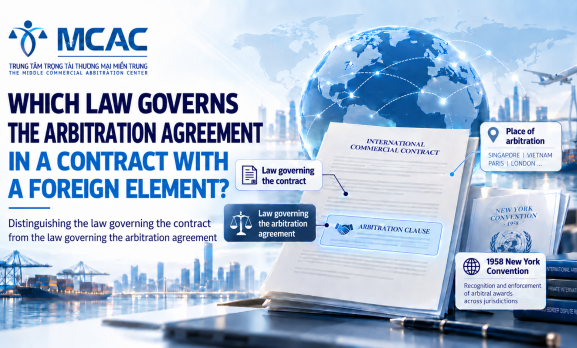
WHICH LAW GOVERNS AN ARBITRATION AGREEMENT IN A CONTRACT WITH FOREIGN ELEMENTS?
In international commercial transactions, parties often agree on the law governing their contract and on arbitration as the method of dispute resolution. However, does the law governing the contract automatically govern the arbitration agreement? If the parties have not agreed on the applicable law, which country's law is used to determine the validity of the arbitration agreement?
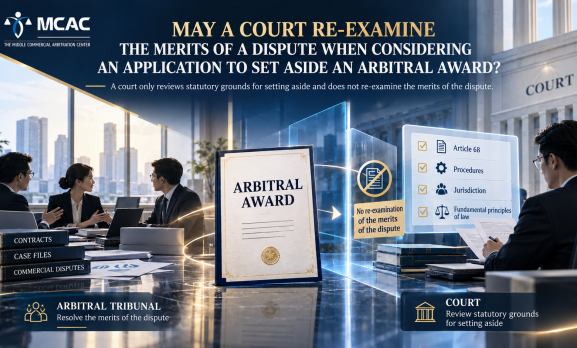
MAY A COURT RE-EXAMINE THE MERITS OF A DISPUTE WHEN CONSIDERING AN APPLICATION TO SET ASIDE AN ARBITRAL AWARD?
When considering an application to set aside an arbitral award, is the Court entitled to reassess evidence, reconsider the parties' rights and obligations, or alter the findings and decisions made by the Arbitral Tribunal?