Working hour: Monday – Friday/8AM – 5PM
|Email: contact@mcac.vn
|Hotline: (+84) 935 925 068 - 0236 3656799
| Language:



Điện thoại: (+84) 935 925 068
Language:

REQUESTS FOR THE REPLACEMENT OF AN ARBITRATOR IN ARBITRAL PROCEEDINGS
27/01/2026


In commercial arbitration proceedings, the principles of independence, impartiality, and objectivity of arbitrators constitute the fundamental basis for ensuring the fairness, transparency, and finality of arbitral awards. Recognising the importance of these principles, the Law on Commercial Arbitration 2010, as well as the arbitration rules of arbitral institutions, including the Middle Commercial Arbitration Center (MCAC), have established legal mechanisms allowing parties to request the replacement of an arbitrator where appropriate grounds exist.
.png)
1. Grounds for Requesting the Replacement of an Arbitrator
Pursuant to Article 42(1) of the Law on Commercial Arbitration 2010, an arbitrator is required to refuse to resolve a dispute, and the parties are entitled to request the replacement of an arbitrator, in the following circumstances:
a) The arbitrator is a relative of, or a representative for, one of the parties;
b) The arbitrator has an interest related to the dispute;
c) There are clear grounds indicating that the arbitrator lacks impartiality or objectivity;
d) The arbitrator has previously acted as a mediator, representative, or lawyer for any of the parties prior to the submission of the dispute to arbitration, unless otherwise agreed by the parties in writing.
In addition to the statutory grounds for requesting the replacement of an arbitrator, where an arbitrator is unable to continue participating in the resolution of the dispute due to force majeure events or objective impediments, or is otherwise replaced, the selection or appointment of a substitute arbitrator shall be carried out in accordance with the procedures prescribed by the Law on Commercial Arbitration. This framework is designed to ensure the continuity of the arbitral proceedings while maintaining the validity and effectiveness of the arbitration agreement concluded by the parties.
Moreover, from the time of their selection or appointment, arbitrators are under an ongoing obligation to proactively disclose in writing any circumstances that may give rise to justifiable doubts as to their impartiality or independence to the arbitral institution, the arbitral tribunal, and the relevant parties.
2. Authority to Decide on the Replacement of an Arbitrator
The authority to decide on the replacement of an arbitrator depends on the form of arbitration and the status of the constitution of the arbitral tribunal. In respect of disputes administered by an arbitral institution, Article 42(3) of the Law on Commercial Arbitration 2010 provides that:
- where the arbitral tribunal has not yet been constituted, the replacement of an arbitrator shall be decided by the President of the arbitral institution;
- where the arbitral tribunal has already been constituted, the replacement shall be decided by the remaining members of the arbitral tribunal; failing such a decision, the President of the arbitral institution shall render the final decision.
Similar provisions are set out in Article 17(2) of the Arbitration Rules of the Middle Commercial Arbitration Center (MCAC) [1]. Accordingly, where the arbitral tribunal has not yet been constituted, the President of the Centre shall decide on the replacement; where the arbitral tribunal has been constituted, the decision shall be made by the remaining arbitrators, and if no decision can be reached, the President of the Centre shall make the determination. In cases where the arbitral tribunal consists of a sole arbitrator, the authority to decide on the replacement rests with the President of the Centre.
Notably, the MCAC Arbitration Rules further provide that a decision on the replacement of an arbitrator may be issued without stating reasons and shall be final, thereby ensuring the efficiency and expeditious conduct of arbitral proceedings.
3. Conclusion
In conclusion, the current Law on Commercial Arbitration, together with the MCAC Arbitration Rules, provides a relatively comprehensive and clear legal framework governing the right of parties to request the replacement of an arbitrator where appropriate grounds exist. This framework clearly defines both the competent authority and the applicable procedures for such requests. The proper application of these provisions serves to ensure the lawful rights and interests of the disputing parties, while at the same time upholding the fundamental principles of arbitral proceedings, including independence, impartiality, and objectivity.
The article above has analyzed in detail the issue of "Request for Replacement of Arbitrators in Commercial Arbitration Proceedings". For more detailed information or legal assistance, please contact the MCAC Secretariat:
- Hotline: 0935 925 068
- Email: contact@mcac.vn
- Read more: How is the statute of limitations determined in commercial arbitration?
Related news
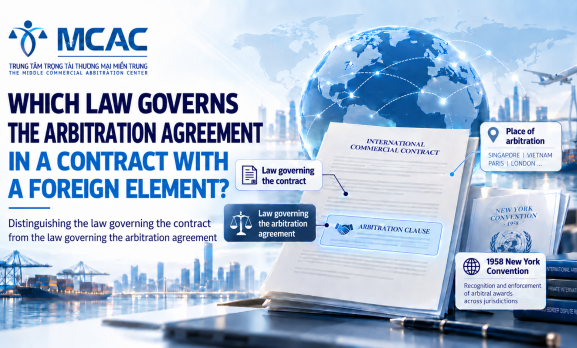
WHICH LAW GOVERNS AN ARBITRATION AGREEMENT IN A CONTRACT WITH FOREIGN ELEMENTS?
In international commercial transactions, parties often agree on the law governing their contract and on arbitration as the method of dispute resolution. However, does the law governing the contract automatically govern the arbitration agreement? If the parties have not agreed on the applicable law, which country's law is used to determine the validity of the arbitration agreement?
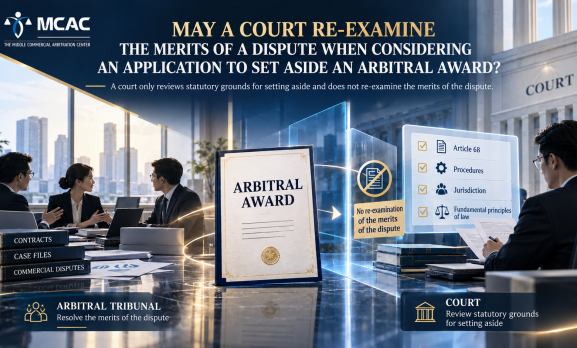
MAY A COURT RE-EXAMINE THE MERITS OF A DISPUTE WHEN CONSIDERING AN APPLICATION TO SET ASIDE AN ARBITRAL AWARD?
When considering an application to set aside an arbitral award, is the Court entitled to reassess evidence, reconsider the parties' rights and obligations, or alter the findings and decisions made by the Arbitral Tribunal?