Working hour: Monday – Friday/8AM – 5PM
|Email: contact@mcac.vn
|Hotline: (+84) 935 925 068 - 0236 3656799
| Language:



Điện thoại: (+84) 935 925 068
Language:

IS THE ARBITRAL TRIBUNAL EMPOWERED TO COLLECT EVIDENCE, OR IS IT LIMITED TO THE EVIDENCE SUBMITTED BY THE PARTIES?
25/02/2026


In commercial arbitration proceedings, evidence constitutes the basis upon which the arbitral tribunal establishes the facts of the dispute and renders its award. A frequently raised question is whether the arbitral tribunal is empowered to collect evidence on its own initiative or whether it is confined to examining only the evidence submitted by the parties.
Under the current Law on Commercial Arbitration and the arbitration rules of arbitral institutions in Vietnam, including the Middle Commercial Arbitration Center (MCAC), relatively comprehensive and specific provisions have been established regarding the authority of the arbitral tribunal to collect evidence in the course of resolving disputes.
1. Principle Governing the Submission of Evidence in Arbitral Proceedings
Commercial arbitration is founded upon the agreement of the parties. Accordingly, the parties bear both the right and the obligation to actively submit evidence in support of their claims or defences. The claimant is required to set out the legal and factual grounds of its claim and to submit supporting evidence (if any) together with the statement of claim. The respondent is likewise required to present the grounds for its defence and to submit supporting evidence (if any) in its statement of defence.

Evidence relied upon in arbitral proceedings must satisfy the requirements of objectivity, relevance, and legality, and shall serve as the basis upon which the arbitral tribunal determines the dispute. However, arbitration law does not confine the role of the arbitral tribunal to the passive receipt of evidence submitted by the parties.
2. Authority of the Arbitral Tribunal to Take Evidence
Pursuant to Article 46 of the Law on Commercial Arbitration 2010 and Article 19 of the Arbitration Rules of the MCAC, the parties have the right and obligation to submit evidence to the arbitral tribunal.
At the same time, at the request of one or more parties, the arbitral tribunal is empowered to request witnesses to provide information and documents relevant to the resolution of the dispute. The arbitral tribunal may also, either on its own initiative or at the request of one or more parties, order expert examination, asset valuation in respect of the disputed property, or consult experts for the purpose of resolving the dispute. The costs arising from such measures shall be advanced by the requesting party or allocated as determined by the arbitral tribunal.
Where the arbitral tribunal or one or more parties have taken all necessary measures to obtain evidence but are unable to do so—meaning that all reasonable means available have been exhausted in requesting individuals, agencies, or organisations in possession or control of such evidence to provide it—an application may be submitted to the competent court requesting an order compelling the production of documents, audio-visual materials, or other tangible evidence relevant to the dispute.
Furthermore, Article 46(2) and Article 47 of the Law on Commercial Arbitration provide that, at the request of one or more parties, the arbitral tribunal may require a witness to provide information and documents and/or to appear at a hearing. If a duly summoned witness fails to attend the hearing without legitimate cause and such absence obstructs the resolution of the dispute, the arbitral tribunal may request the competent court to issue a decision compelling the witness to attend the hearing before the tribunal.
Accordingly, the Law on Commercial Arbitration does not expressly provide a mechanism whereby one party may directly compel the other party to produce information or documents relevant to the dispute, nor does it stipulate that the arbitral tribunal must intervene at the request of one party to order the opposing party to produce such evidence. Nevertheless, the arbitral tribunal is not confined to relying solely on the evidence submitted by the parties; within the limits prescribed by law, it is vested with the authority to take evidence either on its own initiative or at the request of one or more parties for the purpose of resolving the dispute.
3.Conclusion
From the foregoing provisions, it can be seen that in commercial arbitration proceedings, the arbitral tribunal is not confined to considering only the evidence submitted by the parties. Rather, the tribunal is granted statutory authority to take evidence in certain circumstances and may request the assistance of the competent court where all necessary measures to obtain evidence have been undertaken but have proven unsuccessful. However, the primary responsibility for proving the claims and defences remains with the parties to the dispute. Accordingly, the active preparation and timely submission of adequate evidence continue to play a decisive role in the resolution of disputes by arbitration.
The article above has analyzed in detail is the arbitral tribunal empowered to collect evidence, or is it limited to the evidence submitted by the parties?. For more detailed information or legal assistance, please contact the MCAC Secretariat:
- Hotline: 0935 925 068
- Email: contact@mcac.vn
- Read more: How is the statute of limitations determined in commercial arbitration?
Related news
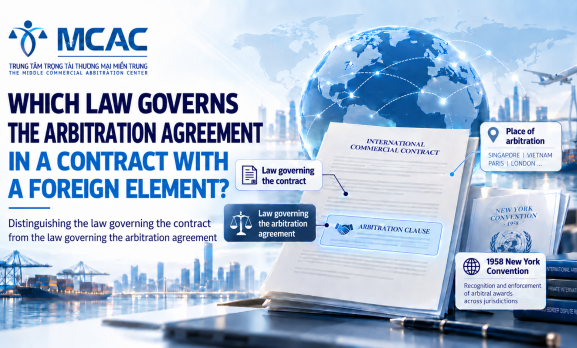
WHICH LAW GOVERNS AN ARBITRATION AGREEMENT IN A CONTRACT WITH FOREIGN ELEMENTS?
In international commercial transactions, parties often agree on the law governing their contract and on arbitration as the method of dispute resolution. However, does the law governing the contract automatically govern the arbitration agreement? If the parties have not agreed on the applicable law, which country's law is used to determine the validity of the arbitration agreement?
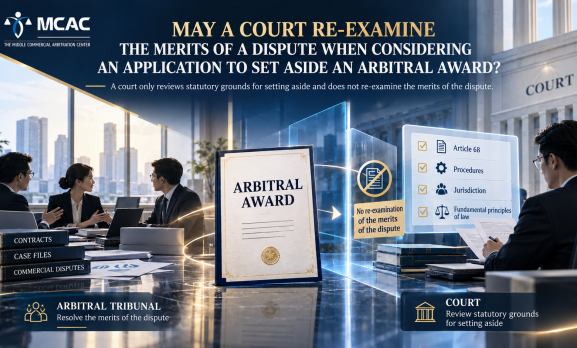
MAY A COURT RE-EXAMINE THE MERITS OF A DISPUTE WHEN CONSIDERING AN APPLICATION TO SET ASIDE AN ARBITRAL AWARD?
When considering an application to set aside an arbitral award, is the Court entitled to reassess evidence, reconsider the parties' rights and obligations, or alter the findings and decisions made by the Arbitral Tribunal?