Working hour: Monday – Friday/8AM – 5PM
|Email: contact@mcac.vn
|Hotline: (+84) 935 925 068 - 0236 3656799
| Language:



Điện thoại: (+84) 935 925 068
Language:

HOW IS THE STATUTE OF LIMITATIONS DETERMINED IN COMMERCIAL ARBITRATION?
20/01/2026


The statute of limitations constitutes a fundamental legal basis for determining the time period within which a party is entitled to request a competent adjudicatory body to protect its lawful rights and interests. In commercial arbitration proceedings, the determination of the applicable statute of limitations directly affects both the effectiveness of the arbitration agreement and the parties’ right to seek dispute resolution through arbitration.

Pursuant to Article 33 of the Law on Commercial Arbitration 2010, the statute of limitations for initiating arbitral proceedings is two (02) years, calculated from the date on which a party’s lawful rights and interests are infringed. This limitation period applies to disputes falling within the jurisdiction of commercial arbitration, unless otherwise provided by specialised legislation. This provision was adopted on the basis of the legislative approach embodied in the Civil Code 2005, thereby ensuring consistency and coherence within the legal system at the time the Law on Commercial Arbitration was enacted.
Meanwhile, the current civil law framework has introduced significant adjustments to the regime governing statutes of limitations. Specifically, Article 429 of the Civil Code 2015 provides that the statute of limitations for initiating court proceedings in respect of contractual disputes is three (03) years, calculated from the date on which the claimant knew or should have known that its lawful rights and interests had been infringed. This approach reflects a shift in legislative policy, moving the focus from the objective occurrence of the infringing act to the subjective awareness of the entitled party, thereby better accommodating the nature and complexity of modern civil and commercial relationships.
In order to ensure compatibility and consistency between arbitration law and civil law, the Draft Law on Commercial Arbitration (as amended), as published by the Ministry of Justice, proposes to extend the statute of limitations applicable to arbitration proceedings from two (02) years to three (03) years. At the same time, the draft seeks to harmonise the determination of the commencement of the limitation period by adopting the approach whereby the statute of limitations is calculated from the date on which the claimant knew or should have known that its lawful rights and interests had been infringed.
Accordingly, under the current Law on Commercial Arbitration 2010, the statute of limitations in arbitral proceedings is determined as two (02) years from the date on which the lawful rights and interests are infringed. However, in line with the proposed legislative amendments, this limitation period is expected to be extended and aligned with the civil law regime. Such alignment would contribute to the further refinement of the legal framework and enhance the effectiveness and practicality of arbitration as a mechanism for dispute resolution.
The article above has analyzed in detail the issue of "Regulations on the statute of limitations in commercial arbitration proceedings and key points to note". For more detailed information or legal assistance, please contact the MCAC Secretariat:
- Hotline: 0935 925 068
- Email: contact@mcac.vn
- Read more: IN WHAT CASES ARE ARBITRATION FEES REFUNDED AND HOW IS THE REFUND HANDLED?
Related news
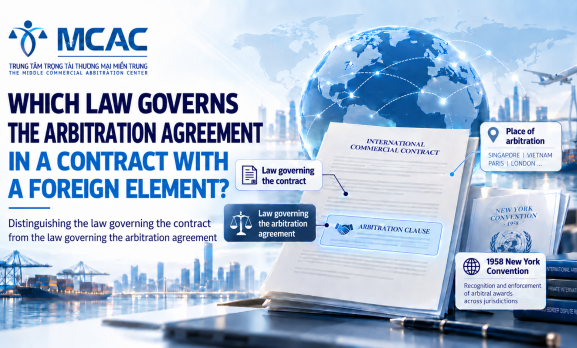
WHICH LAW GOVERNS AN ARBITRATION AGREEMENT IN A CONTRACT WITH FOREIGN ELEMENTS?
In international commercial transactions, parties often agree on the law governing their contract and on arbitration as the method of dispute resolution. However, does the law governing the contract automatically govern the arbitration agreement? If the parties have not agreed on the applicable law, which country's law is used to determine the validity of the arbitration agreement?
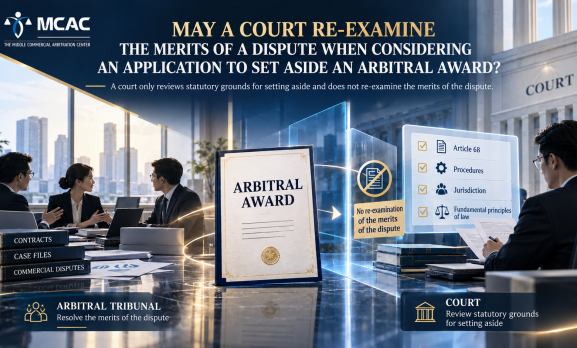
MAY A COURT RE-EXAMINE THE MERITS OF A DISPUTE WHEN CONSIDERING AN APPLICATION TO SET ASIDE AN ARBITRAL AWARD?
When considering an application to set aside an arbitral award, is the Court entitled to reassess evidence, reconsider the parties' rights and obligations, or alter the findings and decisions made by the Arbitral Tribunal?