Working hour: Monday – Friday/8AM – 5PM
|Email: contact@mcac.vn
|Hotline: (+84) 935 925 068 - 0236 3656799
| Language:



Điện thoại: (+84) 935 925 068
Language:

THE RIGHT OF THE PARTIES TO REQUEST AN EXTENSION OF PROCEDURAL TIME LIMITS IN ARBITRAL PROCEEDINGS: IN WHICH CASES MAY THE ARBITRAL TRIBUNAL CONSIDER GRANTING AN EXTENSION?
03/02/2026


In commercial arbitration proceedings, procedural time limits are established to ensure the speed, efficiency, and finality of dispute resolution by arbitration. However, in the course of resolving disputes, due to the complexity of a case or the occurrence of objective circumstances, rigid compliance with procedural deadlines may adversely affect the parties’ right to be heard and their ability to protect their lawful rights and interests.
Arising from this need, the law on commercial arbitration allows the parties to request extensions of procedural time limits in certain circumstances, subject to the consideration and decision of the Arbitral Tribunal.

The legal issue to be addressed is: “In which circumstances do the parties have the right to request an extension of procedural time limits, and on what basis does the Arbitral Tribunal consider and approve such extensions?”
1. Legal basis for procedural time limits and extensions in arbitration
The Law on Commercial Arbitration 2010 of Vietnam (“LCA”) does not contain a separate provision specifically governing the extension of procedural time limits in arbitration. However, a review of the LCA shows that there are several provisions distinguishing between procedural time limits that may be extended and those that may not.
With respect to procedural time limits that may be extended, Clause 2 Article 35 of the LCA provides: “For disputes resolved at an arbitration center, unless otherwise agreed by the parties or otherwise provided in the arbitration rules of the arbitration center, within 30 days from the date of receipt of the statement of claim and accompanying documents, the respondent shall submit its statement of defense to the arbitration center. At the request of one or both parties, this time limit may be extended by the arbitration center based on the specific circumstances of the case.”
Similarly, Clause 2 Article 9 of the MCAC Arbitration Rules provides: “The Center may extend the time limit for submission of the Statement of Defense upon the respondent’s request. The request for extension must be made in writing and must be received by the Center before the expiry of the time limit for submission of the Statement of Defense or before the expiry of the extended time limit”
Accordingly, where the respondent submits a request for extension based on legitimate grounds, the Arbitral Tribunal has the authority to consider and decide on extending the time limit for submission of the Statement of Defense, based on an assessment of necessity and the impact on the progress of the dispute resolution.
With respect to procedural time limits that may not be extended, the time limit for appointing an arbitrator is a mandatory time limit prescribed by law, closely associated with the procedure for constituting the Arbitral Tribunal, and therefore falls outside the scope of extendable time limits. Clause 2 Article 35 of the LCA provides:
“For disputes resolved by ad hoc arbitration, unless otherwise agreed by the parties, within 30 days from the date of receipt of the statement of claim and accompanying documents, the respondent shall send to the claimant and the arbitrator its statement of defense, together with the name and address of the arbitrator selected by it.”
Clause 2 Article 9 of the MCAC Arbitration Rules also stipulates:
“In case a request for extension of the time limit for submission of the Statement of Defense is made, the respondent must still appoint an arbitrator or request the Center to appoint an arbitrator within the 30-day time limit as provided in Clause 1 of this Article”.
The law does not provide a mechanism for extending the time limit for appointing an arbitrator, but instead establishes alternative legal consequences to ensure that the constitution of the Arbitral Tribunal is not delayed or stalled. The prohibition of extension for this time limit is necessary to ensure procedural efficiency and the effectiveness of arbitration.
At the same time, through provisions on procedural principles and the Tribunal’s authority to manage the proceedings, the law establishes a legal basis for considering extensions where necessary. Accordingly, during the arbitral proceedings, each party has the right to request the Arbitral Tribunal to extend procedural time limits (such as deadlines for submission of written submissions or evidence, the scheduling of hearings, or the performance of other procedural acts), provided that the party:
- Submits the request in writing;
- Clearly specifies the requested extended time limit; and
- Sets out legitimate reasons for the extension.
A request for extension is not automatically granted, but is subject to the consideration and decision of the Arbitral Tribunal.
2. Common circumstances in which the Arbitral Tribunal may consider extending procedural time limits
In practice, the Arbitral Tribunal may consider granting an extension of procedural time limits at the request of one or more parties in the following circumstances:
First, where the dispute is complex in nature, involves multiple transactions, multiple parties, or a large volume of evidence, requiring the parties additional reasonable time to collect, review, and submit documents and evidence to the Arbitral Tribunal.
Second, where force majeure events or objective obstacles arise, making it impossible or impracticable to comply with the prescribed procedural time limits. Force majeure events are understood as objective events that are unforeseeable and unavoidable despite the application of all necessary and permissible measures, such as natural disasters, epidemics, or serious and irreparable technical incidents. Objective obstacles refer to circumstances arising from objective conditions that prevent a person with civil rights and obligations from becoming aware that their lawful rights and interests have been infringed or from exercising their civil rights and obligations.
Third, where the parties to the dispute reach a mutual agreement on extending procedural time limits, provided that such agreement does not contravene mandatory provisions of the LCA and does not adversely affect the procedural order of the arbitral proceedings.
In the above cases, the request for extension must be made in writing, clearly stating legitimate reasons and specifying the requested extended time period, as the basis for the Arbitral Tribunal’s consideration and decision.
3. Conclusion
The right of the parties to request an extension of procedural time limits in arbitral proceedings is not an automatic right, but a conditional one, exercised within the framework of the principles and provisions of the Law on Commercial Arbitration. An extension will only be granted where there are legitimate reasons, consistent with the nature of the dispute, and where it does not undermine the speed and efficiency of arbitral proceedings.
When considering a request for extension, the Arbitral Tribunal will conduct a comprehensive assessment of both legal and practical factors of the case, particularly the nature of the time limit for which an extension is sought, in order to clearly distinguish between extendable procedural time limits and mandatory statutory time limits. Proper application of the extension mechanism contributes to safeguarding the parties’ right to be heard while maintaining the efficiency and credibility of commercial arbitration as a dispute resolution mechanism.
The article above has analyzed in detail the issue of the right of the parties to request an extension of procedural time limits in arbitral proceedings. For more detailed information or legal assistance, please contact the MCAC Secretariat:
- Hotline: 0935 925 068
- Email: contact@mcac.vn
- Read more: How is the statute of limitations determined in commercial arbitration?
Related news
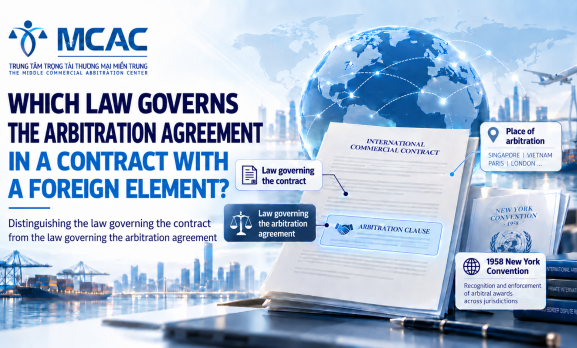
WHICH LAW GOVERNS AN ARBITRATION AGREEMENT IN A CONTRACT WITH FOREIGN ELEMENTS?
In international commercial transactions, parties often agree on the law governing their contract and on arbitration as the method of dispute resolution. However, does the law governing the contract automatically govern the arbitration agreement? If the parties have not agreed on the applicable law, which country's law is used to determine the validity of the arbitration agreement?
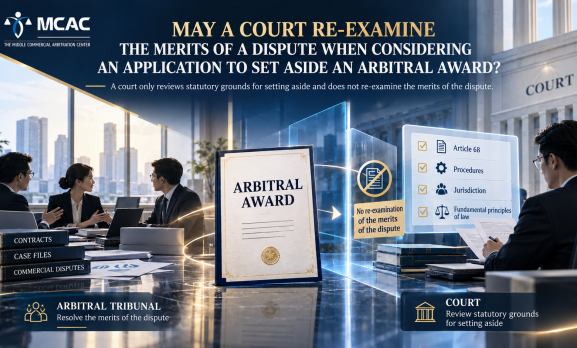
MAY A COURT RE-EXAMINE THE MERITS OF A DISPUTE WHEN CONSIDERING AN APPLICATION TO SET ASIDE AN ARBITRAL AWARD?
When considering an application to set aside an arbitral award, is the Court entitled to reassess evidence, reconsider the parties' rights and obligations, or alter the findings and decisions made by the Arbitral Tribunal?