Working hour: Monday – Friday/8AM – 5PM
|Email: contact@mcac.vn
|Hotline: (+84) 935 925 068 - 0236 3656799
| Language:


Điện thoại: (+84) 935 925 068
Language:

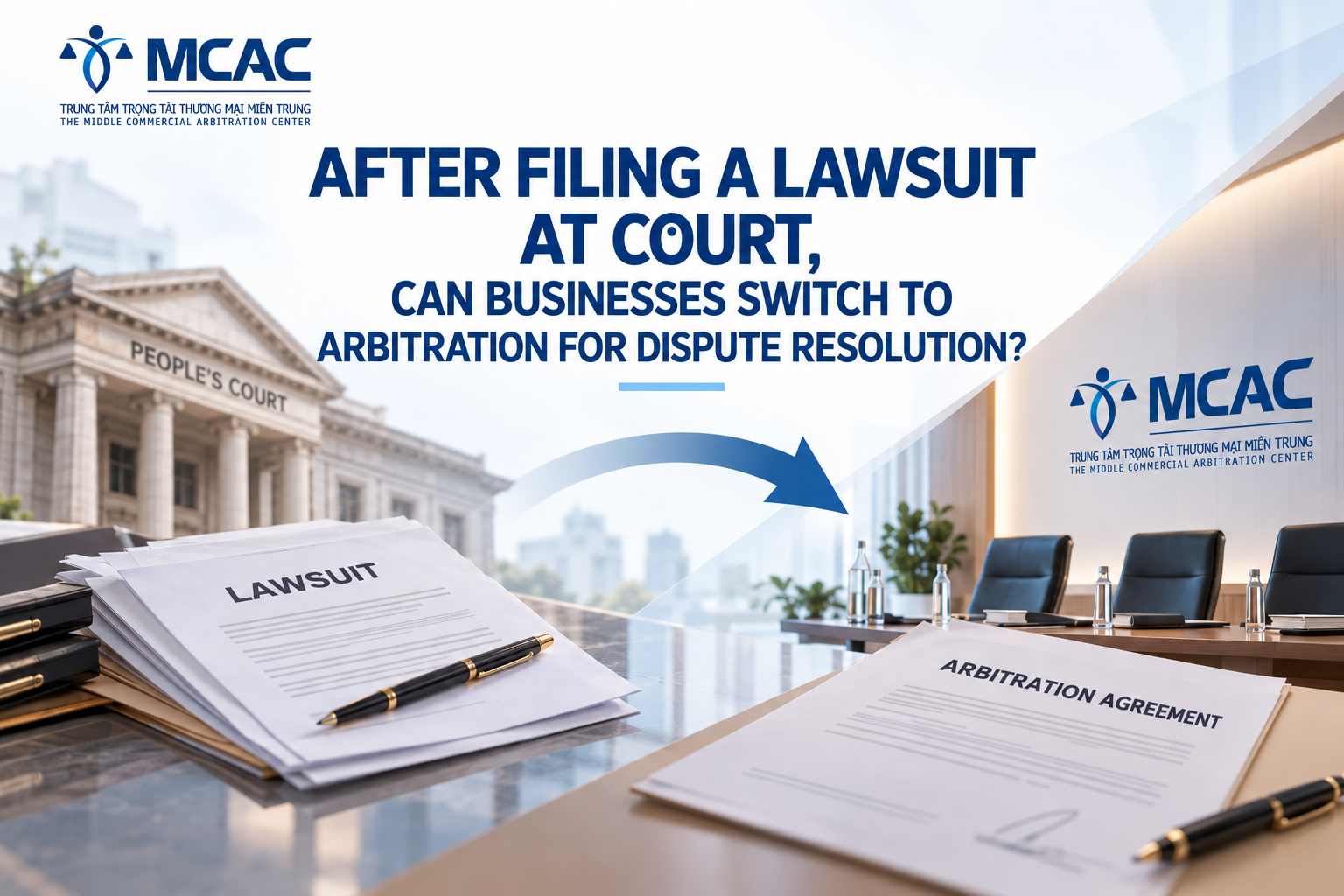
AFTER FILING A LAWSUIT IN COURT, CAN A BUSINESS STILL REFER THE DISPUTE TO ARBITRATION?
19/10/2026


In practice, a business may file a lawsuit in court only to discover subsequently that the contract between the parties contains an arbitration agreement. In other cases, the original contract contains no arbitration clause, but after a dispute arises, the parties agree to resolve it through arbitration.
Does filing a lawsuit in court preclude the possibility of resolving the dispute through arbitration? The answer requires consideration of when the arbitration agreement was concluded, its validity and scope, and whether the court has formally accepted the case or is still at the stage of receiving and reviewing the statement of claim.
1. Where an arbitration agreement existed before the court proceedings were initiated
Clause 1, Article 5 of the 2010 Law on Commercial Arbitration (LCA) establishes an arbitration agreement as a prerequisite for resolving a dispute through arbitration. Under Article 6 of the LCA, where a dispute is subject to an arbitration agreement, the court must decline to accept the case, unless the arbitration agreement is invalid or incapable of being performed.
Point (b), Clause 2, Article 2 of Resolution No. 01/2014/NQ-HĐTP of the Council of Judges of the Supreme People’s Court provides specific guidance on the handling of disputes subject to an arbitration agreement that do not fall within the circumstances prescribed in Clause 3 of that Article:
• If the court has not yet accepted the case: The court shall return the statement of claim and its accompanying documents and evidence to the claimant.
• If the court has already accepted the case and subsequently discovers the arbitration agreement: The court shall issue a decision to discontinue the proceedings and return the statement of claim and accompanying documents, pursuant to Point (g), Clause 1, Article 217, read in conjunction with Point (đ), Clause 1, Article 192 of the 2015 Civil Procedure Code.
Accordingly, a party’s filing of a lawsuit in court does not, in itself, render an existing arbitration agreement ineffective. Businesses should provide the arbitration agreement and relevant documents so that the court can consider and determine jurisdiction in accordance with the law.
2. Where an arbitration agreement is concluded after court proceedings have been initiated
Clause 1, Article 5 of the LCA allows the parties to conclude an arbitration agreement either before or after a dispute arises. Accordingly, the absence of an arbitration clause in the original contract does not prevent the parties from subsequently agreeing to resolve the dispute through arbitration.
Such an agreement must satisfy the requirements of the LCA, including: the dispute must be arbitrable under Article 2; the form of the agreement must comply with Article 16; the signatory must have the requisite authority; and the agreement must not fall within any ground of invalidity under Article 18. Pursuant to Article 16 of the LCA, the parties may enter into a separate arbitration agreement without necessarily amending the original contract.
If the court has not yet accepted the case, the claimant may withdraw the statement of claim so that it is returned under Point (g), Clause 1, Article 192 of the Civil Procedure Code, and then commence arbitration proceedings on the basis of a valid arbitration agreement.
If the court properly accepted the case when no arbitration agreement existed, the parties’ subsequent conclusion of an arbitration agreement does not automatically terminate the court proceedings. The parties must also address the claims pending before the court through the appropriate procedural mechanisms.
To minimize disputes over jurisdiction, the parties should clearly specify in their arbitration agreement the dispute to be referred to arbitration, the scope of the claims, the form of arbitration, and the chosen arbitral institution where institutional arbitration is selected. They should also agree on how to handle claims pending before the court and verify the legal effect of any relevant decision discontinuing the proceedings.
Referring a dispute to arbitration does not mean that the court will automatically transfer the case file to an arbitral institution. Where institutional arbitration is chosen, the claimant must submit a statement of claim and supporting documents to the arbitral institution in accordance with Article 30 of the LCA and the applicable arbitration rules.
3. Determination of the Arbitral Tribunal’s jurisdiction
Under Clause 1, Article 43 of the LCA, before addressing the merits of a dispute, the Arbitral Tribunal must examine the validity and enforceability of the arbitration agreement and determine its own jurisdiction.
Where a dispute has previously been brought before a court, jurisdiction must be assessed in light of the scope of the arbitration agreement, the claims submitted for resolution, and the status of the court proceedings. The parties’ agreement to arbitrate, or the court’s decision to discontinue the case, does not replace the Arbitral Tribunal’s determination of jurisdiction under Article 43 of the LCA.
If a party disagrees with a decision of the Arbitral Tribunal falling within the circumstances specified in Article 43 of the LCA, that party may request a competent court to review the decision under Article 44 of the LCA. Such a request must be made within five working days from receipt of the decision; the requesting party must simultaneously notify the Arbitral Tribunal.
4. Key considerations when referring a dispute to arbitration
Before proceeding, businesses should consider the following:
• Review the arbitration agreement: Verify its validity, enforceability, scope and the authority of the signatory; accurately identify the arbitral institution if institutional arbitration is chosen.
• Check the status of the court proceedings: Determine when the court accepted the case, the current stage of the proceedings, any outstanding claims and the legal effect of any decision discontinuing the proceedings.
• Check the limitation period for commencing arbitration: Article 33 of the LCA generally prescribes a two-year limitation period from the date on which lawful rights and interests are infringed, unless otherwise provided by specialized legislation. The period during which a case is handled by the court should not automatically be treated as excluded when calculating the limitation period for arbitration.
• Maintain a complete case file: Prepare the arbitration agreement, evidence supporting the claims, the court’s notice of acceptance, any decision discontinuing proceedings, and other relevant procedural documents for submission when required.
• Consider cases where the parties have agreed to both court litigation and arbitration: If the parties have not reached a subsequent agreement or concluded a new agreement identifying the dispute resolution forum, jurisdiction must be assessed with reference to Clause 4, Article 2 of Resolution No. 01/2014/NQ-HĐTP. In such cases, the date on which arbitration was requested and the date on which the court accepted the case are relevant to determining jurisdiction.
A distinction must be made between a case still pending before a court and matters already determined by a legally effective court judgment or decision. Under the principle set out in Article 19 of the Civil Procedure Code, the parties must respect and comply with legally effective judgments and decisions; an arbitration agreement concluded subsequently cannot serve as a basis for re-adjudicating matters already decided.
Where the parties choose the The Middle Commercial Arbitration Center (MCAC), they may refer to MCAC’s model arbitration clause and adapt it to the specific dispute, while also clarifying how any pending court proceedings will be handled.
Conclusion
The fact that a lawsuit has already been filed in court does not automatically preclude the resolution of the dispute through arbitration. If a valid and enforceable arbitration agreement already exists, jurisdiction shall be determined under Article 6 of the LCA and the relevant guidance. If the arbitration agreement is concluded only after the court has properly accepted the case, the parties must address the claims pending before the court, check the applicable limitation period, and commence arbitration through the appropriate procedures.
Related news
WHICH LAW GOVERNS AN ARBITRATION AGREEMENT IN A CONTRACT WITH FOREIGN ELEMENTS?
In international commercial transactions, parties often agree on the law governing their contract and on arbitration as the method of dispute resolution. However, does the law governing the contract automatically govern the arbitration agreement? If the parties have not agreed on the applicable law, which country's law is used to determine the validity of the arbitration agreement?
MAY A COURT RE-EXAMINE THE MERITS OF A DISPUTE WHEN CONSIDERING AN APPLICATION TO SET ASIDE AN ARBITRAL AWARD?
When considering an application to set aside an arbitral award, is the Court entitled to reassess evidence, reconsider the parties' rights and obligations, or alter the findings and decisions made by the Arbitral Tribunal?