Working hour: Monday – Friday/8AM – 5PM
|Email: contact@mcac.vn
|Hotline: (+84) 935 925 068 - 0236 3656799
| Language:



Điện thoại: (+84) 935 925 068
Language:

ARBITRATION AGREEMENT ARISING DURING THE DISPUTE RESOLUTION PROCESS: COMMENTARY ON DECISION NO. 1185/2022/QĐ-PQTT OF THE PEOPLE'S COURT OF HO CHI MINH CITY
11/09/2026


An arbitration agreement serves as the basis for determining the jurisdiction of arbitration to resolve disputes. Under the Law on Commercial Arbitration, an arbitration agreement may be entered into either before or after a dispute arises and must be made in a form compliant with applicable law.
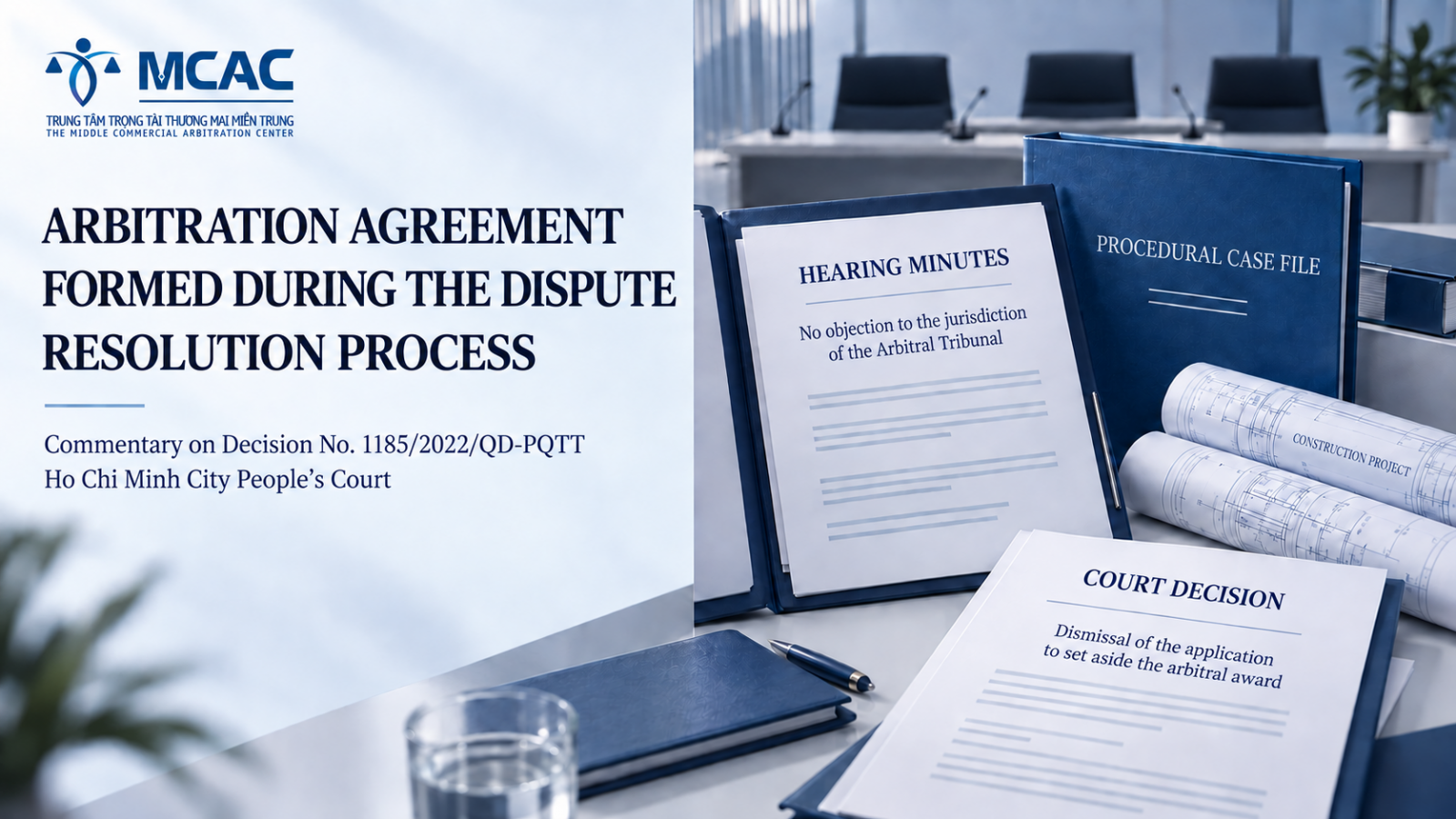
Decision No. 1185/2022/QĐ-PQTT dated 29 July 2022 of the People’s Court of Ho Chi Minh City concerns the determination of an arbitration agreement during the dispute resolution process and the parties’ right to object to the jurisdiction of the Arbitral Tribunal.
1. Facts of the case
Company T (Project Owner) and H Construction Group Joint Stock Company (Contractor) entered into four construction contracts. In two of the contracts, the parties agreed that disputes would be resolved by the "Ho Chi Minh City Economic Arbitration Board" - an arbitration agreement that, at the time the dispute arose, was incapable of being performed because a specific arbitral institution could not be identified.
On 26/10/2021, Company H sent a written request proposing that Company T agree on the selection of another arbitration center and set a 07-day period for response. Company T did not respond.
On 10/11/2021, Company H commenced arbitration against Company T at the arbitration center of its choice, seeking payment of principal and late-payment interest arising from the four construction contracts. Throughout the arbitral proceedings, Company T participated in the resolution of the dispute and did not object to the jurisdiction of the Arbitral Tribunal; at the hearing, Company T's representative also confirmed that it had no objection to the validity of the arbitration agreement, the composition of the Arbitral Tribunal, or the procedural steps already taken.
On 18/3/2022, the Arbitral Tribunal issued an award accepting part of Company H's claims.
2. Application to set aside the arbitral award
After the arbitral award was issued, Company T filed an application with the People's Court of Ho Chi Minh City requesting that the entire arbitral award be set aside.
Company T argued that the arbitration agreement between the parties was incapable of being performed because the arbitral institution designated in the contracts had ceased operations without any successor institution. According to Company T, where the parties could not agree on another arbitral institution, jurisdiction over the dispute should belong to the Court; therefore, the Arbitral Tribunal's acceptance and resolution of the case based on Company H's (the claimant's) request to select the arbitral institution was outside its jurisdiction.
On that basis, Company T requested the Court to set aside the arbitral award pursuant to Point c, Clause 2, Article 68 of the Law on Commercial Arbitration, which applies where the arbitration agreement is invalid or incapable of being performed.
3. Commentary
The Court's reasoning in Decision No. 1185/2022/QĐ-PQTT centered on three legal grounds.
First, Clause 5, Article 43 of the Law on Commercial Arbitration provides that where the parties have an arbitration agreement but a specific arbitral institution cannot be identified, the parties must reach a new agreement; if they fail to do so, the arbitral institution shall be selected at the claimant's request. The Court viewed Company T's failure to respond to Company H's proposal within the prescribed period as an indication that the parties had "failed to reach an agreement", thereby giving Company H, as the claimant, the right to select the arbitral institution.
Second, Point dd, Clause 2, Article 16 of the Law on Commercial Arbitration recognizes as a written arbitration agreement an exchange in which one party asserts the existence of an arbitration agreement and the other party does not deny it. On this basis, the Court considered Company T's failure to object to the arbitral institution selected by Company H, together with its continued participation in the proceedings, as grounds for establishing an arbitration agreement between the two parties.
Third, Article 13 of the Law on Commercial Arbitration provides for loss of the right to object: where a party is aware of a violation but continues to participate in the arbitral proceedings without raising an objection within the statutory time limit, it loses the right to object before the arbitration or the Court. Company T's representative confirmed at the hearing that there was no objection to the validity of the arbitration agreement, the jurisdiction of the Arbitral Tribunal, or the procedure followed. This provided the basis for the Court to find that Company T had lost the right to raise those issues again in its application to set aside the award.
From these three grounds, the approach of the People's Court of Ho Chi Minh City was closely linked to the actual course of the proceedings: a party's silence in response to a proposal to select an arbitral institution, followed by continued participation in the proceedings without reserving any objection, was viewed by the Court as a sequence of conduct demonstrating acceptance of the Arbitral Tribunal's jurisdiction, consistent with the provisions of the Law on Commercial Arbitration concerning the form of arbitration agreements and the consequences of losing the right to object.
4. Court's findings
The Court determined that the arbitration agreement referring disputes to the "Ho Chi Minh City Economic Arbitration Board" in the relevant contracts was incapable of being performed. After Company H proposed the selection of another arbitral institution and set a 07-day response period, Company T did not respond within that period. The Court held that this showed the parties had failed to agree on the selection of an arbitral institution and therefore applied Clause 5, Article 43 of the Law on Commercial Arbitration, under which the arbitral institution is selected at the claimant's request.
The Court also noted that when Company H notified Company T of the commencement of arbitration and the selected arbitral institution, Company T neither objected nor proposed another arbitral institution; throughout the proceedings, Company T did not object to the jurisdiction of the Arbitral Tribunal. Pursuant to Point dd, Clause 2, Article 16 of the Law on Commercial Arbitration, the Court determined that Company T's failure to object was deemed to constitute its agreement to establish an arbitration agreement with Company H.
At the same time, the minutes of the hearing recorded that Company T's representative confirmed that there was no objection to the validity of the arbitration agreement, the composition and jurisdiction of the Arbitral Tribunal, or the procedure already followed. The Court therefore found that Company T had lost its right to object under Article 13 of the Law on Commercial Arbitration and that there was no basis to accept the application to set aside the arbitral award.
Accordingly, the Court decided not to accept Company T's application to set aside the arbitral award; Company T was not required to pay the fee. The Decision took effect from the date of signing and was final.
[1] Law on Commercial Arbitration No. 54/2010/QH12 dated 17/6/2010, Article 13, Article 16, Clause 5 Article 43, and Point c Clause 2 Article 68.
[2] Decision No. 1185/2022/QĐ-PQTT dated 29/7/2022 of the People's Court of Ho Chi Minh City.
Related news
INSTITUTIONAL OR AD HOC ARBITRATION: WHAT SHOULD BUSINESSES CONSIDER WHEN CHOOSING?
How does the law define institutional and ad hoc arbitration? Under Clause 6, Article 3 of the LCA, institutional arbitration is a form of dispute resolution conducted at an arbitration center in accordance with the LCA and the arbitration rules of that center.
CAN A CLAIMANT AMEND OR SUPPLEMENT ITS CLAIMS DURING ARBITRATION PROCEEDINGS?
Accordingly, after filing the Statement of Claim with an arbitration center, may the Claimant amend or supplement its claims? Until what stage may such amendments or additions be made, and in what circumstances may the Arbitral Tribunal (Tribunal) decline to accept them?