Working hour: Monday – Friday/8AM – 5PM
|Email: contact@mcac.vn
|Hotline: (+84) 935 925 068 - 0236 3656799
| Language:


Điện thoại: (+84) 935 925 068
Language:

INSTITUTIONAL OR AD HOC ARBITRATION: WHAT SHOULD BUSINESSES CONSIDER WHEN CHOOSING?
08/10/2026


When entering into commercial contracts, parties may agree to resolve disputes through arbitration. However, choosing arbitration also entails selecting an appropriate form of arbitration, as this directly affects how the proceedings are administered and conducted.
Under the 2010 Law on Commercial Arbitration (LCA), disputes may be resolved through institutional arbitration or ad hoc arbitration. How do these two forms differ, and what should businesses consider when making their choice?
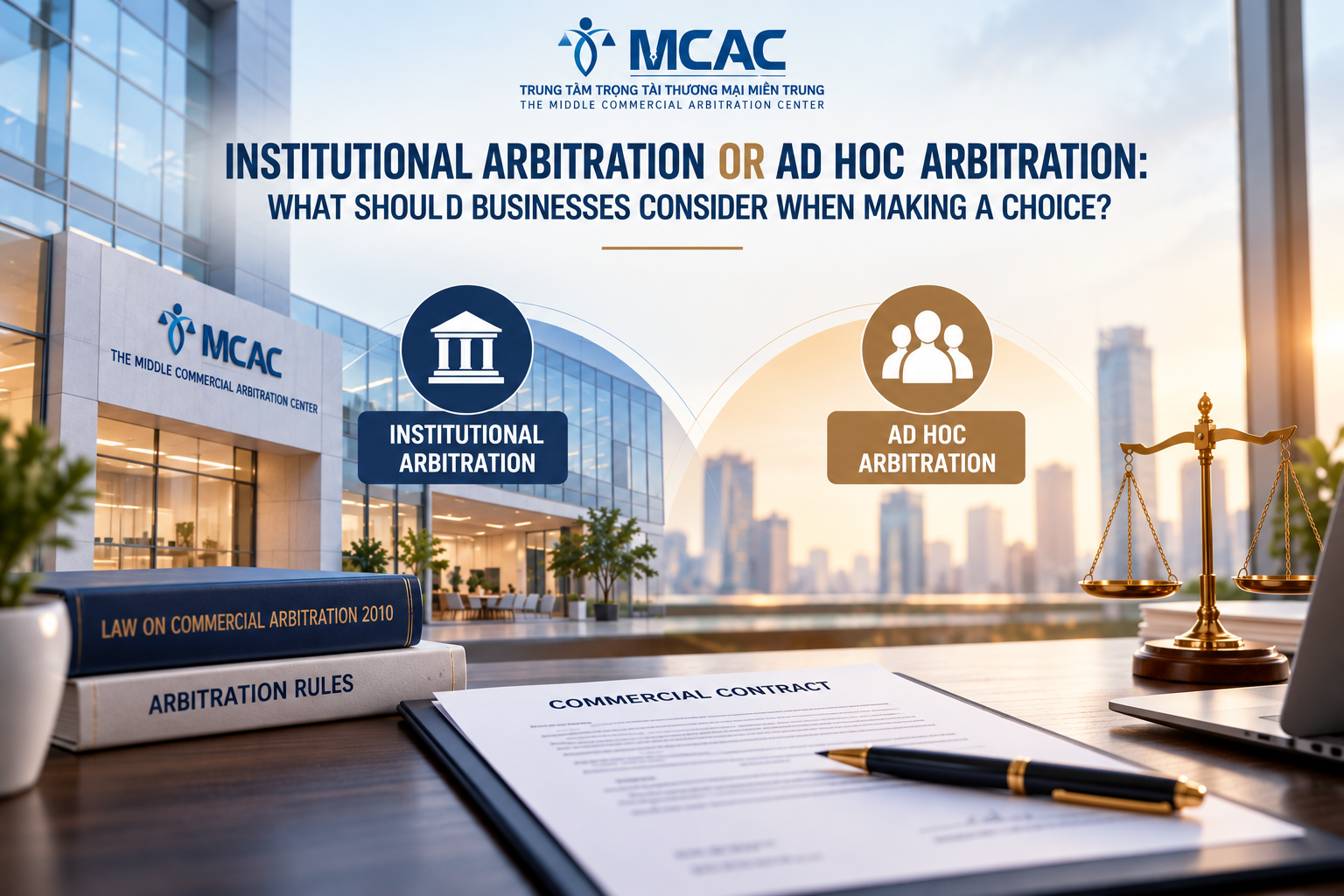
1. How does the law define institutional and ad hoc arbitration?
Under Clause 6, Article 3 of the LCA, institutional arbitration is a form of dispute resolution conducted at an arbitration center in accordance with the LCA and the arbitration rules of that center.
Clause 7, Article 3 of the LCA defines ad hoc arbitration as a form of dispute resolution conducted in accordance with the LCA and the procedures agreed upon by the parties.
The fundamental distinction therefore lies in the organization and conduct of the proceedings. Institutional arbitration is administered by an arbitration center under its arbitration rules. By contrast, ad hoc arbitration has no permanent administering institution; an arbitral tribunal is constituted to resolve a particular dispute.
2. Differences in the dispute resolution process
First, administration and management of proceedings.
In institutional arbitration, the arbitration center organizes and coordinates the proceedings and provides administrative support. Tasks such as receiving the Statement of Claim, issuing notices, assisting with the constitution of the arbitral tribunal, and managing case files are carried out under the center’s arbitration rules.
In ad hoc arbitration, since there is no permanent administrative body, the parties and the arbitral tribunal arrange procedural matters themselves in accordance with their agreement and applicable law.
Second, procedural rules.
Institutional arbitration follows the rules of the selected arbitration center. These rules set out the dispute resolution process, time limits, and procedural steps, providing the parties with a framework for participating in the proceedings.
In contrast, ad hoc arbitration allows the parties to agree on the procedure for resolving their dispute, subject to mandatory legal provisions. They may also agree to adopt an existing set of procedural rules rather than drafting the entire procedure themselves.
Third, constitution of the arbitral tribunal.
Articles 40 and 41 of the LCA prescribe different mechanisms for constituting an arbitral tribunal in institutional and ad hoc arbitration.
In institutional arbitration, where the parties fail to appoint an arbitrator or cannot agree on the constitution of the tribunal, the President of the arbitration center may appoint an arbitrator in accordance with applicable law and the relevant arbitration rules.
In ad hoc arbitration, where the parties fail to appoint an arbitrator and have no alternative agreement on the appointment mechanism, one or more parties may request the competent Court to appoint an arbitrator under Article 41 of the LCA.
Institutional arbitration may therefore facilitate procedural administration through the support provided by the arbitration center. Ad hoc arbitration, meanwhile, emphasizes party autonomy but also requires cooperation in organizing the proceedings.
3. What factors should businesses consider when choosing?
The choice of arbitration form should take into account the nature of the dispute, the parties’ ability to cooperate, and the need for procedural administration.
For disputes involving multiple parties, extensive documents and evidence, or complex procedural issues, institutional arbitration may be advantageous because of the center’s established procedural rules and administrative support.
Ad hoc arbitration may be appropriate where the parties can cooperate and wish to determine for themselves how the dispute resolution process will be conducted.
As regards cost and duration, neither form can automatically be regarded as less expensive or faster. These factors depend on the amount in dispute, the number of arbitrators, the complexity of the case, and expenses incurred during the proceedings.
In particular, businesses should pay attention to the legal effect and enforcement of arbitral awards.
Under Clause 5, Article 61 of the LCA, an arbitral award is final and takes effect on the date it is issued. This principle applies to both institutional and ad hoc arbitration.
However, finality does not preclude an application to the Court to set aside an arbitral award on the grounds stipulated in Articles 68 and 69 of the LCA. When considering such an application, the Court does not rehear the merits of the dispute decided by the arbitral tribunal.
For ad hoc arbitration, Article 62 of the LCA also provides for registration of the arbitral award with a Court before requesting the competent civil judgment enforcement agency to enforce it.
Accordingly, a party seeking to register an ad hoc arbitral award must submit its application to the competent Court within one year from the date the award is issued. Registration or non-registration does not alter the content or legal validity of the award. Nevertheless, under Clause 2, Article 66 of the LCA, registration is a prerequisite for the award creditor to request enforcement of an ad hoc arbitral award by the civil judgment enforcement agency.
Businesses selecting ad hoc arbitration should therefore pay attention to the registration procedure and deadline to preserve their ability to request enforcement as provided by law.
4. Considerations when drafting an arbitration agreement
Under Clause 1, Article 5 of the LCA, a dispute may be resolved by arbitration if the parties have an arbitration agreement. Such an agreement may be made before or after a dispute arises and must comply with the form requirements under Article 16 of the LCA.
Where institutional arbitration is selected, the parties should clearly identify the arbitration center and may also agree on the number of arbitrators, the place of arbitration, and other matters consistent with applicable law.
Where ad hoc arbitration is selected, the parties should consider the applicable procedure, how the tribunal will be constituted, and the appointment mechanism if they cannot reach agreement.
Notably, Clause 5, Article 43 of the LCA provides that where an arbitration agreement does not specify the form of arbitration or an identifiable arbitration institution, the parties must agree again on the form or institution after a dispute arises. If they fail to agree, the choice will be made at the claimant’s request.
For example, the clause “All disputes arising from this contract shall be resolved by commercial arbitration” does not specify the form of arbitration or a particular arbitration institution. The parties may therefore need to agree on these matters after a dispute arises.
To reduce difficulties in identifying the dispute resolution institution, parties may refer to the model arbitration clause of the Mien Trung Commercial Arbitration Center (MCAC):
“All disputes arising from or in connection with this Contract shall be resolved by arbitration at the Mien Trung Commercial Arbitration Center (MCAC) in accordance with its Arbitration Rules.”
In addition to the foregoing, the parties may agree on other matters appropriate to the nature of the contract and applicable law.
Conclusion
Institutional and ad hoc arbitration are both forms of dispute resolution recognized under Vietnamese law. They differ principally in the organization, administration, and conduct of proceedings, as well as certain procedures relating to enforcement of arbitral awards.
When selecting a form of arbitration, businesses should consider the nature of their contractual relationship, the potential complexity of disputes, and the need for procedural support. A clearly drafted arbitration agreement at the contract formation stage also helps minimize procedural difficulties if a dispute arises.
The article above has analyzed in detail is "INSTITUTIONAL OR AD HOC ARBITRATION: WHAT SHOULD BUSINESSES CONSIDER WHEN CHOOSING?". For more detailed information or legal assistance, please contact the MCAC Secretariat:
- Hotline: 0935 925 068 - 0236 3656799
- Email: contact@mcac.vn
- Read more:CAN A CLAIMANT AMEND OR SUPPLEMENT ITS CLAIMS DURING ARBITRATION PROCEEDINGS?
Related news
CAN A CLAIMANT AMEND OR SUPPLEMENT ITS CLAIMS DURING ARBITRATION PROCEEDINGS?
Accordingly, after filing the Statement of Claim with an arbitration center, may the Claimant amend or supplement its claims? Until what stage may such amendments or additions be made, and in what circumstances may the Arbitral Tribunal (Tribunal) decline to accept them?
BUSINESS PERSPECTIVE: CHECKLIST OF 07 ITEMS TO PREPARE BEFORE THE FIRST ARBITRATION HEARING
For businesses participating in arbitral proceedings for the first time, preparation for the hearing should be systematic and should go beyond merely compiling documents. Below are 07 matters businesses should note before attending their first arbitration hearing at MCAC.