Working hour: Monday – Friday/8AM – 5PM
|Email: contact@mcac.vn
|Hotline: (+84) 935 925 068 - 0236 3656799
| Language:



Điện thoại: (+84) 935 925 068
Language:

BUSINESS PERSPECTIVE: CHECKLIST OF 07 ITEMS TO PREPARE BEFORE THE FIRST ARBITRATION HEARING
25/09/2026


A dispute resolution hearing is a stage of arbitral proceedings at which the parties directly present their claims and defenses, provide and explain documents and evidence, and answer issues raised by the Arbitral Tribunal (Tribunal).
For businesses participating in arbitral proceedings for the first time, preparation for the hearing should be systematic and should go beyond merely compiling documents. Below are 07 matters businesses should note before attending their first arbitration hearing at MCAC.
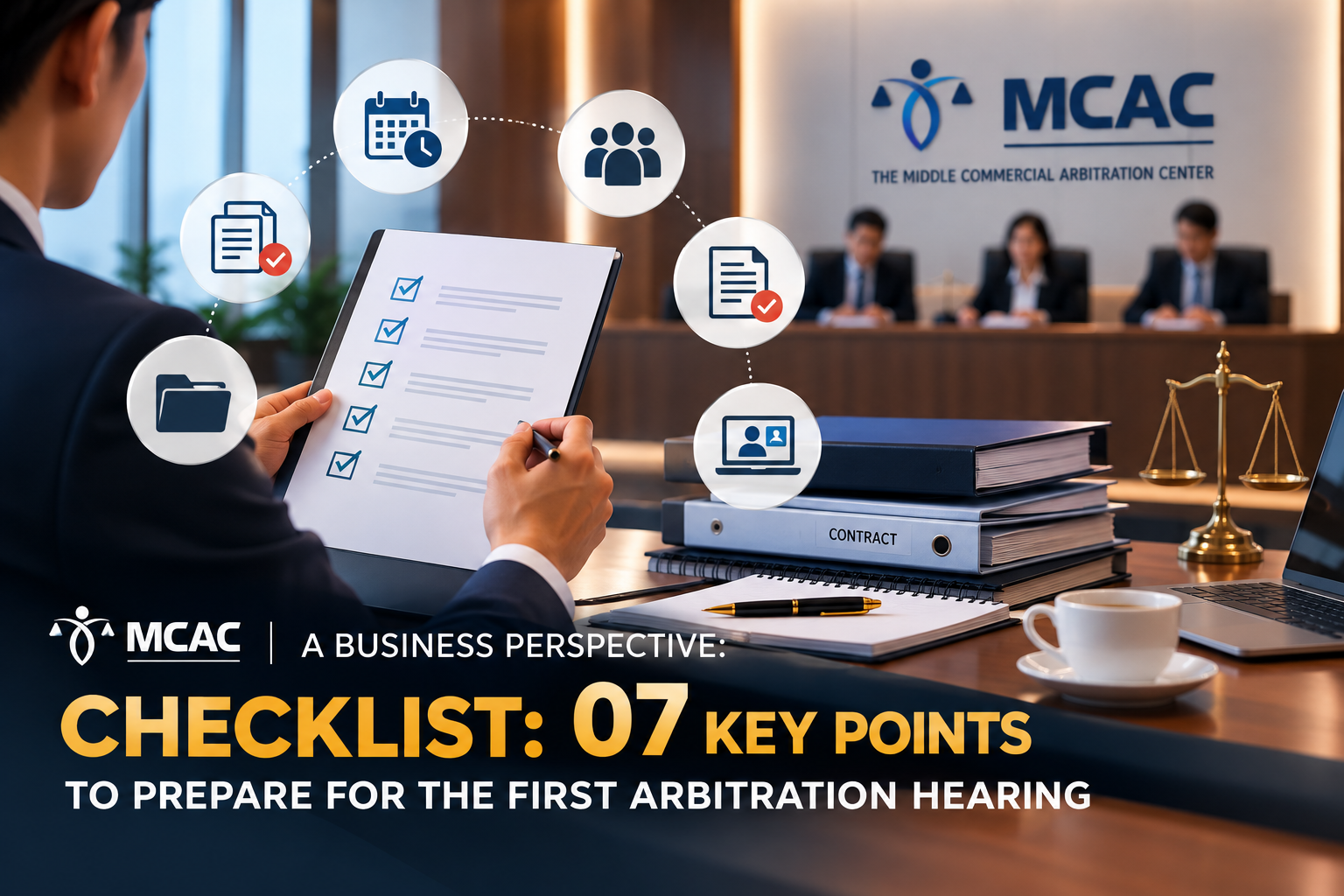
1. Review the Summons and relevant procedural notices
The business should carefully check the time, venue or format of the hearing, the participants, the Tribunal’s requests for documents and evidence, and all applicable procedural deadlines.
Under Article 25.2 of the MCAC Rules of Arbitration, the Centre shall send the Summons to the parties no later than 15 days before the hearing date, unless the parties agree otherwise. The hearing may be held in person or by teleconference or video conference if the parties so agree (Article 25.1). Timely review of the Summons enables the business to proactively arrange personnel and prepare the necessary conditions for participation.
2. Determine the status and scope of authority of attendees
The business should clearly identify the person directly participating in the proceedings: if the attendee is the legal representative, documents proving representative status should be prepared when necessary; if another individual is authorized, the power of attorney must clearly define the scope of representation and ensure sufficient authority to exercise the necessary procedural rights and obligations.
Depending on the nature of the case, the business may consider the participation of a lawyer or representative protecting its lawful rights and interests, personnel directly responsible for contract negotiation/performance, accounting–finance personnel, technical specialists, and witnesses. Under Article 25.3 of the MCAC Rules of Arbitration, the parties may invite witnesses and persons protecting their lawful rights and interests to attend the hearing, provided that the Tribunal is notified before the hearing date.
3. Review the claims, statement of defense, and scope of the dispute
For the Claimant, each claim should be clearly identified, including the value of each claim, contractual and legal grounds, claims for interest, contractual penalties, damages, or other costs (if any), together with the corresponding supporting documents.
For the Respondent, the business should identify the matters admitted, the claims disputed, and the grounds for objection (validity of the contract, performance or breach of obligations, limitation period, jurisdiction of the Tribunal), as well as the contents of any Counterclaim.
The business should prepare a summary table covering 04 items: disputed issue – position – legal basis – supporting documents/evidence, in order to control its arguments and avoid inconsistent presentations at the hearing.
4. Organize documents and evidence
Under Article 19.1 of the MCAC Rules of Arbitration (corresponding to the principle set out in Article 46.1 of the 2010 Law on Commercial Arbitration), the parties are obliged to provide evidence as requested by the Tribunal to prove their claims or objections.
The business should review and arrange documents under a consistent system – contracts and appendices, purchase orders, delivery/acceptance minutes, invoices, payment records, correspondence, meeting minutes, breach notices, documents evidencing losses, and procedural documents already submitted to MCAC – together with a consistently numbered index indicating the date of each document and the relevant page number for convenient reference. Documents prepared in a language other than the language of arbitration (Article 23 of the MCAC Rules of Arbitration) should be translated when required by the Tribunal.
5. Prepare the presentation for the hearing
The presentation should focus on four matters: the legal relationship giving rise to the dispute (contract formation, performance, and the time the dispute arose); the matters to be resolved by the Tribunal (issues still disputed between the parties); the basis for each argument (linked to specific contractual provisions, legal rules, or evidence); and the specific relief sought from the Tribunal. The business should also anticipate issues the Tribunal may request it to clarify, particularly where there are inconsistencies between oral/written submissions and the case file.
6. Check amendments and supplements to claims, documents, and evidence before the hearing
Under Article 14.2 of the MCAC Rules of Arbitration, the parties may amend or supplement the Statement of Claim, Counterclaim, or Statement of Defense before the close of the final hearing; the Tribunal may refuse an amendment if it considers that the amendment is being abused to cause difficulty, delay the issuance of the award, or exceeds the scope of the arbitration agreement.
Businesses should pay particular attention to the following: the first hearing is not automatically merely preparatory. Under Article 25.4 of the MCAC Rules of Arbitration, if the Tribunal considers that the parties have no further relevant documents or evidence to submit, it may declare the hearing to be the final hearing; after that point, the Tribunal is not obliged to consider additional documents or evidence unless the parties agree otherwise. Therefore, the business should complete its evidentiary submissions and define the scope of its claims before the hearing, rather than assuming that missing documents can be submitted at a later stage.
7. Prepare for procedural issues that may arise
Postponement of the hearing: Under Article 26 of the MCAC Rules of Arbitration, a request for postponement must be made in writing, state the reasons, be accompanied by supporting evidence, and be submitted to the Centre no later than 07 working days before the hearing date; if submitted later, the requesting party must bear any resulting costs (if any). The Tribunal decides whether to accept the request and determines the postponement period.
Absence of the parties: Under Article 27 of the MCAC Rules of Arbitration, if the Claimant, despite having been duly summoned, is absent without a legitimate reason or leaves the hearing without the Tribunal’s approval, the Claimant shall be deemed to have withdrawn the Statement of Claim (the Tribunal shall continue only if the Respondent so requests or has filed a Counterclaim); the Respondent’s absence under similar circumstances does not suspend the hearing, and the Tribunal shall continue to resolve the dispute on the basis of the available documents and evidence.
Confidential nature of the hearing: Under Article 25.3 of the MCAC Rules of Arbitration (Article 4.4 of the 2010 Law on Commercial Arbitration), the hearing is conducted in private unless the parties agree otherwise. The business should control the use and sharing of documents and information relating to the hearing and the participation of persons outside the procedural participants.
PRE-HEARING CHECKLIST
- Checked the time, venue, and format of the hearing;
- Identified the correct attendees and completed the power of attorney, if any;
- Fully reviewed the claims, statement of defense, and Counterclaim;
- Clearly identified the disputed issues for the Tribunal’s consideration;
- Organized documents and evidence and prepared an index for reference;
- Prepared the presentation and corresponding legal grounds;
- Checked amendments and supplements to claims, documents, and evidence before the hearing;
- Anticipated issues relating to witnesses, interpreters, experts, or specialist personnel;
- Prepared a response plan in case a postponement needs to be requested or other procedural issues arise.
Conclusion
The dispute resolution hearing is an important stage of arbitral proceedings, at which the Tribunal directly considers the parties’ arguments, evidence, and positions before issuing an award. Thorough preparation before the hearing not only safeguards the business’s procedural rights but also enables the case to be presented systematically and consistently with the documents and evidence already submitted.
A business should not assume that the first hearing is merely procedural or that there will certainly be a subsequent hearing: under Article 25.4 of the MCAC Rules of Arbitration, the first hearing may also be the final hearing. Therefore, reviewing the case file, accurately defining the scope of the claims, completing the evidence, arranging the appropriate attendees, and preparing the presentation are tasks that should be completed before the business attends an arbitration hearing at MCAC.
Related news
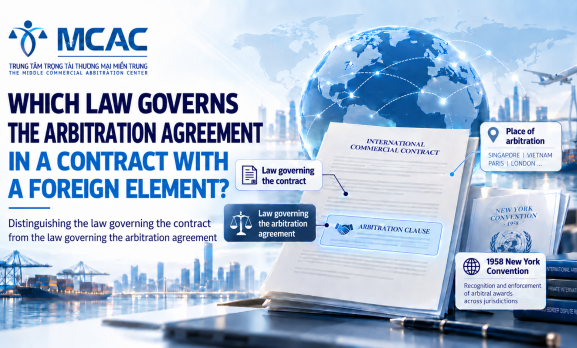
WHICH LAW GOVERNS AN ARBITRATION AGREEMENT IN A CONTRACT WITH FOREIGN ELEMENTS?
In international commercial transactions, parties often agree on the law governing their contract and on arbitration as the method of dispute resolution. However, does the law governing the contract automatically govern the arbitration agreement? If the parties have not agreed on the applicable law, which country's law is used to determine the validity of the arbitration agreement?
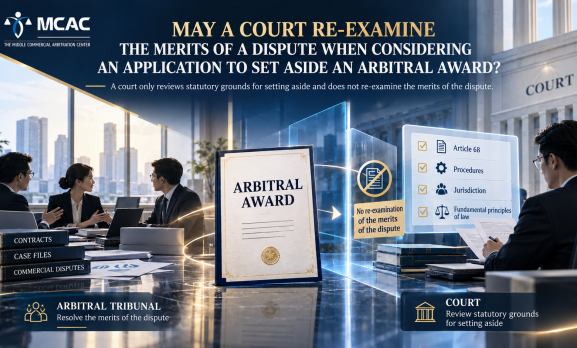
MAY A COURT RE-EXAMINE THE MERITS OF A DISPUTE WHEN CONSIDERING AN APPLICATION TO SET ASIDE AN ARBITRAL AWARD?
When considering an application to set aside an arbitral award, is the Court entitled to reassess evidence, reconsider the parties' rights and obligations, or alter the findings and decisions made by the Arbitral Tribunal?