Working hour: Monday – Friday/8AM – 5PM
|Email: contact@mcac.vn
|Hotline: (+84) 935 925 068 - 0236 3656799
| Language:



Điện thoại: (+84) 935 925 068
Language:

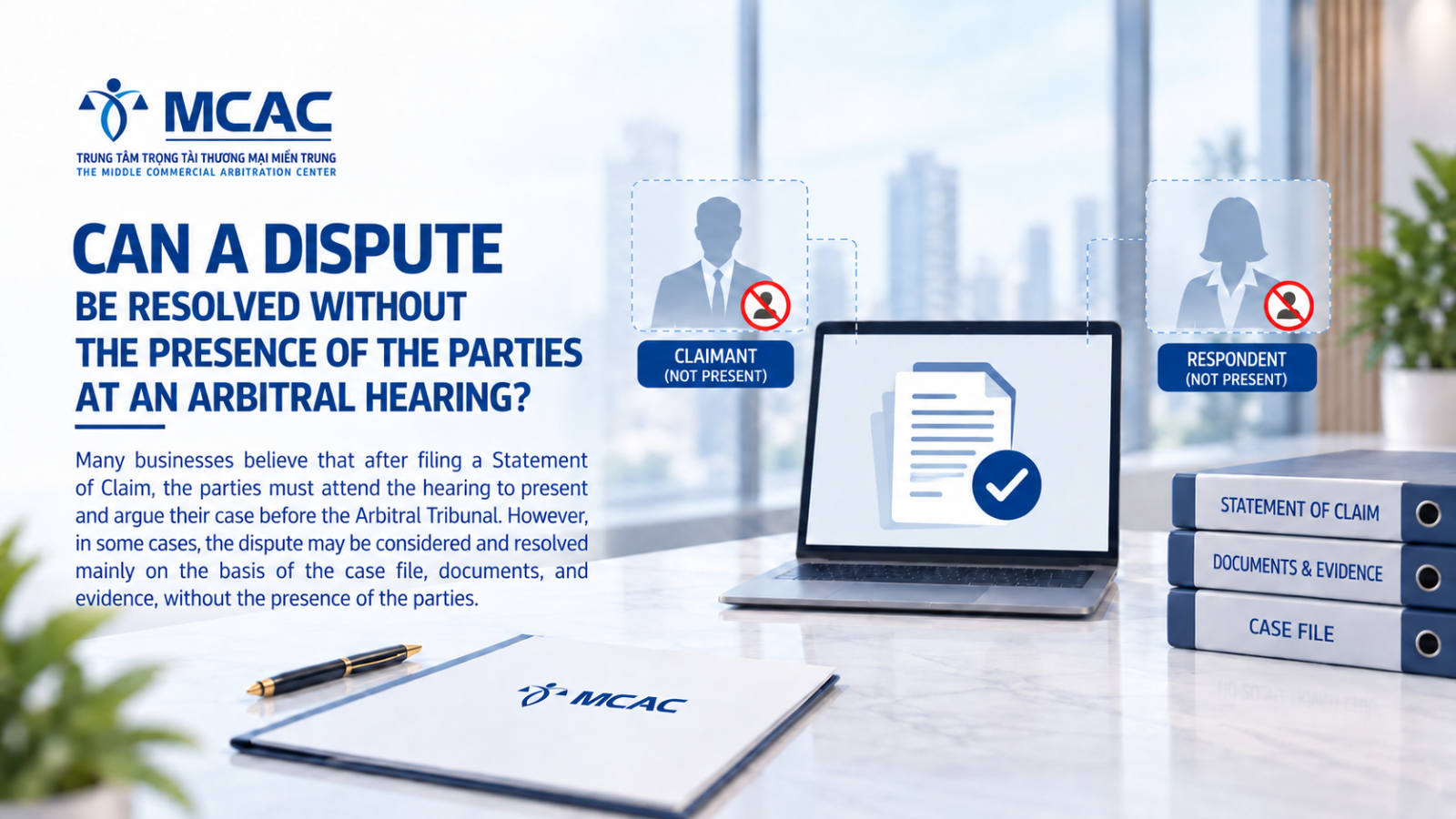
CAN A DISPUTE BE RESOLVED WITHOUT THE PARTIES BEING PRESENT AT THE ARBITRAL HEARING?
23/09/2026


Many businesses assume that once a Statement of Claim has been filed, the parties are required to attend the hearing in order to present their cases and arguments directly before the Arbitral Tribunal. However, in certain circumstances, a dispute may be considered and resolved primarily on the basis of the case file, documents and evidence, without the parties being present.
1. Resolving an arbitration dispute without the parties being present
Article 56.3 of the 2010 Law on Commercial Arbitration provides: “At the request of the parties, the Arbitral Tribunal may conduct the dispute resolution hearing on the basis of the case file without the parties being present.” A corresponding provision is set out in Article 27.3 of the MCAC Rules of Arbitration.
Accordingly, the Arbitral Tribunal may conduct the dispute resolution hearing on the basis of the case file, documents and evidence submitted by the parties, without requiring the parties to make oral submissions or arguments in person or online, provided that the parties so request. This is a mechanism recognized by arbitration law to provide flexibility in the dispute resolution process.
2. Distinguishing this from a case where only one party does not wish to attend the hearing
Resolution of a dispute on the basis of the case file under Article 56.3 of the 2010 Law on Commercial Arbitration may only be carried out upon the joint request of both the Claimant and the Respondent. This situation must be distinguished from one in which a party unilaterally requests to be absent or simply fails to attend the hearing.
Under Article 27.4 of the MCAC Rules of Arbitration, the Arbitral Tribunal may conduct the dispute resolution hearing even where one party requests to be absent; in such a case, the other party retains the right to attend and present its views. This mechanism is entirely different from both parties jointly requesting the Arbitral Tribunal to resolve the dispute on the basis of the case file.
3. Consequences when a party is absent without authorization
A party's failure to attend the hearing does not mean that the arbitral proceedings are automatically terminated. Under Article 56 of the 2010 Law on Commercial Arbitration and Article 27 of the MCAC Rules of Arbitration:
- For the Claimant: if the Claimant has been duly summoned but is absent without a legitimate reason, or leaves the hearing without the Arbitral Tribunal's approval, the Claimant shall be deemed to have withdrawn the Statement of Claim. In such a case, the Arbitral Tribunal shall continue resolving the dispute only if the Respondent so requests or has filed a Counterclaim.
- For the Respondent: if the Respondent has been duly summoned but is absent without a legitimate reason, or leaves the hearing without the Arbitral Tribunal's approval, the Arbitral Tribunal shall nevertheless continue resolving the dispute on the basis of the available documents and evidence.
Accordingly, the Respondent cannot prevent the dispute resolution process merely by refusing to participate in the proceedings. This is one of the mechanisms intended to limit deliberate attempts by a party to prolong the dispute resolution process.
4. When may resolution on the basis of the case file be appropriate?
This approach may be considered where:
- The facts of the dispute are already set out relatively fully in the case file;
- The evidence consists mainly of documents and written materials, with few issues requiring confrontation or oral clarification;
- The parties have had a full opportunity to present their claims, views and evidence;
- There is no need to question witnesses or experts directly, or to clarify complex facts at the hearing;
- The parties prioritize prompt resolution and the reduction of additional costs.
Conversely, where a dispute involves numerous facts requiring clarification, conflicting statements, the need to question witnesses or experts, or the need for the parties to explain evidence directly, a hearing attended by the parties remains necessary to provide the Arbitral Tribunal with a sufficient basis to consider the case.
5. What should businesses keep in mind?
Not attending a hearing pursuant to a procedural mechanism permitted by law is entirely different from a party neglecting the arbitral proceedings. Even where the parties do not attend the hearing in person, they must still proactively and fully exercise their procedural rights and perform their procedural obligations, in particular:
- Submit the Statement of Claim, Statement of Defence, Counterclaim and other procedural submissions in full and within the required time limits;
- Provide all documents and evidence supporting their claims or views;
- Monitor notices and requests issued by the Centre and the Arbitral Tribunal;
- Timely provide comments on documents and evidence submitted by the other party;
- Clearly state in writing any request for the dispute to be resolved on the basis of the case file without the parties being present.
Conclusion
An arbitration dispute may be considered and resolved on the basis of the case file, documents and evidence without the parties being present at the hearing, provided that the conditions under the Law on Commercial Arbitration and the applicable Rules of Arbitration are satisfied. This mechanism reflects the flexibility of commercial arbitration, allowing the parties to choose a method of resolution suited to the characteristics of each dispute while helping to save time and procedural costs.
However, businesses should clearly distinguish between resolution on the basis of the case file at the joint request of the parties and a situation where one party is absent without authorization or fails to participate in the proceedings, because the legal consequences of these two situations are entirely different. For disputes administered by the Middle Commercial Arbitration Center (MCAC), the parties may agree on and select an appropriate procedural mechanism in accordance with the 2010 Law on Commercial Arbitration and the MCAC Rules of Arbitration.
The article above has analyzed in detail is "CAN A DISPUTE BE RESOLVED WITHOUT THE PARTIES BEING PRESENT AT THE ARBITRAL HEARING?". For more detailed information or legal assistance, please contact the MCAC Secretariat:
- Hotline: 0935 925 068 - 0236 3656799
- Email: contact@mcac.vn
- Read more:WHAT DOCUMENTS MUST ACCOMPANY A STATEMENT OF CLAIM FILED WITH AN ARBITRATION CENTER?
Related news
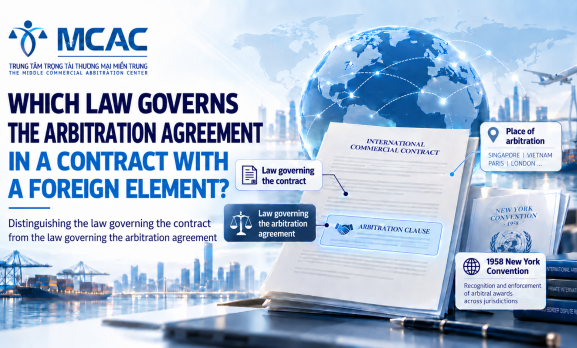
WHICH LAW GOVERNS AN ARBITRATION AGREEMENT IN A CONTRACT WITH FOREIGN ELEMENTS?
In international commercial transactions, parties often agree on the law governing their contract and on arbitration as the method of dispute resolution. However, does the law governing the contract automatically govern the arbitration agreement? If the parties have not agreed on the applicable law, which country's law is used to determine the validity of the arbitration agreement?
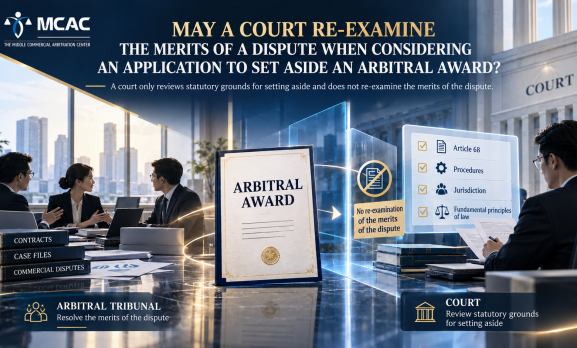
MAY A COURT RE-EXAMINE THE MERITS OF A DISPUTE WHEN CONSIDERING AN APPLICATION TO SET ASIDE AN ARBITRAL AWARD?
When considering an application to set aside an arbitral award, is the Court entitled to reassess evidence, reconsider the parties' rights and obligations, or alter the findings and decisions made by the Arbitral Tribunal?