Working hour: Monday – Friday/8AM – 5PM
|Email: contact@mcac.vn
|Hotline: (+84) 935 925 068 - 0236 3656799
| Language:



Điện thoại: (+84) 935 925 068
Language:

WHAT DOCUMENTS MUST ACCOMPANY A STATEMENT OF CLAIM FILED WITH AN ARBITRATION CENTER?
14/09/2026


When initiating arbitration proceedings, properly preparing the Statement of Claim together with the accompanying documents and evidence is an important first step. The Statement of Claim sets out the Claimant’s requests; however, in order for the arbitration center to process the case and for the Arbitral Tribunal to have sufficient grounds to resolve the dispute, the Claimant should also submit documents establishing the Tribunal’s jurisdiction, the disputed legal relationship, and the basis for each claim.
Clause 3 Article 30 of the 2010 Law on Commercial Arbitration provides that the Statement of Claim must be accompanied by the arbitration agreement and the originals or copies of relevant documents. Similarly, Clause 3 Article 7 of the Rules of Arbitration of the Middle Commercial Arbitration Center (MCAC) provides that the Statement of Claim must be accompanied by the arbitration agreement and other relevant documents, whether in original or copy form.
In practice, depending on the nature and circumstances of each dispute, the following groups of documents should generally be prepared:
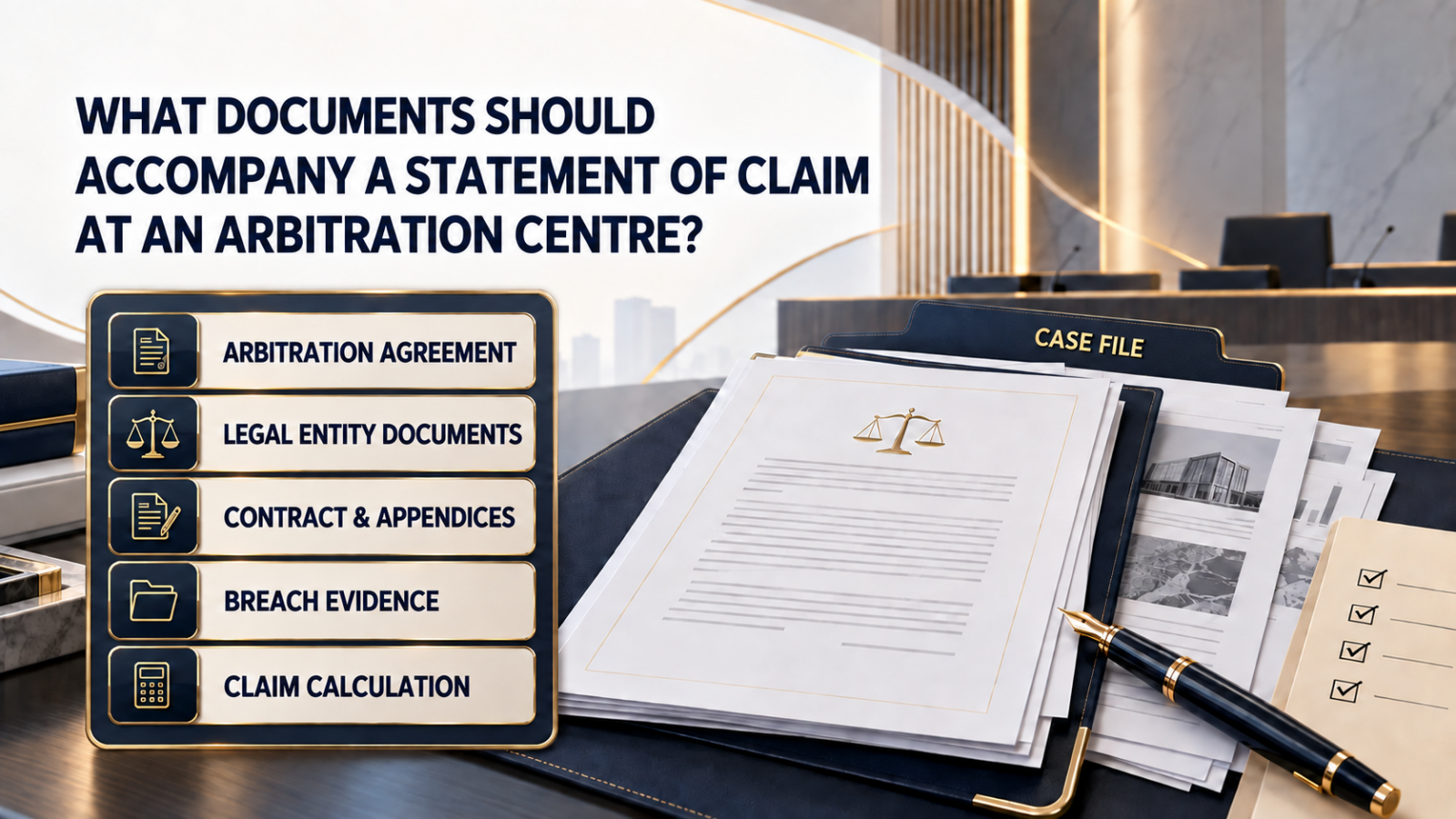
1. Arbitration agreement
The arbitration agreement is an important document for determining whether the dispute falls within the jurisdiction of arbitration.
The arbitration agreement may be contained in:
- an arbitration clause incorporated into the main contract;
- a separate arbitration agreement;
- an appendix, memorandum, letter, email or other document evidencing the parties’ agreement to resolve disputes by arbitration; or
- other forms recognized by the Law on Commercial Arbitration.
Where the parties have agreed to refer disputes to MCAC, the Claimant should clearly identify and submit the document containing such arbitration agreement.
2. Documents proving the legal status of the parties and the authority of their representatives
Depending on whether the parties are organizations or individuals, relevant documents may include:
- Enterprise Registration Certificate or other equivalent legal documents;
- identification documents of individuals, where necessary;
- documents evidencing the authority of the legal representative; and
- power of attorney or other documents evidencing the authority of an authorized representative.
These documents assist in accurately identifying the parties to the dispute and the authority of the persons participating in the arbitration proceedings.
3. Documents establishing the legal relationship between the parties
The Claimant should provide documents evidencing the establishment and contents of the legal relationship from which the dispute arises, such as:
- contracts and contract appendices;
- purchase orders, quotations or transaction confirmations;
- agreements, memoranda or minutes;
- emails, correspondence and other communications between the parties; and
- other documents recording the parties’ rights and obligations.
These documents provide the basis for determining the contractual relationship as well as the rights and obligations agreed upon by the parties.
4. Documents and evidence relating to contract performance and breaches
Depending on the nature of the dispute, the Claimant may submit:
- delivery and receipt records;
- acceptance or inspection minutes;
- invoices and payment documents;
- bank statements or payment confirmations;
- debt reconciliation or debt confirmation records;
- notices of breach;
- requests for payment or performance of obligations;
- records, emails and correspondence concerning the performance of the contract; and
- other documents proving that a contractual obligation has or has not been properly performed.
This group of documents is particularly important in determining whether a breach occurred, the time of breach and the consequences arising from such breach.
5. Documents supporting the amount and basis of each claim
Each claim stated in the Statement of Claim should be supported by corresponding documents and calculations.
Depending on the case, the Claimant may need to provide documents relating to:
- outstanding principal amounts;
- contractual penalties;
- late-payment interest;
- compensation for actual damages;
- legal fees or other reasonable expenses, where claimed; and
- detailed calculations of the amounts requested.
The calculation should clearly indicate the amount claimed, the calculation method, the applicable period and the legal or contractual basis for such calculation.
6. Notices, requests for performance, negotiation and mediation records
Where available, the Claimant should also submit documents evidencing the process of requesting performance and attempting to resolve the dispute before commencing arbitration, such as:
- notices requesting payment;
- notices requesting performance or remedy of a breach;
- notices of termination or suspension of a contract;
- minutes of meetings or negotiations;
- mediation records; and
- correspondence exchanged between the parties in relation to the dispute.
These documents may assist the Arbitral Tribunal in determining the sequence of events, the parties’ positions and other relevant circumstances of the dispute.
Practical notes when preparing the arbitration filing
The documents and evidence should be arranged systematically and, where possible, numbered and listed in an index attached to the Statement of Claim. This facilitates examination and reference during the arbitration proceedings.
Where documents are in a foreign language, a Vietnamese translation may be required depending on the language of the arbitration and the requirements of the Arbitral Tribunal.
The Claimant should also ensure that the required number of copies is submitted in accordance with the MCAC Rules of Arbitration and should retain the originals for presentation or verification where necessary during the proceedings.
Accordingly, preparing a complete arbitration filing does not merely mean submitting a Statement of Claim. The accompanying documents and evidence play an important role in establishing arbitral jurisdiction, clarifying the disputed legal relationship and providing the legal and factual basis for each claim. A properly organized and comprehensive filing will contribute to a more efficient resolution of the dispute by the Arbitral Tribunal.
The article above has analyzed in detail is "WHAT DOCUMENTS MUST ACCOMPANY A STATEMENT OF CLAIM FILED WITH AN ARBITRATION CENTER?". For more detailed information or legal assistance, please contact the MCAC Secretariat:
- Hotline: 0935 925 068 - 0236 3656799
- Email: contact@mcac.vn
- Read more:ARBITRATION AGREEMENTS ENTERED INTO BY PERSONS WHO ARE NOT LEGAL REPRESENTATIVES: COMMENTARY ON DECISION NO. 810/2017/QD-PQTT OF THE PEOPLE’S COURT OF HO CHI MINH CITY
Related news
INSTITUTIONAL OR AD HOC ARBITRATION: WHAT SHOULD BUSINESSES CONSIDER WHEN CHOOSING?
How does the law define institutional and ad hoc arbitration? Under Clause 6, Article 3 of the LCA, institutional arbitration is a form of dispute resolution conducted at an arbitration center in accordance with the LCA and the arbitration rules of that center.
CAN A CLAIMANT AMEND OR SUPPLEMENT ITS CLAIMS DURING ARBITRATION PROCEEDINGS?
Accordingly, after filing the Statement of Claim with an arbitration center, may the Claimant amend or supplement its claims? Until what stage may such amendments or additions be made, and in what circumstances may the Arbitral Tribunal (Tribunal) decline to accept them?