Working hour: Monday – Friday/8AM – 5PM
|Email: contact@mcac.vn
|Hotline: (+84) 935 925 068 - 0236 3656799
| Language:



Điện thoại: (+84) 935 925 068
Language:

ARBITRATION AGREEMENTS ENTERED INTO BY PERSONS WHO ARE NOT LEGAL REPRESENTATIVES: COMMENTARY ON DECISION NO. 810/2017/QD-PQTT OF THE PEOPLE’S COURT OF HO CHI MINH CITY
07/09/2026


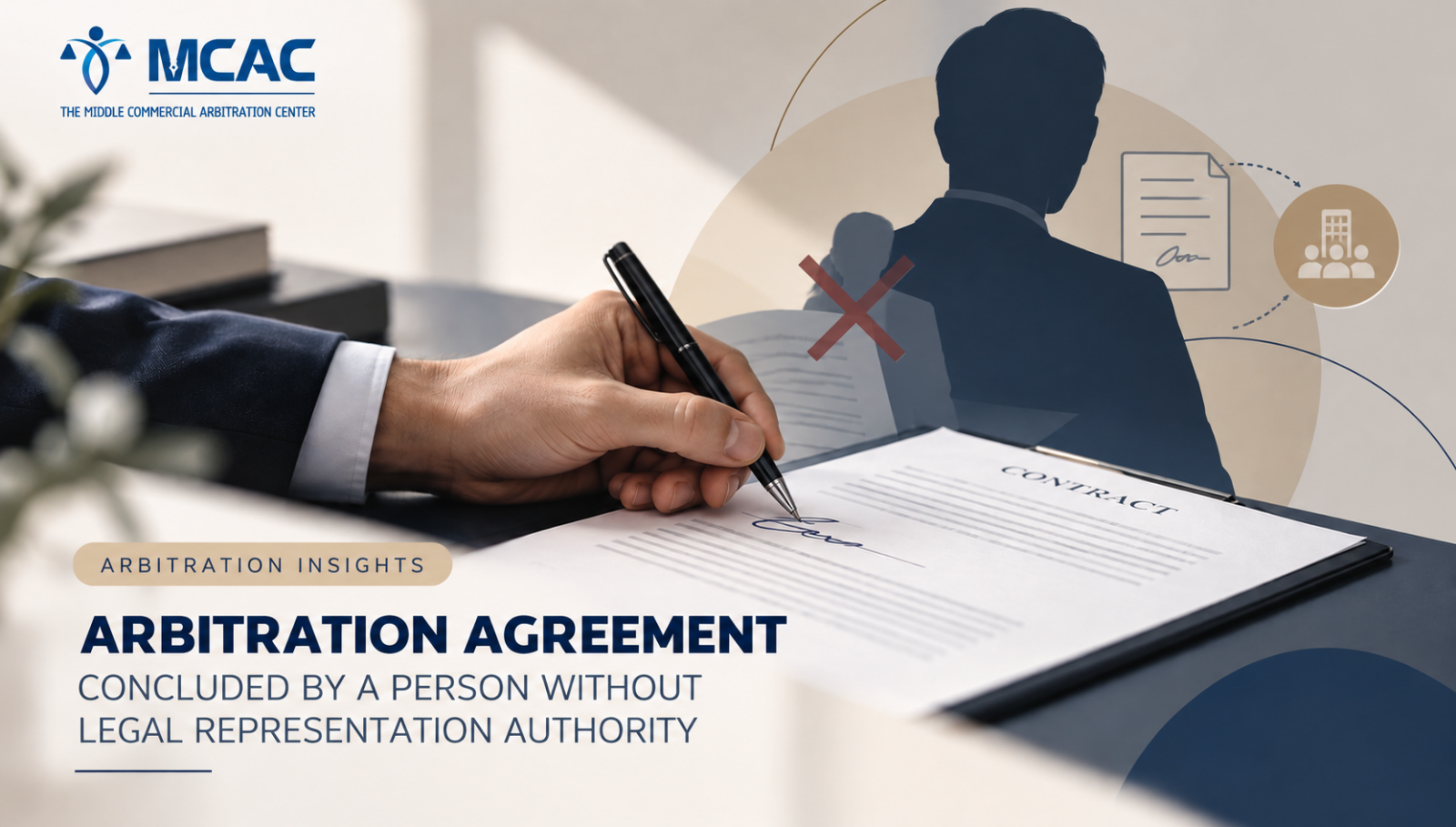
In commercial practice, not every contract entered into by an enterprise is directly signed by its legal representative. Where a contract containing an arbitration clause is signed by a person who is not the legal representative, a question may arise as to whether the arbitration agreement is automatically rendered invalid.
Decision No. 810/2017/QD-PQTT dated 29 June 2017 of the People’s Court of Ho Chi Minh City provides a noteworthy example. Although the person who signed the contract on behalf of the Respondent was not its legal representative, the Court nevertheless held that the arbitration agreement remained valid, taking into account the parties’ subsequent performance of the contract and the conduct of the person having proper authority in relation to the transaction.
1. Summary of the Case
OZ Company and Anh & Quan Company entered into Interior Design and Construction Contract No. 25/2012/HDKT/TGD.OZ dated 9 April 2012. The Contract contained an arbitration clause.
On behalf of Anh & Quan Company, the Contract was signed by Mr. Toshio. However, Mr. Toshio was not the legal representative of Anh & Quan Company.
After the Contract was signed, the parties proceeded with performance of the works and exchanged various documents, including records relating to the reconciliation of outstanding debts. When a dispute subsequently arose, OZ Company initiated arbitration proceedings against Anh & Quan Company before the Vietnam International Arbitration Centre (VIAC).
During the arbitration proceedings, Anh & Quan Company did not deny that the Contract had been performed. Instead, it argued that the outstanding payment had not been made because the works performed by OZ Company failed to satisfy the required quality standards and had not yet been accepted, handed over or finally settled.
On 2 July 2015, the Arbitral Tribunal issued Arbitral Award No. 68/14HCM resolving the dispute between the parties.
Anh & Quan Company subsequently applied to the People’s Court of Ho Chi Minh City for setting aside the arbitral award.
2. Application for Setting Aside the Arbitral Award
One of the arguments raised by Anh & Quan Company was that Mr. Toshio was neither its legal representative nor otherwise duly authorized to enter into Contract No. 25/2012/HDKT/TGD.OZ.
According to the Respondent, the fact that the Contract had been signed by an unauthorized person rendered the Contract invalid and, consequently, also invalidated the arbitration agreement contained therein.
The People’s Court of Ho Chi Minh City did not accept this argument.
The Court found that, although Mr. Toshio was not the legal representative of Anh & Quan Company, the two companies had exchanged numerous documents and conducted debt reconciliations during the performance of the Contract.
In addition, in its Statement of Defence dated 30 January 2015 and at the arbitration hearing, Anh & Quan Company stated that the reason for its non-payment was that the works performed by OZ Company did not meet the required quality standards and had not yet been accepted, handed over or finally settled. It did not deny the existence or performance of the Contract itself.
Prior to the commencement of the dispute resolution proceedings, Anh & Quan Company had also issued no written document denying the validity of the Contract signed by Mr. Toshio.
On the basis of these circumstances, the Court held that there were sufficient grounds to determine that Anh & Quan Company had been aware of and had accepted the performance of the Contract. Accordingly, its argument that the Contract and the arbitration agreement were invalid merely because Mr. Toshio was not its legal representative was unfounded.
After examining the grounds relied upon in support of the application for setting aside, the Court decided not to set aside Arbitral Award No. 68/14HCM dated 2 July 2015.
3. Commentary
Clause 2 Article 18 of the 2010 Law on Commercial Arbitration provides that an arbitration agreement shall be invalid where “the person who entered into the arbitration agreement lacked authority as prescribed by law”.[2]
However, this provision should be considered together with Clause 2 Article 3 of Resolution No. 01/2014/NQ-HDTP dated 20 March 2014 of the Judicial Council of the Supreme People’s Court.
Accordingly, a person entering into an arbitration agreement without authority may include a person who is not the legal representative, a person who has not been lawfully authorized, or a person who exceeds the scope of the authorization granted to them.
As a general rule, an arbitration agreement entered into by a person lacking authority may be considered invalid. Nevertheless, Resolution No. 01/2014/NQ-HDTP also provides an important exception: where, during the establishment or performance of the arbitration agreement or during the arbitration proceedings, the duly authorized person accepts the agreement or is aware of it without raising any objection, the arbitration agreement shall not be invalid.[3]
In the case considered under Decision No. 810/2017/QD-PQTT, several circumstances are particularly noteworthy.
First, Anh & Quan Company participated in the performance of the Contract after it had been signed.
The transaction did not merely consist of an unauthorized person signing the contractual document. Following execution, both companies continued to perform the works, exchange documents and reconcile outstanding debts.
These subsequent acts constituted important circumstances for determining whether the enterprise was aware of and had accepted the transaction that had been entered into on its behalf.
Second, Anh & Quan Company did not promptly reject the transaction entered into by Mr. Toshio.
According to the Court’s findings, prior to the dispute being brought for resolution, Anh & Quan Company had issued no written document denying the validity of the Contract.
On the contrary, the parties’ subsequent communications demonstrated that Anh & Quan Company continued to participate in the performance of the Contract and to address the rights and obligations arising therefrom.
This circumstance is consistent with the situation in which the authorized person “was aware of the agreement without raising any objection” as prescribed in Clause 2 Article 3 of Resolution No. 01/2014/NQ-HDTP.
Third, during the arbitration proceedings, the Respondent continued to acknowledge the contractual relationship in substance.
In its Statement of Defence and at the arbitration hearing, Anh & Quan Company explained that payment had not been made because of issues relating to the quality of the works and the absence of acceptance, handover and final settlement.
Accordingly, the Respondent’s arguments focused on the performance of contractual rights and obligations rather than denying, from the outset, the existence of the contractual relationship.
This was another factor supporting the Court’s conclusion that Anh & Quan Company had been aware of and had accepted the performance of the Contract signed by Mr. Toshio.
Fourth, the validity of an arbitration agreement must be considered independently from the validity of the underlying contract.
Article 19 of the 2010 Law on Commercial Arbitration provides that an arbitration agreement is entirely independent from the underlying contract. Any amendment, extension, cancellation or invalidity of the contract, or the fact that the contract is incapable of being performed, does not automatically invalidate the arbitration agreement.[4]
Accordingly, an argument that “the underlying contract is invalid and therefore the arbitration clause is automatically invalid” is legally incomplete.
Even where the validity of the underlying contract is disputed, the validity of the arbitration agreement must still be independently assessed against the requirements prescribed under the Law on Commercial Arbitration.
This case demonstrates that the decisive issue does not lie solely in the formal title or position of the individual who signed the contract. It also depends on whether the person having proper authority within the enterprise subsequently accepted or performed the transaction, or was aware of the transaction and the arbitration agreement without objecting to them.
For enterprises, where it is discovered that a contract or arbitration agreement has been entered into by an unauthorized person, any objection should be made clearly and promptly. Continuing to perform the contract, conducting debt reconciliations, corresponding regarding contractual obligations or participating in arbitration proceedings without objection may constitute important circumstances for determining that the enterprise has subsequently accepted the arbitration agreement.
4. Conclusion
An arbitration agreement signed by a person who is not the legal representative of an enterprise is not automatically invalid in every case.
Under the 2010 Law on Commercial Arbitration and Resolution No. 01/2014/NQ-HDTP, even where the person who initially entered into the arbitration agreement lacked authority, the agreement may nevertheless be recognized as valid where the duly authorized person subsequently accepted it or was aware of it without raising any objection during the establishment or performance of the agreement or during the arbitration proceedings.
Decision No. 810/2017/QD-PQTT demonstrates that the Court did not merely examine the formal signature appearing on the Contract. Rather, it considered the parties’ conduct as a whole following execution, including their performance of the Contract, reconciliation of outstanding debts and positions taken during the arbitration proceedings.
Accordingly, enterprises should carefully control the authority of persons signing contracts and arbitration agreements from the outset. Where an enterprise discovers that an agreement has been entered into by an unauthorized person, it should promptly determine and clearly communicate its position. Continuing to perform the transaction without objection may directly affect the enterprise’s ability to subsequently rely on the lack of authority as a basis for challenging the validity of the arbitration agreement.
[1] Decision No. 810/2017/QD-PQTT dated 29 June 2017 of the People’s Court of Ho Chi Minh City.
[2] Law on Commercial Arbitration No. 54/2010/QH12 dated 17 June 2010, Article 18.
[3] Resolution No. 01/2014/NQ-HDTP dated 20 March 2014 of the Judicial Council of the Supreme People’s Court, Clause 2 Article 3.
[4] Law on Commercial Arbitration No. 54/2010/QH12 dated 17 June 2010, Article 19.
The article above has analyzed in detail is "ARBITRATION AGREEMENTS ENTERED INTO BY PERSONS WHO ARE NOT LEGAL REPRESENTATIVES: COMMENTARY ON DECISION NO. 810/2017/QD-PQTT OF THE PEOPLE’S COURT OF HO CHI MINH CITY". For more detailed information or legal assistance, please contact the MCAC Secretariat:
- Hotline: 0935 925 068 - 0236 3656799
- Email: contact@mcac.vn
- Read more:CAN A BUSINESS AUDIO- OR VIDEO-RECORD AN ARBITRAL HEARING?
Related news
INSTITUTIONAL OR AD HOC ARBITRATION: WHAT SHOULD BUSINESSES CONSIDER WHEN CHOOSING?
How does the law define institutional and ad hoc arbitration? Under Clause 6, Article 3 of the LCA, institutional arbitration is a form of dispute resolution conducted at an arbitration center in accordance with the LCA and the arbitration rules of that center.
CAN A CLAIMANT AMEND OR SUPPLEMENT ITS CLAIMS DURING ARBITRATION PROCEEDINGS?
Accordingly, after filing the Statement of Claim with an arbitration center, may the Claimant amend or supplement its claims? Until what stage may such amendments or additions be made, and in what circumstances may the Arbitral Tribunal (Tribunal) decline to accept them?