Working hour: Monday – Friday/8AM – 5PM
|Email: contact@mcac.vn
|Hotline: (+84) 935 925 068 - 0236 3656799
| Language:


Điện thoại: (+84) 935 925 068
Language:

ARE DISPUTES ARISING FROM NON-DISCLOSURE AGREEMENTS (NDA) IN EMPLOYMENT RELATIONSHIPS SUBJECT TO COMMERCIAL ARBITRATION?
09/11/2026


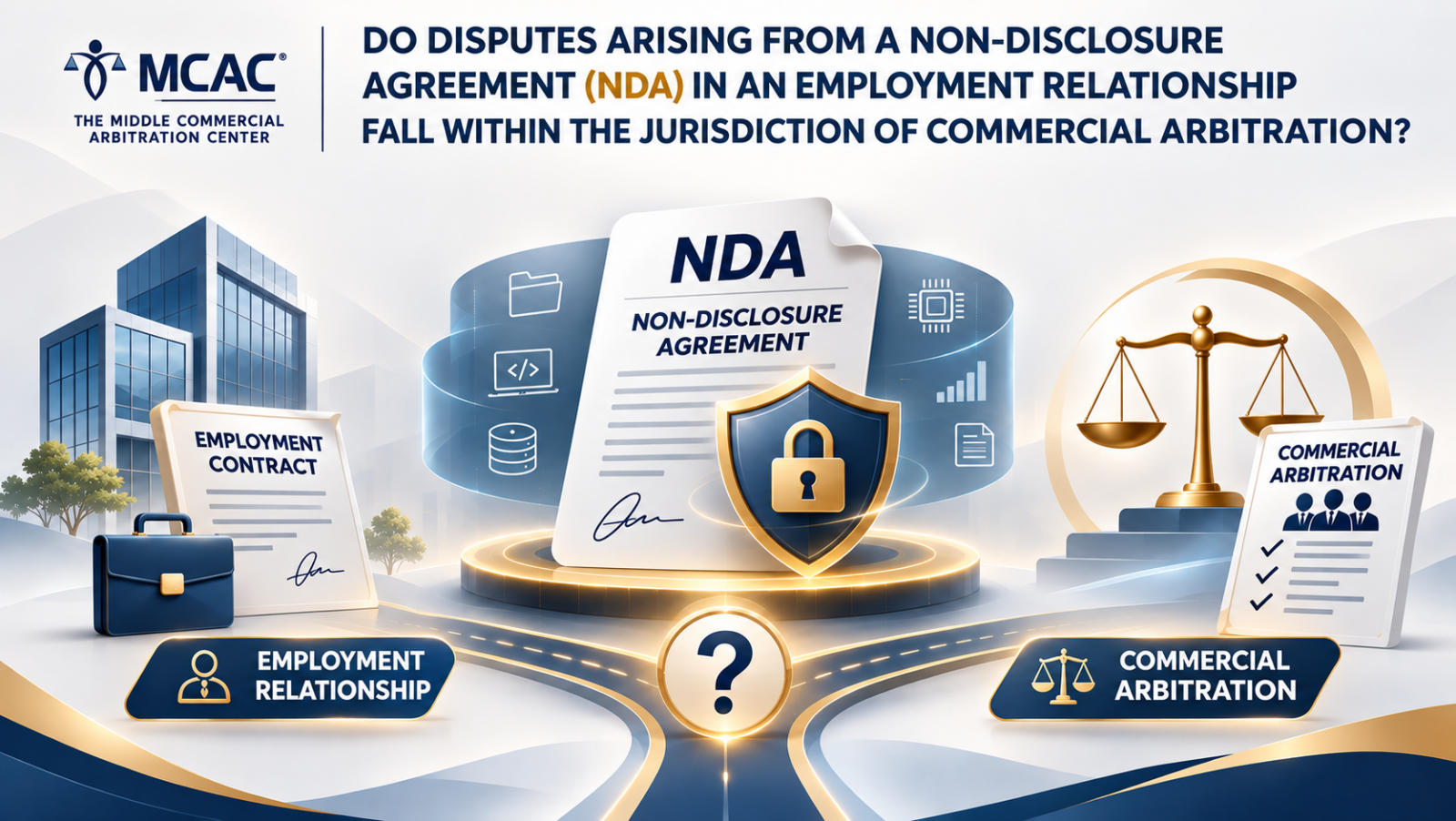
In employment relationships, employers and employees may enter into non-disclosure agreements (NDAs) to protect trade secrets, technological secrets and other important business information. When disputes arise, particularly after an employee leaves employment, can NDA disputes be resolved through commercial arbitration, or must they follow the mechanisms for resolving labour disputes?
1. Non-disclosure agreements (NDAs) in employment relationships
A non-disclosure agreement (NDA) establishes obligations to maintain confidentiality and not to disclose or use without authorization information designated by the parties as protected.
In employment relationships, NDAs are commonly concluded between employers and employees whose work directly involves trade secrets or technological secrets. Protected information may concern production processes, business strategies or customer data. The scope of confidentiality should be specifically defined in the agreement.
Under Clause 2, Article 21 of Labour Code No. 45/2019/QH14 of 2019 (the “2019 Labour Code”), an employer may enter into a written agreement with an employee whose work directly involves trade secrets or technological secrets concerning the content and duration of protection, the employee’s benefits and compensation in the event of a breach.
Furthermore, Clause 1, Article 4 of Circular No. 10/2020/TT-BLDTBXH dated 12 November 2020 of the Minister of Labour, Invalids and Social Affairs (“Circular No. 10/2020/TT-BLDTBXH”) provides that the protection of trade secrets and technological secrets may be agreed upon in an employment contract or in another written instrument as prescribed by law.
Accordingly, an NDA may be incorporated directly into an employment contract or executed as a separate document. However, execution as a separate document does not, by itself, establish the NDA’s independence from the employment contract. The nature of the dispute must be determined by the substance of the obligations and the relationship between the agreements, rather than solely by their titles or the parties’ declarations of independence.
2. Jurisdiction of commercial arbitration over NDA disputes
Under Clause 1, Article 179 of the 2019 Labour Code, labour disputes include disputes over rights, obligations and interests arising during the establishment, performance or termination of employment relationships, as well as disputes arising from relationships directly connected with employment relationships.
For individual labour disputes, Article 187 of the 2019 Labour Code assigns dispute-resolution authority to labour mediators, labour arbitration councils and People’s Courts, in accordance with statutory procedures. A labour arbitration council under the 2019 Labour Code is distinct from an arbitral tribunal constituted under Commercial Arbitration Law No. 54/2010/QH12 of 2010, as amended and supplemented in 2025 (the “Commercial Arbitration Law”).
By contrast, Article 2 of the Commercial Arbitration Law provides that commercial arbitration has jurisdiction over disputes arising from commercial activities between parties, disputes between parties where at least one party engages in commercial activities, and other disputes that the law permits to be resolved by arbitration.
Where one party to an NDA dispute is an enterprise engaged in commercial activities, Clause 2, Article 2 of the Commercial Arbitration Law is a relevant provision when assessing jurisdiction. This provision does not require both parties to engage in commercial activities. Nevertheless, the nature of the dispute must be established to distinguish it from an individual labour dispute governed by the Labour Code.
In addition, under Clause 1, Article 5 of the Commercial Arbitration Law, a dispute may be resolved by arbitration where the parties have an arbitration agreement. Such an agreement may be made before or after the dispute arises.
For an NDA concluded in the context of an employment relationship, commercial arbitral jurisdiction must be assessed by reference to the nature of the disputed relationship, the NDA’s independence from the employment contract and the parties’ agreement on the method of dispute resolution.
In this regard, Precedent No. 69/2023/AL, concerning the jurisdiction of commercial arbitration over disputes arising from confidentiality and non-compete agreements, addresses a situation in which an employee and an employer agreed that, for a specified period following termination of employment, the employee would not undertake similar or competing work, and that disputes would be resolved by commercial arbitration. The legal solution set out in the precedent requires the confidentiality and non-compete agreement to be regarded as independent of the employment contract, with the dispute falling within commercial arbitral jurisdiction.
In the case underlying the precedent, the Court also noted that the employee had not objected to arbitral jurisdiction during the proceedings and had acknowledged that the NDA was independent of the employment contract. Accordingly, reliance on the precedent requires comparison with materially similar legal facts. Moreover, because the precedent concerned an agreement combining confidentiality and non-competition obligations, it cannot be generalized to mean that every dispute involving confidentiality obligations alone falls within commercial arbitral jurisdiction.
Further, Clause 3, Article 4 of Circular No. 10/2020/TT-BLDTBXH distinguishes the handling of compensation according to when the breach is discovered. Where discovered during the term of the employment contract, the procedures under Clause 2, Article 130 of the 2019 Labour Code apply. Where discovered after termination of the employment contract, civil law and other relevant laws apply. This provision concerns the handling of compensation and does not independently establish commercial arbitral jurisdiction.
Jurisdiction must also be distinguished from assessment of the substantive terms of an NDA. The fact that a dispute falls within commercial arbitral jurisdiction does not mean that all non-compete restrictions are enforceable or that a claim for compensation will necessarily succeed. These issues must be assessed in light of the agreement, the evidence and the applicable law.
3. Matters to consider when choosing commercial arbitration for NDA disputes
The fact that an NDA is signed by an employee and an employer does not mean that every resulting dispute is a labour dispute. Conversely, neither the execution of an NDA as a separate document nor the emergence of a dispute after termination of employment automatically confers jurisdiction on commercial arbitration.
Accordingly, when considering commercial arbitration for an NDA dispute, the following matters should be clarified:
First, the nature of the disputed relationship. A distinction must be drawn between disputes over rights and obligations within the employment relationship and disputes arising from a confidentiality agreement that is independent of the employment contract.
For example, after an employee leaves employment, an enterprise may seek compensation on the ground that the former employee used protected information. To determine the competent dispute-resolution body, the allegedly breached obligation, confidentiality period, NDA terms and arbitration agreement must be examined. Termination of the employment contract is merely one relevant circumstance and does not itself determine jurisdiction.
Second, the existence and validity of the arbitration agreement. The agreement to arbitrate must satisfy the requirements of the Commercial Arbitration Law and cover the NDA dispute in question. Specifically, it must be in writing under Article 16, must not be invalid under Article 18, and must not be incapable of performance under the guidance in Article 4 of Resolution No. 01/2014/NQ-HDTP dated 20 March 2014 of the Council of Justices of the Supreme People’s Court, guiding the implementation of certain provisions of the Commercial Arbitration Law.
Where an NDA is executed separately, it is necessary to determine whether the arbitration clause in the employment contract extends to disputes arising from the NDA. The parties may include an arbitration clause directly in the NDA and expressly identify the chosen arbitral institution. However, such a clause applies only where the dispute is legally capable of resolution by arbitration.
Third, jurisdiction over each specific claim. The dispute must fall within the scope of Article 2 of the Commercial Arbitration Law. Under Clause 1, Article 43 of that Law, before examining the merits, the arbitral tribunal must determine the validity and enforceability of the arbitration agreement and its own jurisdiction. Arbitral jurisdiction over an NDA does not automatically extend to claims concerning wages, allowances or termination of employment.
For disputes satisfying jurisdictional requirements, the private nature of arbitral proceedings is a factor enterprises may consider when seeking to protect information. Clause 4, Article 4 of the Commercial Arbitration Law provides that arbitration proceedings are conducted in private unless otherwise agreed by the parties.
Thus, disputes arising from NDAs in employment relationships may be resolved by commercial arbitration where the requirements concerning the scope of arbitrable disputes and the arbitration agreement are met. Enterprises should clearly define confidentiality obligations, the relationship between the NDA and the employment contract, and the dispute-resolution mechanism when drafting the agreement.
The article above has analyzed in detail is "ARE DISPUTES ARISING FROM NON-DISCLOSURE AGREEMENTS (NDAs) IN EMPLOYMENT RELATIONSHIPS SUBJECT TO COMMERCIAL ARBITRATION?". For more detailed information or legal assistance, please contact the MCAC Secretariat:
- Hotline: 0935 925 068 - 0236 3656799
- Email: contact@mcac.vn
- Read more: AFTER THE FINAL HEARING IN A DISPUTE, WHEN IS THE ARBITRAL AWARD ISSUED AND WHEN DOES IT TAKE EFFECT?
Related news
PARTY AUTONOMY IN COMMERCIAL ARBITRATION: SCOPE AND LIMITS
Party autonomy allows parties to determine the method and procedure for resolving their disputes through arbitration. However, this autonomy must be exercised within the limits of the law and the applicable arbitration rules.
APPLICATION OF EQUITY IN DISPUTE RESOLUTION THROUGH COMMERCIAL ARBITRATION
In international commercial arbitration, certain legal frameworks permit an arbitral tribunal to decide disputes on the basis of equity where the parties have expressly authorised it to do so. In Vietnam, the application of equity must be considered within the framework of the applicable law. This article examines the concept, legal basis and limitations of applying equity in commercial arbitration and highlights certain considerations for parties to disputes and arbitral tribunals.