Working hour: Monday – Friday/8AM – 5PM
|Email: contact@mcac.vn
|Hotline: (+84) 935 925 068 - 0236 3656799
| Language:



Điện thoại: (+84) 935 925 068
Language:

CASES FOR SETTING ASIDE ARBITRAL AWARDS UNDER VIETNAMESE LAW AND DIRECTIONS FOR LEGAL REFORM
30/12/2025


Commercial arbitration has become an increasingly trusted method of dispute resolution due to its inherent advantages, including confidentiality, procedural flexibility, and the finality of arbitral awards. In order to ensure that disputes resolved through commercial arbitration comply with proper procedures and safeguard the lawful and legitimate rights and interests of the parties, the law permits courts to intervene in the validity of arbitral awards through the mechanism of setting aside arbitral awards in cases prescribed by law.

This article analyzes the current Vietnamese legal provisions governing the setting aside of arbitral awards, identifies existing shortcomings, compares them with international arbitration law, and proposes amendments aimed at enhancing the effectiveness of the arbitration mechanism in Viet Nam.
1. Vietnamese Legal Provisions on Grounds for Setting Aside Arbitral Awards
Under the 2003 Ordinance on Arbitration, a party dissatisfied with an arbitral decision had the right to file a petition with the provincial-level People’s Court where the arbitral tribunal issued its decision, requesting the court to consider setting aside the arbitral award. This approach granted a relatively broad right to request annulment and could easily lead to abuse of the setting-aside procedure as a means of prolonging dispute resolution. As a result, the finality and stability of arbitral awards were undermined.
Since 1 January 2011, the Law on Commercial Arbitration 2010 (“LCA 2010”) has taken effect and significantly restricted the right to request the setting aside of arbitral awards. Under this Law, a party requesting annulment must provide sufficient evidence demonstrating that the arbitral tribunal rendered an award falling within one of the statutory grounds. Specifically, Article 69(1) of the LCA 2010 provides that:
“Where a party has sufficient grounds to prove that the arbitral tribunal has rendered an award falling under one of the cases prescribed in Clause 2 Article 68 of this Law, it shall have the right to file a petition with the competent court requesting the setting aside of the arbitral award.”
Pursuant to Article 68(2) of the LCA 2010, an arbitral award shall be set aside in the following cases:
a) There is no arbitration agreement, or the arbitration agreement is invalid;
b) The composition of the arbitral tribunal or the arbitral proceedings is inconsistent with the agreement of the parties or contrary to the provisions of this Law;
c) The dispute does not fall within the jurisdiction of the arbitral tribunal; where part of the award falls outside the tribunal’s jurisdiction, that part shall be set aside;
d) The evidence relied upon by the arbitral tribunal to render the award is forged; or an arbitrator has received money, property, or other material benefits from one of the parties, thereby affecting the objectivity and impartiality of the arbitral award;
e) The arbitral award is contrary to the fundamental principles of Vietnamese law.
From these provisions, it can be seen that arbitral awards may be set aside on the following grounds:
First, Grounds Related to Jurisdiction
Pursuant to Article 11(2)(c) of Resolution No. 01/2014/NQ-HĐTP of the Council of Justices of the Supreme People’s Court, this ground applies where “the arbitral tribunal resolves a dispute falling outside the jurisdiction of arbitration as provided in Article 2 of the Law on Commercial Arbitration; or where the arbitral tribunal resolves a dispute without the parties’ agreement to submit such dispute to arbitration, or resolves a dispute beyond the scope of the arbitration agreement.”
Second, Grounds Related to Arbitral Procedure
An arbitral award shall be set aside where the composition of the arbitral tribunal or the arbitral proceedings is inconsistent with the parties’ agreement. Article 68(2)(b) of the LCA 2010 provides that:
“An arbitral award shall be set aside if the composition of the arbitral tribunal or the arbitral proceedings is inconsistent with the agreement of the parties”.
Guidance on the application of this provision is provided in Article 14(2)(b) of Resolution No. 01/2014/NQ-HĐTP, which states:
“Where the parties have agreed on the composition of the arbitral tribunal or the arbitral procedural rules, but the arbitral tribunal fails to comply with such agreement”.
In addition, an arbitral award shall also be set aside where the composition of the arbitral tribunal or the arbitral proceedings violates the mandatory provisions of the Law on Commercial Arbitration. Article 68(2)(b) further provides that an award shall be set aside if such composition or procedure is contrary to the provisions of the Law. Clarifying this point, Article 14(2)(b) of Resolution No. 01/2014/NQ-HĐTP stipulates that:
“Where the arbitral tribunal fails to comply with the provisions of the Law on Commercial Arbitration on the composition of the arbitral tribunal or arbitral proceedings, and the court considers such violations to be serious and requiring the award to be set aside, if such violations cannot be remedied or are not remedied in accordance with the court’s request as prescribed in Article 71(7) of the Law on Commercial Arbitration”.
Third, Grounds Related to the Substance of the Award
An arbitral award shall be set aside where the evidence relied upon by the arbitral tribunal is forged.
According to Article 14(2)(d) of Resolution No. 01/2014/NQ-HĐTP, “The court shall only consider the determination of forged evidence where there is evidence proving such allegation, and such evidence must be related to the rendering of the award and have an impact on the objectivity and impartiality of the arbitral award. The court shall rely on the Law on Commercial Arbitration, arbitral procedural rules, the parties’ agreement, and the rules on evidence assessment applied by the arbitral tribunal in resolving the dispute to determine whether the evidence is forged”.
Accordingly, the mere existence of forged evidence in the case file is insufficient to justify setting aside the award; it is also necessary to prove a direct causal link between such forged evidence and the substance of the arbitral award.
In addition, an arbitral award shall be set aside where an arbitrator has received money, property, or other material benefits from one of the disputing parties, thereby affecting the objectivity and impartiality of the award. The application of this ground requires the simultaneous satisfaction of two conditions: (i) the arbitrator has received money, property, or other material benefits from one party; and (ii) such conduct has actually affected the objectivity and impartiality of the arbitral award.
One of the fundamental principles of modern commercial arbitration is the finality of arbitral awards. An arbitral award is not a first-instance court judgment; therefore, courts must not act as appellate bodies to re-hear the dispute. This principle is clearly affirmed in the UNCITRAL Model Law and the legal practice of many jurisdictions[1], specifically:
(1) Errors of Law
Most modern arbitration legal systems, including the UNCITRAL Model Law, and the laws of France, Switzerland, and the United States, do not consider errors of law as grounds for setting aside arbitral awards. A historical exception is English law, which allows limited appeals on points of law; however, this mechanism may be excluded by party agreement and is, in practice, rarely applied.[2]
(2) Errors of Fact
Errors of fact, even serious ones, are in principle not grounds for setting aside arbitral awards. The assessment of evidence and determination of facts fall within the core jurisdiction of the arbitral tribunal, and allowing courts to re-examine these issues would seriously undermine the finality of arbitration.
2. Shortcomings in Vietnamese Law on Setting Aside Arbitral Awards
First, The Scope of Grounds for Setting Aside Remains Open-Ended and Lacks Clear Boundaries
Although Article 68 of the LCA 2010 adopts an approach consistent with the UNCITRAL Model Law, certain grounds—particularly the ground that “the arbitral award is contrary to the fundamental principles of Vietnamese law”—are drafted with unclear content, leading to an expansive application in practice.
In judicial practice, the concept of “fundamental principles of Vietnamese law” is sometimes interpreted and applied as a basis for re-evaluating the legal reasoning or conclusions of the arbitral tribunal, rather than being limited to controlling serious violations related to public policy. This undermines the finality of arbitral awards and creates uncertainty for parties choosing arbitration.
Second, Lack of Clear Distinction Between Procedural Violations and Review of the Merits
Article 68 of the LCA 2010 allows setting aside where the composition of the arbitral tribunal or arbitral proceedings is inconsistent with the parties’ agreement or contrary to the Law. However, the current law does not establish criteria for assessing the seriousness of procedural violations or clearly define which violations are sufficient to justify annulment.
As a result, in some cases, courts tend to delve into the evaluation of evidence and reasoning of the arbitral tribunal, indirectly reviewing the merits of the dispute under the guise of procedural review. This approach runs counter to the spirit of the UNCITRAL Model Law and blurs the boundary between the adjudicative function of arbitration and judicial supervision by the courts.
Third, Lack of a Clear Legal Mechanism to Remedy Defects Instead of Setting Aside Awards
The LCA 2010 does not fully establish a mechanism allowing courts to suspend consideration of a setting-aside application to enable the arbitral tribunal to remedy curable defects. In contrast, under the UNCITRAL Model Law and the laws of many countries, remission of awards is regarded as an important solution to preserve the value of arbitral awards.
The absence of such a mechanism results in situations where courts have only two options: either set aside the award or dismiss the request, even where there are remediable formal or reasoning defects that do not warrant annulment. This increases the risk of unnecessary annulments and prolongs dispute resolution.
From the above limitations, it is evident that further improvement of the legal framework governing commercial arbitration - particularly the law on setting aside arbitral awards - is an urgent requirement to establish a clear and transparent legal corridor, limit arbitrary application, and promote the sustainable development of arbitration in Viet Nam.
3. Proposals for Improvement
The Draft Law amending and supplementing the Law on Commercial Arbitration[3] clearly reflects a legislative orientation toward limiting judicial intervention in arbitration, thereby enhancing the finality, effectiveness, and enforceability of arbitral awards, in line with the UNCITRAL Model Law and international practice.
However, for the provisions on setting aside arbitral awards to be truly effective in practice, it is necessary to further clarify the substance of the grounds for annulment, the conditions for their application, and the scope of judicial review, to avoid the risk of courts re-examining the merits of disputes under the guise of setting-aside proceedings.
First, Amendments to Article 68(2)(a), (b), and (đ) of the Draft Amended Law
“a) There is no arbitration agreement, or the arbitration agreement is invalid; the court shall not re-examine this case if there has already been a court decision resolving a complaint regarding the absence or invalidity of the arbitration agreement pursuant to Article … of this Law.
b) The composition of the arbitral tribunal or there exists a serious violation of arbitral procedural rules inconsistent with the parties’ agreement or contrary to the provisions of this Law;
đ) Further clarification of the content of the provision ‘the arbitral award is contrary to the fundamental principles of Vietnamese law,’ based on legal theory, domestic legal provisions, and with reference to the UNCITRAL Model Law and foreign laws.”
The Draft revises Article 68 in the direction of clarifying the grounds for setting aside arbitral awards, particularly “serious violations of arbitral procedure” and “contrariness to the fundamental principles of Vietnamese law.” This is a necessary adjustment to address shortcomings arising from the application of the LCA 2010.
However, the Draft has not yet clearly established the boundary between reviewing procedural validity and re-evaluating the merits of the dispute. In this context, the risk of courts expanding their review to issues such as evidence assessment, factual findings, or legal reasoning of arbitral tribunals remains.
Therefore, it is necessary to introduce a guiding principle - either in Article 68 or Article 71 - affirming that, when considering a request to set aside an arbitral award, courts shall not re-examine the merits of the dispute, reassess evidence or facts, or re-evaluate the application of law by the arbitral tribunal, except where procedural violations seriously affect the lawful rights and interests of the parties. This provision is crucial to preventing “disguised annulment due to legal disagreement,” which is a major factor undermining business confidence in arbitration.
The Draft currently combines issues relating to “the composition of the arbitral tribunal” and “serious procedural violations” within the same clause of Article 68, but does not define specific legal criteria for determining what constitutes a “serious violation.” To ensure transparency and predictability, it is necessary to concretize this concept. This approach is consistent with international standards, particularly the application of the UNCITRAL Model Law in arbitration-friendly jurisdictions, and limits reliance on purely formal violations as grounds for annulment.
Second, Clarification and Narrowing of the Ground “Contrary to the Fundamental Principles of Vietnamese Law”
The Draft expressly requires clearer definition of this ground, acknowledging that it is the most susceptible to abuse in practice. Narrowing and clarifying this ground will contribute to consistency in judicial practice and enhance the predictability of the annulment mechanism.
Third, Amendment to Article 69 on the Right to Request Setting Aside
The Draft proposes adding Clause 3:
3. The parties may agree to waive the right to request the setting aside of an arbitral award. Many jurisdictions, such as Belgium, France, and Switzerland, allow parties to waive this right to enhance arbitration efficiency. To promote the robust development of arbitration in Viet Nam in line with deeper international integration and the UNCITRAL Model Law, this provision should be adopted.
This is the first time the Draft proposes allowing parties to waive the right to request annulment, representing a significant step forward and aligning Vietnamese law with jurisdictions that have a strong arbitration tradition, particularly Switzerland.
Fourth, the Draft amends and supplements Clause 7 of Article 71 regarding the court’s consideration of applications for setting aside arbitral awards, in the following direction:
“At the request of a party, the arbitral tribunal, or the court, and where it deems appropriate, the panel considering the application may suspend the consideration and resolution of the application to set aside the arbitral award for a period not exceeding 60 days, to create conditions for the arbitral tribunal to remedy defects arising in the arbitral proceedings (including the addition of the possibility to correct certain substantive defects), in accordance with the arbitral tribunal’s own assessment, with a view to eliminating the grounds for setting aside the arbitral award. The arbitral tribunal shall notify the court of the remediation of such procedural defects. Where the arbitral tribunal fails to carry out the remediation of procedural defects, the panel shall continue to consider the application for setting aside the arbitral award.”
The Draft allows the court to temporarily suspend the resolution of an application to set aside an arbitral award to enable the arbitral tribunal to remedy defects, including so-called “substantive defects.” This provision is, in principle, consistent with the “remission” mechanism under the UNCITRAL Model Law, which prioritizes the preservation of arbitral awards rather than their annulment.
However, it is necessary to clarify that “substantive defects” in this context do not include any modification of the essence or outcome of the arbitral award, but should be limited to the interpretation of the award, the correction of manifest errors, or the supplementation and clarification of reasoning for the purpose of eliminating the grounds for setting aside. In addition, the law should provide for an obligation to notify and seek the opinions of the parties before the arbitral tribunal undertakes such remedial measures, in order to ensure transparency and safeguard the parties’ procedural participation rights.
Fifth, Addition of New Article 72a on Review of Decisions to Set Aside Arbitral Awards
The Draft proposes two options regarding review mechanisms for decisions setting aside or refusing to set aside arbitral awards. Given inconsistencies in judicial practice, establishing a higher-level review mechanism is necessary.
Accordingly, the preferable approach is that decisions of provincial-level courts refusing to set aside arbitral awards shall be final, while decisions setting aside arbitral awards must be reviewed and approved by the Supreme People’s Court. This mechanism would help prevent abuse of annulment, ensure uniform application of the law, and enhance protection of arbitral awards.
The article above has provided a detailed analysis of 'Cases for setting aside arbitral awards under Vietnamese law and orientations for legal improvement.' For further information or legal support, please contact the MCAC Secretariat:
- Hotline: 0935 925 068
- Email: contact@mcac.vn
- See more: Key innovations in the draft amendments to the law on commercial arbitration
Related news
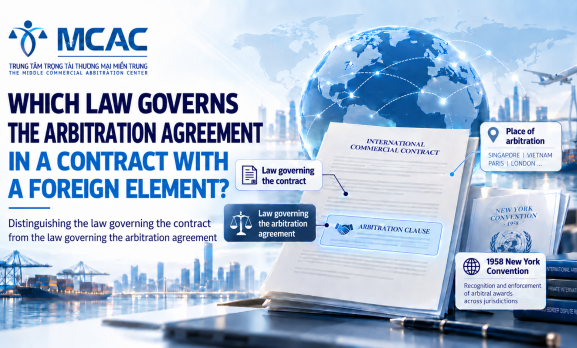
WHICH LAW GOVERNS AN ARBITRATION AGREEMENT IN A CONTRACT WITH FOREIGN ELEMENTS?
In international commercial transactions, parties often agree on the law governing their contract and on arbitration as the method of dispute resolution. However, does the law governing the contract automatically govern the arbitration agreement? If the parties have not agreed on the applicable law, which country's law is used to determine the validity of the arbitration agreement?
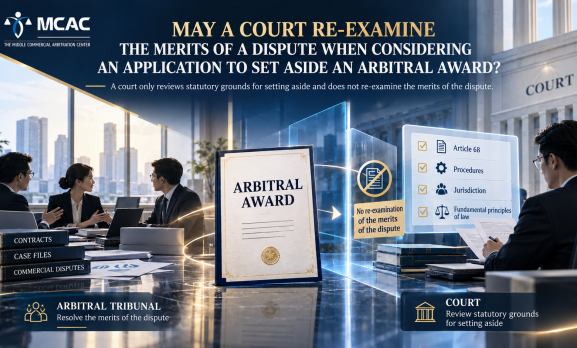
MAY A COURT RE-EXAMINE THE MERITS OF A DISPUTE WHEN CONSIDERING AN APPLICATION TO SET ASIDE AN ARBITRAL AWARD?
When considering an application to set aside an arbitral award, is the Court entitled to reassess evidence, reconsider the parties' rights and obligations, or alter the findings and decisions made by the Arbitral Tribunal?