Working hour: Monday – Friday/8AM – 5PM
|Email: contact@mcac.vn
|Hotline: (+84) 935 925 068 - 0236 3656799
| Language:



Điện thoại: (+84) 935 925 068
Language:

CORRECTION, INTERPRETATION, AND SUPPLEMENTATION OF ARBITRAL AWARDS: APPLICABLE CIRCUMSTANCES
07/01/2026


Within the framework of commercial arbitration, an arbitral award constitutes the final outcome of the arbitral proceedings and is final and binding upon the parties. In practice, however, after an award has been rendered, certain technical errors, ambiguities in wording, or omissions of claims duly submitted by the parties during the proceedings may arise. In order to remedy such deficiencies without altering the substantive nature of the award, the Law on Commercial Arbitration 2010 (LCA 2010) permits the correction, interpretation, and supplementation of arbitral awards in specific circumstances.
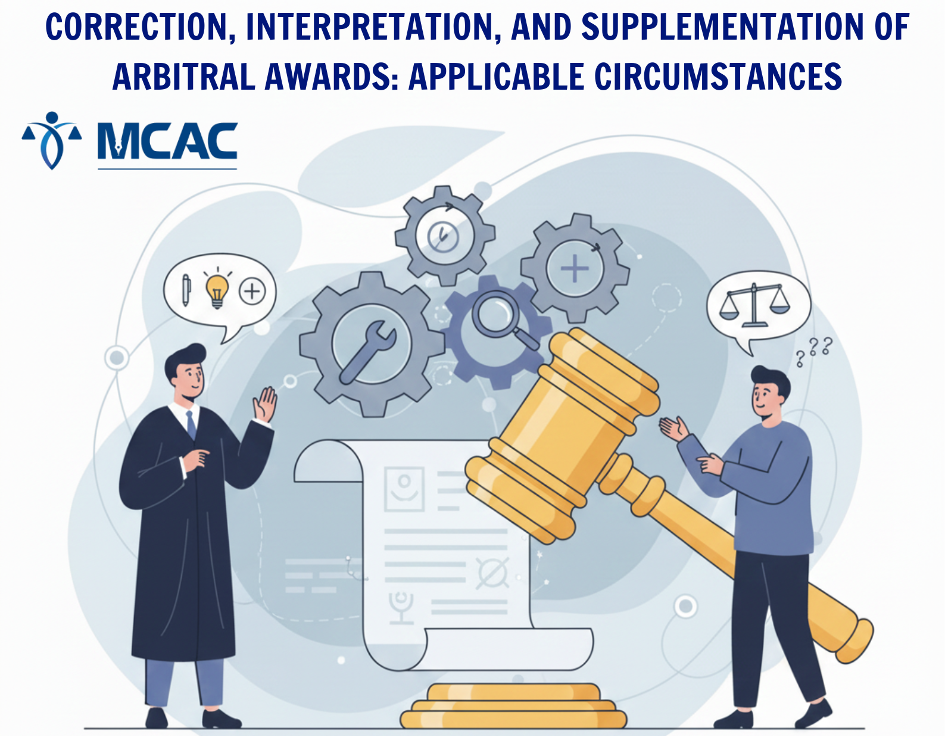
1. Correction of Arbitral Awards
Pursuant to Article 63(1) of the LCA 2010, within thirty (30) days from the date of receipt of the arbitral award, a party may request the Arbitral Tribunal to correct manifest errors of form or technical nature, including clerical, typographical, computational, or similar errors. Where the Arbitral Tribunal considers such request to be well-founded, it shall effect the correction within thirty (30) days from the date of receipt of the request.
This statutory provision is further elaborated in Article 33 of the MCAC Arbitration Rules, which provides that: “Within 30 days from the date of receipt of the Arbitral Award unless the parties have agreed otherwise on the period of time, a party may request the Arbitral Tribunal to correct any spelling, printing, or typographical error, or any error of a similar nature; any numerical errors caused by a mistake or incorrect computation in the Arbitral Award, and shall immediately notify the request to another party. If the Arbitral Tribunal considers the request legitimate and there is proof that the request has been notified to the other party, it shall make a Decision on correction within 30 days from the date of receipt of the request.”[1]. Where necessary, this time limit may be extended in accordance with Article 33(5) of the MCAC Arbitration Rules.
Notably, Article 63(3) of the LCA 2010 and Article 33(2) of the MCAC Arbitration Rules also empower the Arbitral Tribunal to correct the aforementioned errors ex officio within thirty (30) days from the date of issuance of the award, even in the absence of a request from the parties. This mechanism serves to enhance the formal and technical accuracy of arbitral awards, thereby reducing potential risks and obstacles at the enforcement stage.
2. Interpretation of Arbitral Awards
In certain circumstances, the reasoning or operative part of an arbitral award may not be expressed with sufficient clarity or completeness, potentially giving rise to divergent interpretations and practical difficulties at the enforcement stage. To address such situations, arbitration law permits the interpretation of arbitral awards; however, such authority is vested exclusively in the Arbitral Tribunal that rendered the award.
Specifically, pursuant to Article 63(2) of the LCA 2010 and Article 33(3) of the MCAC Arbitration Rules, within thirty (30) days from the date of receipt of the arbitral award -unless otherwise agreed by the parties as to the time limit - a party may request the Arbitral Tribunal to interpret the award and must promptly notify the other party thereof. Where the Arbitral Tribunal considers the request to be well-founded, the interpretation shall be issued within thirty (30) days from the date of receipt of the request, and such interpretation shall form an integral part of the arbitral award.
The interpretation of an arbitral award does not alter its substance or dispositive conclusions; rather, it serves solely to clarify the intent and reasoning already expressed by the Arbitral Tribunal. This mechanism enhances transparency and legal certainty, thereby facilitating consistent and effective enforcement of arbitral awards in practice.
3. Supplementation of Arbitral Awards
Arbitral practice indicates that, in certain cases, although the Arbitral Tribunal has examined multiple claims submitted by the parties, one or more claims duly raised during the arbitral proceedings may be inadvertently omitted from the arbitral award. To remedy such omissions, the LCA 2010 provides a mechanism for the supplementation of arbitral awards, without reopening the merits of the dispute. Specifically, unless otherwise agreed by the parties, within thirty (30) days from the date of receipt of the arbitral award, a party may request the Arbitral Tribunal to supplement the award in respect of claims that were presented during the proceedings but were not addressed in the award, and must promptly notify the other party thereof. Where the Arbitral Tribunal considers such request to be well-founded, it shall render a supplementary (additional) arbitral award within forty-five (45) days from the date of receipt of the request[2].
This mechanism is further elaborated in Article 33(4) of the MCAC Arbitration Rules, pursuant to which a party may request the Arbitral Tribunal to issue a supplementary arbitral award addressing claims that were duly submitted but omitted from the original award. The Arbitral Tribunal shall issue a supplementary award only where it is satisfied that the request is justified and that evidence exists demonstrating that the other party has been duly notified. Where necessary, the time limit for issuing the supplementary arbitral award may be extended in accordance with the applicable procedural rules.
The supplementation of an arbitral award serves to ensure the completeness and integrity of the arbitral decision, while preserving the finality and binding nature of the original award. This mechanism is strictly confined to addressing omitted claims and does not permit any reconsideration of the substance or conclusions of the dispute, thereby reinforcing legal certainty and the effectiveness of arbitration as a dispute resolution mechanism.
Conclusion:
It can be observed that, although an arbitral award is final and binding upon the parties, the Law on Commercial Arbitration 2010 and the MCAC Arbitration Rules establish a necessary legal framework allowing for the correction, interpretation, and supplementation of arbitral awards within narrowly defined limits. This framework is not intended to reopen the merits of the dispute or to alter the substantive nature of the award. Rather, it aims to rectify purely technical errors, clarify ambiguities or insufficiently expressed determinations, and ensure the completeness of the award with respect to claims duly raised during the arbitral proceedings.
By striking an appropriate balance between the finality of arbitral awards and procedural accuracy, this mechanism safeguards the stability and binding force of arbitral awards while simultaneously enhancing their transparency, precision, and enforceability in practice. In doing so, it contributes to strengthening the effectiveness and credibility of commercial arbitration as a dispute resolution mechanism.
The article above has provided a detailed analysis of 'Correction, interpretation, and supplementation of arbitral awards: applicable circumstances'. For further information or legal support, please contact the MCAC Secretariat:
- Hotline: 0935 925 068
- Email: contact@mcac.vn
- See more: Key innovations in the draft amendments to the law on commercial arbitration
Related news
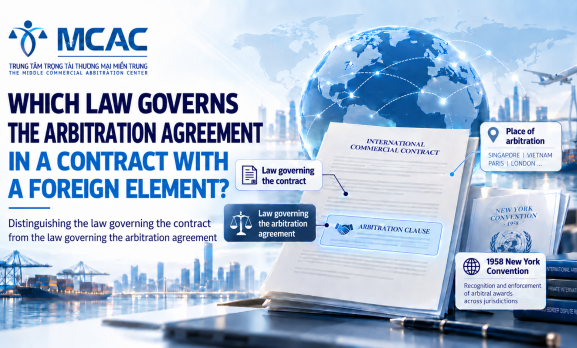
WHICH LAW GOVERNS AN ARBITRATION AGREEMENT IN A CONTRACT WITH FOREIGN ELEMENTS?
In international commercial transactions, parties often agree on the law governing their contract and on arbitration as the method of dispute resolution. However, does the law governing the contract automatically govern the arbitration agreement? If the parties have not agreed on the applicable law, which country's law is used to determine the validity of the arbitration agreement?
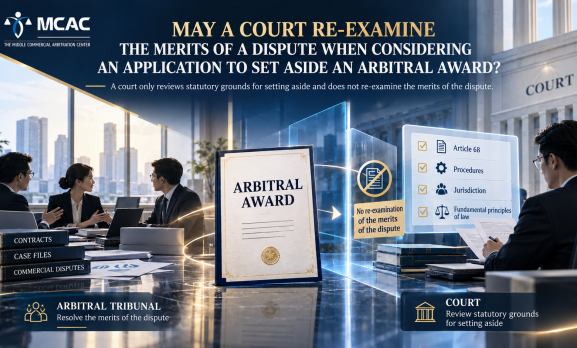
MAY A COURT RE-EXAMINE THE MERITS OF A DISPUTE WHEN CONSIDERING AN APPLICATION TO SET ASIDE AN ARBITRAL AWARD?
When considering an application to set aside an arbitral award, is the Court entitled to reassess evidence, reconsider the parties' rights and obligations, or alter the findings and decisions made by the Arbitral Tribunal?