Working hour: Monday – Friday/8AM – 5PM
|Email: contact@mcac.vn
|Hotline: (+84) 935 925 068 - 0236 3656799
| Language:



Điện thoại: (+84) 935 925 068
Language:

DISTINGUISHING COMMERCIAL MEDIATION AND COMMERCIAL ARBITRATIO
12/12/2025


1. General Overview
In the context of increasingly diverse and complex commercial activities, the need for dispute resolution mechanisms that offer flexibility and efficiency has become more prominent than ever. Apart from the judicial system, Vietnamese law recognizes and allows parties to adopt various forms of Alternative Dispute Resolution (ADR), among which commercial mediation and commercial arbitration are the two most widely utilized mechanisms. Both methods operate on the basis of voluntariness and party autonomy, and the relevant procedures are conducted in accordance with the provisions of applicable laws. As consensual dispute resolution mechanisms, they enable parties to tailor the process to their specific needs while ensuring compliance with statutory requirements and procedural safeguards.
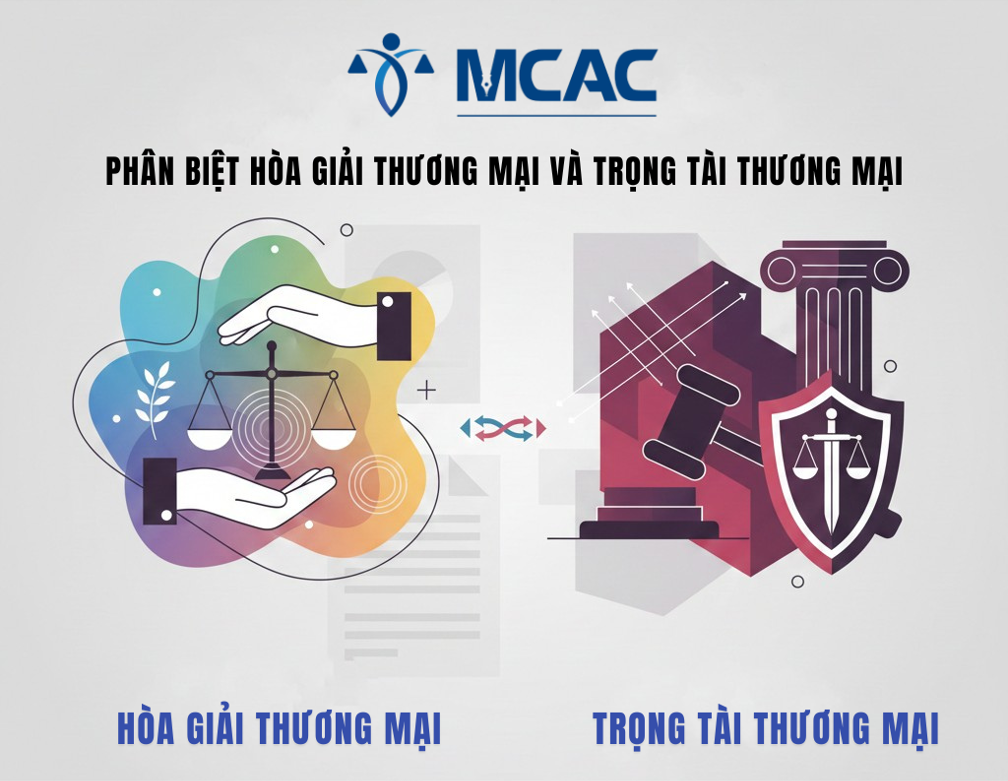
These two mechanisms share several fundamental similarities:
Basis of establishment: Both mechanisms arise from the parties’ written agreement, which may be incorporated as a mediation or arbitration clause within the contract or established as a separate agreement.
Confidentiality: Proceedings and all information related to the dispute are kept confidential, thereby safeguarding the parties’ business reputation and commercial secrets.
Party autonomy in selecting neutrals: The parties may select mediators or arbitrators based on their expertise, experience, professional qualifications, and language competence.
These features make both mechanisms flexible and business-friendly alternatives capable of addressing certain limitations of court litigation.
2. Distinctions Between Commercial Mediation and Commercial Arbitration
|
Criteria |
Commercial Mediation |
Commercial Arbitration |
|
Legal Basis |
Decree No. 22/2017/ND-CP dated 24 February 2017 on Commercial Mediation, as amended and supplemented. |
The Law on Commercial Arbitration 2010 and its implementing instruments. |
|
Definition |
A dispute resolution mechanism agreed upon by the parties, in which a commercial mediator acts as a neutral intermediary to assist the parties in resolving the dispute in accordance with applicable regulations. |
A dispute resolution mechanism agreed upon by the parties and conducted in accordance with the provisions of the Law on Commercial Arbitration 2010. |
|
Role |
The mediator facilitates communication, supports negotiations, and persuades the parties toward settlement but has no authority to impose an outcome. |
The arbitral tribunal adjudicates the dispute and issues a final and binding award. The parties cannot know the outcome in advance until the award is rendered. |
|
Procedural Framework |
The parties may agree on the mediation procedures or choose to apply the Mediation Rules of a commercial mediation institution. If the parties do not reach an agreement on the mediation procedures, the commercial mediator shall conduct the mediation in a manner that he or she considers appropriate to the circumstances of the case and the parties’ wishes, provided that such manner is accepted by the parties. |
The procedure follows formal rules under the Law on Commercial Arbitration and the procedural rules of the chosen arbitral institution. |
|
Legal effect |
If the parties reach a settlement, the process concludes with a written record of the successful mediation. |
The arbitral award is final and binding and is not subject to appeal or protest. |
- Commercial Mediation: A persuasive and voluntary mechanism that facilitates the preservation of cooperative relationships between the parties. However, a successful mediation settlement does not have direct enforceability unless it is recognized by a competent court.
- Commercial Arbitration: An adjudicatory mechanism that ensures finality, binding effect, and enforceability equivalent to a court judgment. Notably, an arbitration agreement is legally independent from the underlying contract; therefore, any modification, extension, termination, invalidity, or impossibility of performance of the principal contract does not affect the validity of the arbitration agreement.
3. Conclusion
The foregoing analysis demonstrates that, despite their differences in nature and function, commercial mediation and commercial arbitration share a fundamental foundation: the parties’ mutual agreement. The parties’ voluntary decision to entrust a mediator or an arbitrator with the resolution of their dispute reflects the principles of party autonomy and freedom of contract that underpin modern commercial law.
Accordingly, the choice of an appropriate mechanism depends on the parties’ practical needs and the level of legal binding effect they require. Commercial mediation is the optimal option when the parties prioritize flexibility and wish to maintain long-term cooperative relationships, whereas commercial arbitration is preferred when an adjudicatory mechanism with finality, flexible procedures, confidentiality, and enforceability of the arbitral award is required.
See more: How shall the appointment of arbitrators be handled when the parties cannot reach an agreement?
Related news
WHICH LAW GOVERNS AN ARBITRATION AGREEMENT IN A CONTRACT WITH FOREIGN ELEMENTS?
In international commercial transactions, parties often agree on the law governing their contract and on arbitration as the method of dispute resolution. However, does the law governing the contract automatically govern the arbitration agreement? If the parties have not agreed on the applicable law, which country's law is used to determine the validity of the arbitration agreement?
MAY A COURT RE-EXAMINE THE MERITS OF A DISPUTE WHEN CONSIDERING AN APPLICATION TO SET ASIDE AN ARBITRAL AWARD?
When considering an application to set aside an arbitral award, is the Court entitled to reassess evidence, reconsider the parties' rights and obligations, or alter the findings and decisions made by the Arbitral Tribunal?