Working hour: Monday – Friday/8AM – 5PM
|Email: contact@mcac.vn
|Hotline: (+84) 935 925 068 - 0236 3656799
| Language:


Điện thoại: (+84) 935 925 068
Language:

WHO BEARS ARBITRATION FEES IN ARBITRAL PROCEEDINGS?
15/10/2026


When opting for commercial arbitration to resolve a dispute, the claimant is required to pay arbitration fees under the applicable arbitration rules. However, a party’s initial payment of arbitration fees does not necessarily mean that it must ultimately bear the full amount once the dispute is resolved.
Who, then, bears the arbitration fees: the claimant or the losing party? How are those fees allocated if the claims are only partially upheld?
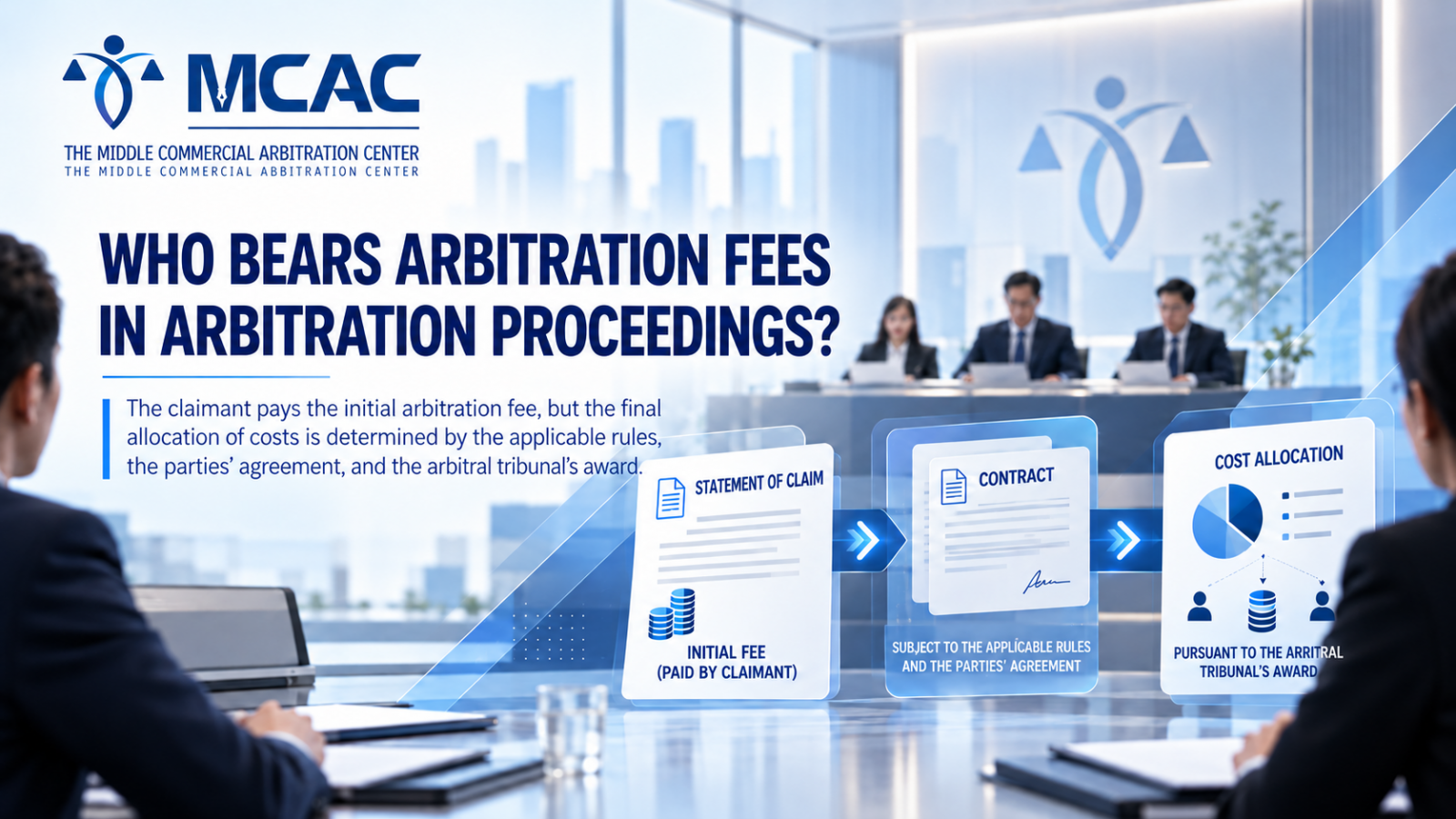
1. Who is required to pay arbitration fees initially?
Pursuant to Article 35(1) of the Arbitration Rules of the Middle Commercial Arbitration Center (MCAC), when filing a Statement of Claim, the Claimant must pay in full the arbitration costs of the Center specified in Article 34(1) and (2) of the Rules, in accordance with the Schedule of Arbitration Fees in effect at the time of filing, unless the parties agree otherwise.
If the Respondent files a counterclaim, Article 35(2) of the MCAC Arbitration Rules likewise requires the Respondent to pay these costs in full under the Schedule of Arbitration Fees in effect at the time the Counterclaim is filed, unless the parties agree otherwise.
Failure by the Claimant or Respondent to pay the required costs in full within the period prescribed by the Center will be deemed a withdrawal of the Statement of Claim or Counterclaim, respectively, under Article 35(1) and (2) of the MCAC Arbitration Rules. In the Claimant’s case, such deemed withdrawal does not affect its right to refile the claim.
Other costs falling within arbitration fees shall be advanced or paid during the proceedings in accordance with Article 35(3), (4), and (5) of the MCAC Arbitration Rules.
However, the obligation to make the initial payment of arbitration fees must be distinguished from the obligation to ultimately bear those fees after the dispute has been resolved.
2. Must the losing party bear all arbitration fees?
Under Article 34(3) of the 2010 Law on Commercial Arbitration:
“The losing party shall bear the arbitration fees, unless the parties agree otherwise, the arbitration rules provide otherwise, or the Arbitral Tribunal allocates them differently.”
Accordingly, as a general rule, the losing party must bear the arbitration fees. However, the fees may be allocated differently by agreement of the parties, under the arbitration rules, or by decision of the Arbitral Tribunal.
Furthermore, Article 36(1) of the MCAC Arbitration Rules provides that the Arbitral Tribunal shall allocate the arbitration fees unless the parties agree otherwise.
Consequently, the determination of which party must bear the arbitration fees, and in what proportion, is made on the basis of the applicable provisions, the parties’ agreement, and the outcome of the dispute.
The allocation of arbitration fees and other related costs must be specified in the Arbitral Award pursuant to Article 61(1)(h) of the 2010 Law on Commercial Arbitration.
3. Can the prevailing party recover arbitration fees already paid?
Where the Claimant has paid arbitration fees and the Arbitral Tribunal upholds all of its claims, the Tribunal may order the losing party to bear the entire arbitration fees and reimburse the Claimant for the fees it has paid, subject to the general rule and exceptions set out in Section 2.
Example: Company A initiates arbitration against Company B at MCAC to recover a contractual debt and pays VND 50 million in arbitration fees.
Having considered the case, the Arbitral Tribunal upholds all of Company A’s claims and orders Company B to bear the full arbitration fees and reimburse Company A for the VND 50 million it has paid.
In this case, Company B is obliged to reimburse Company A for the arbitration fees paid by Company A, as ordered in the Arbitral Award.
Reimbursement between the parties pursuant to an Arbitral Award must be distinguished from a refund by the Center under its Schedule of Arbitration Fees. Prevailing in a case does not automatically give rise to an obligation on the part of the Center to refund fees.
Conversely, if all of the claims are rejected, the Claimant must, in principle, bear the arbitration fees, subject to the alternative allocations described in Section 2.
Where only part of the claims is upheld, the Arbitral Tribunal may consider allocating arbitration fees between the parties in light of the outcome and the specific circumstances of the dispute, unless the parties agree otherwise. The above provisions do not prescribe any fixed allocation ratio corresponding to the portions of the claims that are upheld or rejected.
4. What should businesses keep in mind regarding arbitration fees?
To better prepare for dispute resolution, businesses should pay attention to the following:
- Determine payment obligations: Review the Schedule of Arbitration Fees in force when the claim is filed, the fees payable or to be advanced, and the deadlines stated in the Center’s notices.
- Agree on the allocation of fees: Parties may stipulate in their contracts who will be responsible for arbitration fees if a dispute arises.
- Prepare sufficient legal grounds and evidence: Clearly formulate the claims and the request for reimbursement of arbitration fees paid; submit supporting documents and proof of payment for the Arbitral Tribunal’s consideration.
Conclusion
As a general rule, the losing party bears the arbitration fees. However, the fees may be allocated differently by agreement of the parties, under the arbitration rules, or by decision of the Arbitral Tribunal.
At MCAC, the Arbitral Tribunal allocates arbitration fees in accordance with the Center’s Arbitration Rules, unless the parties agree otherwise. Businesses should therefore distinguish between the obligation to pay fees initially and the obligation to bear fees under the Arbitral Award, so that they can proactively protect their lawful rights and interests in dispute resolution.
Related news
WHICH LAW GOVERNS AN ARBITRATION AGREEMENT IN A CONTRACT WITH FOREIGN ELEMENTS?
In international commercial transactions, parties often agree on the law governing their contract and on arbitration as the method of dispute resolution. However, does the law governing the contract automatically govern the arbitration agreement? If the parties have not agreed on the applicable law, which country's law is used to determine the validity of the arbitration agreement?
MAY A COURT RE-EXAMINE THE MERITS OF A DISPUTE WHEN CONSIDERING AN APPLICATION TO SET ASIDE AN ARBITRAL AWARD?
When considering an application to set aside an arbitral award, is the Court entitled to reassess evidence, reconsider the parties' rights and obligations, or alter the findings and decisions made by the Arbitral Tribunal?