Working hour: Monday – Friday/8AM – 5PM
|Email: contact@mcac.vn
|Hotline: (+84) 935 925 068 - 0236 3656799
| Language:



Điện thoại: (+84) 935 925 068
Language:

AMBIGUOUS ARBITRATION CLAUSES: INSIGHTS FROM DISPUTE RESOLUTION PRACTICE
01/06/2026


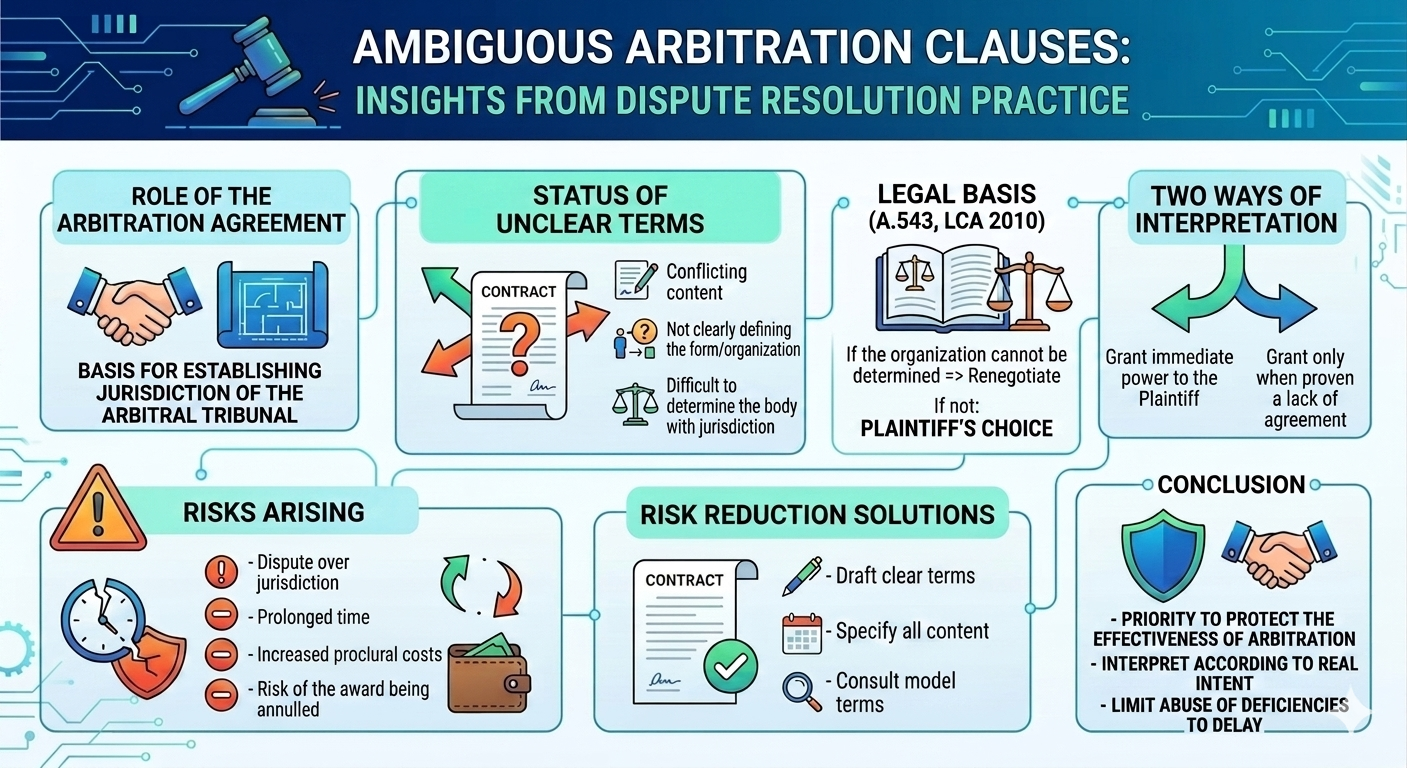
In the context of commercial arbitration increasingly establishing itself as an effective dispute resolution mechanism, an arbitration agreement serves as the legal foundation for conferring jurisdiction upon an arbitral tribunal. However, in practice, many arbitration clauses are drafted with ambiguous wording, inconsistent provisions, or language that fails to fully reflect the parties’ intentions. Such deficiencies often give rise to disputes concerning the validity of the arbitration agreement, the jurisdiction of arbitral tribunals, and the enforceability of arbitral awards.
1. What Constitutes an Ambiguous Arbitration Agreement?
An ambiguous arbitration agreement may be understood as an agreement in which the parties have expressed their intention to resolve disputes through arbitration, but the wording, language, or content of the agreement is contradictory, insufficiently clear, lacking in transparency, or omits essential elements necessary to identify the applicable form of arbitration or a specific arbitral institution.
2. Legal Framework and Practical Approaches to Ambiguous Arbitration Agreements
2.1. Current Legal Framework
Pursuant to Article 43.5 of the Law on Commercial Arbitration 2010:
“Where the parties have entered into an arbitration agreement but have failed to specify the form of arbitration or where a specific arbitral institution cannot be identified, the parties shall, upon the occurrence of a dispute, reach a further agreement on the form of arbitration or the specific arbitral institution for dispute resolution. If no such agreement can be reached, the choice of the form of arbitration or arbitral institution shall be made at the claimant’s request.”
Although the law provides a mechanism for addressing situations in which an arbitration agreement fails to clearly identify the form of arbitration or the arbitral institution, there remains no specific guidance on the criteria for determining when the parties are deemed unable to reach an agreement. This ambiguity has resulted in inconsistent interpretations and approaches among commercial arbitration centers in practice.
2.2. Divergent Views on Determining the Arbitral Institution in Cases of Ambiguous Arbitration Clauses
In practice, one view holds that the above provision does not adequately reflect the realities of dispute resolution. Where the parties have failed to specify an arbitral institution from the outset, requiring them to subsequently negotiate and agree on an arbitral institution after a dispute has arisen is often impracticable, particularly when the relationship between the parties has already deteriorated.
Where one party refuses to cooperate or deliberately delays the process, the mechanism of reaching a further agreement becomes virtually unworkable. Accordingly, proponents of this view argue that continued negotiations serve merely as a procedural formality. Instead, the requirement for further negotiation should be dispensed with, and the claimant should be granted the authority to select the arbitral institution directly, thereby ensuring a clear basis for establishing arbitral jurisdiction.
Conversely, another view maintains that Article 43.5 of the Law on Commercial Arbitration 2010 should be interpreted on the premise that the parties have already demonstrated a mutual intention to submit disputes to arbitration, notwithstanding their failure to identify a specific arbitral institution. Under this interpretation, the claimant’s right to select the arbitral institution arises only after the parties have genuinely failed to reach a supplementary agreement.
According to this approach, the inability to reach an agreement should be evidenced by the claimant having sent a notice or proposal to the respondent suggesting a specific arbitral institution within a reasonable period, without receiving any response or receiving a response that does not indicate mutual consent. In such circumstances, the authority to determine the arbitral institution would then vest in the claimant.
2.3. Practical Risks and Procedural Challenges
The existence of ambiguous arbitration clauses may also result in a range of adverse consequences during arbitral proceedings. First, disputes may incur significant delays and additional costs when one party exploits the ambiguity of the clause to challenge the tribunal’s jurisdiction and thereby prolong the proceedings.
In practice, the objecting party often raises jurisdictional objections before the arbitral tribunal and subsequently petitions the court for review pursuant to Article 44 of the Law on Commercial Arbitration 2010. As a result, substantial time and resources may be expended merely to determine the competent dispute resolution body.
Furthermore, ambiguous arbitration clauses increase the risk that an arbitral award may be set aside under Article 68 of the Law on Commercial Arbitration 2010 if a court determines that the arbitral tribunal interpreted the arbitration agreement beyond the parties’ actual intentions or asserted jurisdiction without a reasonable legal basis.
To mitigate the risks arising from ambiguous arbitration agreements, parties are advised to refer to model arbitration clauses published by reputable arbitral institutions when drafting contracts. Such model clauses are typically drafted with precision and clearly identify the arbitral institution, applicable procedural rules, number of arbitrators, seat of arbitration, and governing law.
In this regard, the model arbitration clause issued by the Central Commercial Arbitration Center (MCAC) may serve as a useful reference for businesses in the contract drafting process.
CONCLUSION
Ambiguous arbitration clauses remain a common issue in commercial practice and may give rise to complex legal consequences. Nevertheless, contemporary arbitration law generally favors preserving the validity of arbitration agreements by interpreting them in accordance with the parties’ true intentions and applying the principle of effectiveness (or the principle of validity-preserving interpretation).
This approach helps prevent parties from exploiting drafting deficiencies as a means of delaying proceedings, while simultaneously promoting legal certainty and stability in commercial transactions.
Related news

WHICH LAW GOVERNS AN ARBITRATION AGREEMENT IN A CONTRACT WITH FOREIGN ELEMENTS?
In international commercial transactions, parties often agree on the law governing their contract and on arbitration as the method of dispute resolution. However, does the law governing the contract automatically govern the arbitration agreement? If the parties have not agreed on the applicable law, which country's law is used to determine the validity of the arbitration agreement?
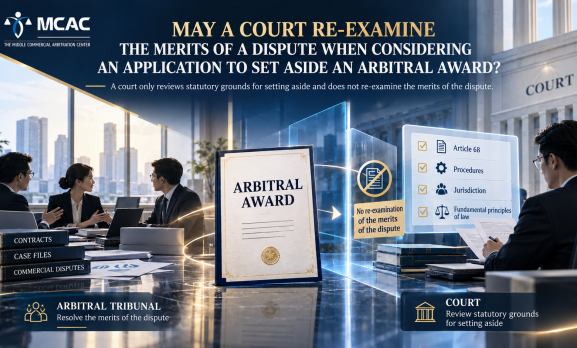
MAY A COURT RE-EXAMINE THE MERITS OF A DISPUTE WHEN CONSIDERING AN APPLICATION TO SET ASIDE AN ARBITRAL AWARD?
When considering an application to set aside an arbitral award, is the Court entitled to reassess evidence, reconsider the parties' rights and obligations, or alter the findings and decisions made by the Arbitral Tribunal?