Working hour: Monday – Friday/8AM – 5PM
|Email: contact@mcac.vn
|Hotline: (+84) 935 925 068 - 0236 3656799
| Language:



Điện thoại: (+84) 935 925 068
Language:

CAN THE EXCHANGE OF A STATEMENT OF CLAIM AND A STATEMENT OF DEFENCE GIVE RISE TO AN ARBITRATION AGREEMENT?
16/07/2026


An arbitration agreement constitutes the legal basis for establishing the jurisdiction of an Arbitral Tribunal. In practice, such an agreement is commonly made in the form of an arbitration clause contained in a contract or a separate agreement concluded either before or after a dispute arises.
However, there are many cases where the contract contains no arbitration clause, the arbitration clause fails to clearly identify the arbitral institution, or a disagreement arises as to the existence of an arbitration agreement. In such circumstances, a legal question arises: Can the exchange of a Statement of Claim and a Statement of Defence during the arbitral proceedings give rise to or establish an arbitration agreement?
1. Legal basis
Under Article 5 of the Law on Commercial Arbitration 2010 (the “LCA”), a dispute may only be resolved by arbitration where the parties have an arbitration agreement. Therefore, determining the existence of an arbitration agreement is a prerequisite for the Arbitral Tribunal to establish its jurisdiction over the dispute.
Clause 2, Article 16 of the LCA provides that an arbitration agreement must be made in writing. Point dd of Clause 2 of this Article recognises a particular form of arbitration agreement:
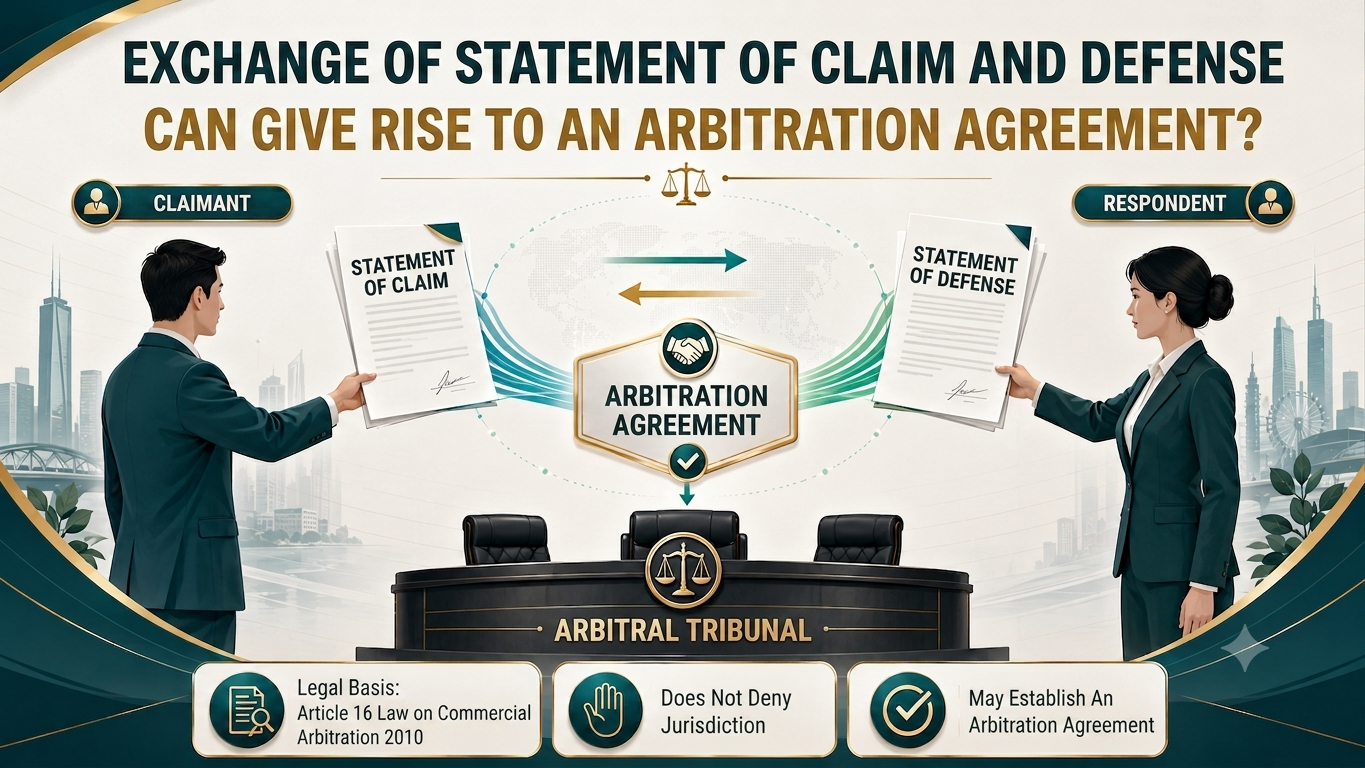
“An exchange of a statement of claim and a statement of defence in which the existence of an agreement alleged by one party is not denied by the other party.”
This provision demonstrates that Vietnamese law recognises the possibility that the parties may establish or acknowledge the existence of an arbitration agreement during the dispute resolution process through the exchange of a Statement of Claim and a Statement of Defence.
2. Conditions under which the exchange of a Statement of Claim and a Statement of Defence may constitute an arbitration agreement
Not every case in which the Claimant submits a Statement of Claim and the Respondent submits a Statement of Defence will give rise to an arbitration agreement. For Point dd, Clause 2, Article 16 of the LCA to apply, there must be a meeting of the parties’ intentions as demonstrated through their exchange of procedural documents.
First, one party must clearly assert the existence of an arbitration agreement. Such assertion may refer to an arbitration clause in a contract, correspondence, emails or other documents demonstrating that the parties agreed to select arbitration as the method of dispute resolution. The Claimant’s unilateral submission of a Statement of Claim to an arbitral institution, without evidence of the Respondent’s consent, is insufficient to establish the jurisdiction of the arbitral tribunal.
In addition, the other party must not deny the existence of the arbitration agreement. However, whether the other party has failed to deny the agreement should not be assessed solely on the basis of the contents of the Statement of Defence. The Respondent’s conduct throughout the arbitral proceedings must also be considered. For example, the Respondent may refrain from objecting to the jurisdiction of the Arbitral Tribunal, participate in the appointment or selection of an arbitrator, submit arguments on the merits of the dispute, attend hearings or take other actions demonstrating its acceptance of arbitration as the method of dispute resolution.
Conversely, where the Respondent promptly objects to the existence, validity or enforceability of the arbitration agreement, the mere fact that the Respondent has submitted a Statement of Defence or otherwise participated in the proceedings cannot, by itself, justify the conclusion that an arbitration agreement has been established.
3. Judicial practice
In a case involving an application to set aside an arbitral award, the parties had initially agreed to resolve their dispute before a particular arbitral institution. However, before the dispute arose, that arbitral institution had ceased operations and had no successor institution.
After the dispute arose, the Claimant proposed that the dispute be referred to another arbitration centre. Throughout the proceedings, the Respondent did not object to the selection of that arbitration centre, did not request the selection of a different arbitral institution and continued to participate in the proceedings. At the hearing, the Respondent also expressly confirmed that it had no objection to the jurisdiction of the Arbitral Tribunal.
After the Arbitral Tribunal rendered its award, the Respondent applied to the Court to set aside the award on the ground that the Arbitral Tribunal lacked jurisdiction over the dispute.
Having comprehensively assessed the arbitral proceedings and the documents contained in the case file, the Court found that the Claimant’s proposal to resolve the dispute before the new arbitration centre, together with the Respondent’s failure to deny that proposal and its continued participation in the proceedings without objecting to the jurisdiction of the Arbitral Tribunal, demonstrated a meeting of the parties’ intentions to refer the dispute to arbitration.
Accordingly, the Court determined that the parties had established an arbitration agreement pursuant to Point dd, Clause 2, Article 16 of the LCA and rejected the Respondent’s application to set aside the arbitral award.
This case demonstrates that, when determining the existence of an arbitration agreement, the Court does not rely solely on a single document. Instead, it conducts an overall assessment of the parties’ exchanges, the contents of their procedural submissions and their conduct throughout the dispute resolution process.
Accordingly, the existence of an arbitration agreement does not depend exclusively on the form of a particular document. Rather, it depends on a comprehensive assessment of the parties’ intentions as consistently demonstrated throughout the arbitral proceedings.
4. Conclusion
In certain circumstances, the exchange of a Statement of Claim and a Statement of Defence may constitute a basis for establishing or acknowledging the existence of an arbitration agreement, provided that the conditions outlined above are satisfied.
To minimise disputes concerning jurisdiction, parties should draft clear and comprehensive arbitration clauses at the time of entering into their contracts. They should also maintain a consistent position throughout the arbitral proceedings.
Any objection to or acceptance of arbitral jurisdiction should be expressed promptly and clearly and should comply with the provisions of the Law on Commercial Arbitration, thereby avoiding subsequent disputes concerning the existence or validity of the arbitration agreement.
The article above has analyzed in detail is "CAN THE EXCHANGE OF A STATEMENT OF CLAIM AND A STATEMENT OF DEFENCE GIVE RISE TO AN ARBITRATION AGREEMENT? ". For more detailed information or legal assistance, please contact the MCAC Secretariat:
- Hotline: 0935 925 068 - 0236 3656799
- Email: contact@mcac.vn
- Read more:WHAT CAN THE SUCCESSFUL PARTY DO IF THE OTHER PARTY FAILS TO COMPLY WITH AN ARBITRAL AWARD?
Related news

WHICH LAW GOVERNS AN ARBITRATION AGREEMENT IN A CONTRACT WITH FOREIGN ELEMENTS?
In international commercial transactions, parties often agree on the law governing their contract and on arbitration as the method of dispute resolution. However, does the law governing the contract automatically govern the arbitration agreement? If the parties have not agreed on the applicable law, which country's law is used to determine the validity of the arbitration agreement?
MAY A COURT RE-EXAMINE THE MERITS OF A DISPUTE WHEN CONSIDERING AN APPLICATION TO SET ASIDE AN ARBITRAL AWARD?
When considering an application to set aside an arbitral award, is the Court entitled to reassess evidence, reconsider the parties' rights and obligations, or alter the findings and decisions made by the Arbitral Tribunal?