Working hour: Monday – Friday/8AM – 5PM
|Email: contact@mcac.vn
|Hotline: (+84) 935 925 068 - 0236 3656799
| Language:



Điện thoại: (+84) 935 925 068
Language:

10 COMMON LATIN TERMS IN INTERNATIONAL ARBITRATION
21/07/2026


For ease of reference and research into certain Latin terms used in international commercial arbitration, MCAC presents in this article 10 commonly used Latin terms in international commercial arbitration, compiled and introduced by Lawyer and Arbitrator Kieu Anh Vu.
1. Ad hoc
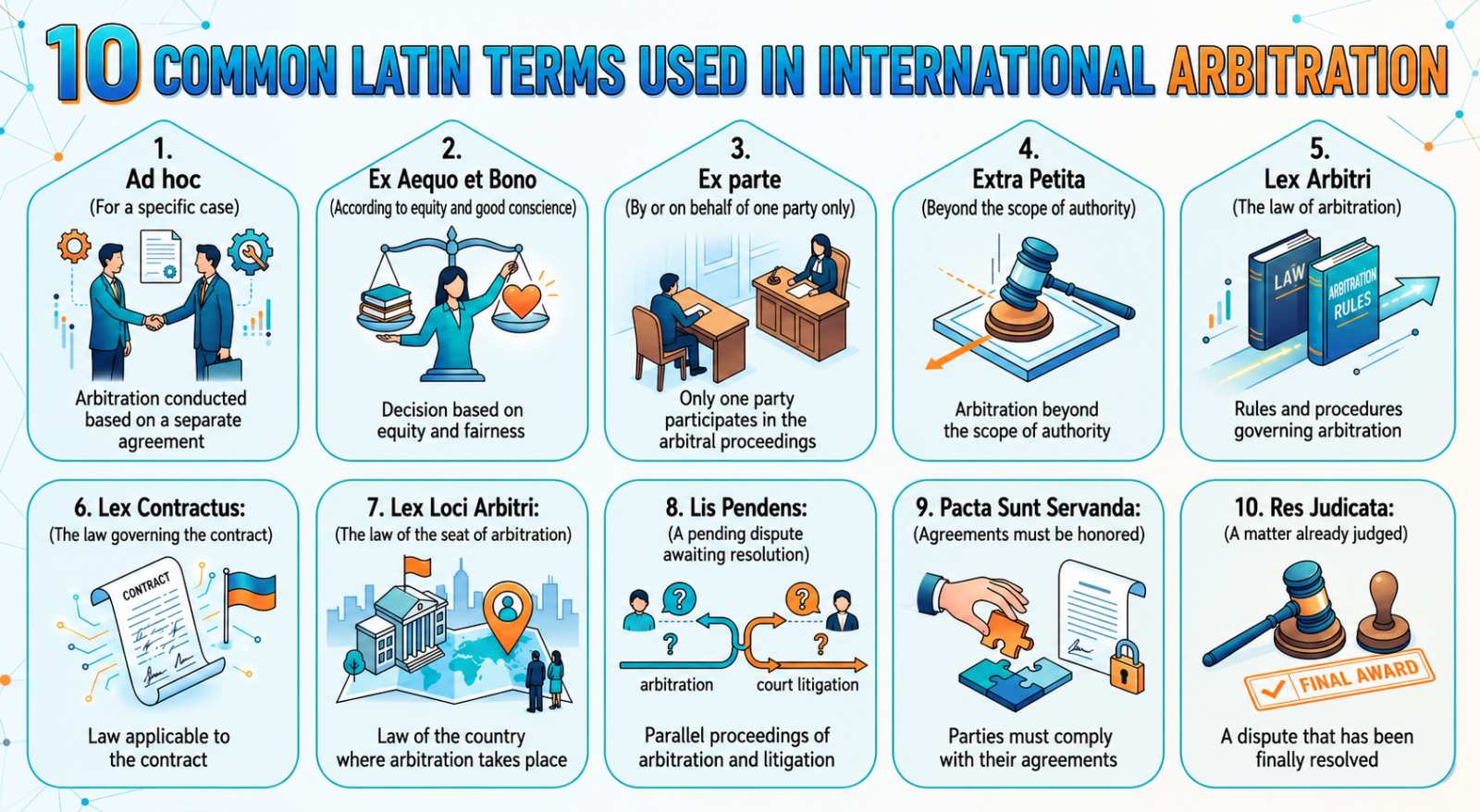
“For this particular purpose” or “for a specific case.” This term refers to a form of arbitration—ad hoc arbitration—that is conducted entirely in accordance with the procedures agreed upon by the parties, generally without the administration of an arbitral institution, as opposed to institutional arbitration.
2. Ex Aequo et Bono
“According to what is equitable and good.” This concept refers to the parties’ authorization of the Arbitral Tribunal to decide a dispute on the basis of fairness and equity rather than through the strict application of legal rules.
3. Ex Parte
“By or for one party.” This term refers to a situation in which only one party participates in the arbitral proceedings. For example, where the respondent does not participate throughout the arbitration and only the claimant takes part, the proceedings may be described as ex parte proceedings.
4. Extra Petita
A situation in which the Arbitral Tribunal decides matters or grants relief beyond the scope of the parties’ claims or requests.
5. Lex Arbitri
The law governing the procedural or formal aspects of the arbitral proceedings.
6. Lex Contractus
The law applicable to and governing the contract, also known as the substantive law of the contract.
7. Lex Loci Arbitri
The law of the country or jurisdiction in which the arbitration is seated or legally conducted.
8. Lis Pendens
“A pending dispute” or “pending proceedings.” This principle seeks to prevent parallel proceedings that may result in conflicting decisions. Where a dispute is already pending before one adjudicatory body, the parties should not commence proceedings concerning the same dispute before another adjudicatory body.
9. Pacta Sunt Servanda
The principle that agreements and contracts are binding upon the parties. The parties to an agreement or contract are required to comply with and remain bound by its terms.
10. Res Judicata
“A matter already adjudicated.” This principle refers to an issue or dispute that has already been resolved or finally determined. Where a dispute has been resolved through arbitration by a final arbitral award, the same dispute may not be adjudicated again.
The article above has analyzed in detail is "10 COMMON LATIN TERMS IN INTERNATIONAL ARBITRATION ". For more detailed information or legal assistance, please contact the MCAC Secretariat:
- Hotline: 0935 925 068 - 0236 3656799
- Email: contact@mcac.vn
- Read more: CAN THE EXCHANGE OF A STATEMENT OF CLAIM AND A STATEMENT OF DEFENCE GIVE RISE TO AN ARBITRATION AGREEMENT?
Related news
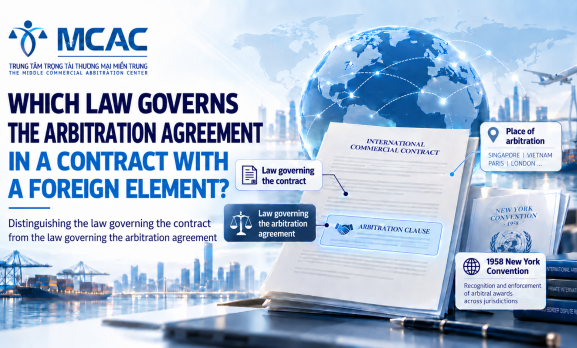
WHICH LAW GOVERNS AN ARBITRATION AGREEMENT IN A CONTRACT WITH FOREIGN ELEMENTS?
In international commercial transactions, parties often agree on the law governing their contract and on arbitration as the method of dispute resolution. However, does the law governing the contract automatically govern the arbitration agreement? If the parties have not agreed on the applicable law, which country's law is used to determine the validity of the arbitration agreement?
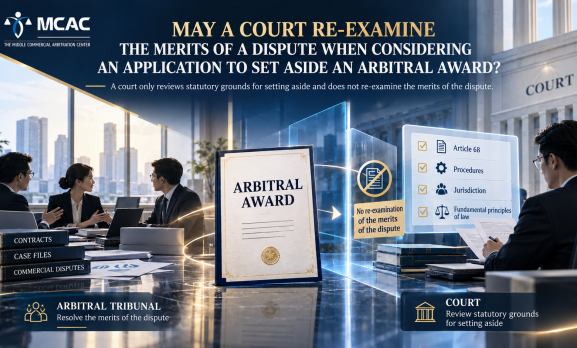
MAY A COURT RE-EXAMINE THE MERITS OF A DISPUTE WHEN CONSIDERING AN APPLICATION TO SET ASIDE AN ARBITRAL AWARD?
When considering an application to set aside an arbitral award, is the Court entitled to reassess evidence, reconsider the parties' rights and obligations, or alter the findings and decisions made by the Arbitral Tribunal?