Working hour: Monday – Friday/8AM – 5PM
|Email: contact@mcac.vn
|Hotline: (+84) 935 925 068 - 0236 3656799
| Language:



Điện thoại: (+84) 935 925 068
Language:

ARBITRATION AND COURTS: KEY DIFFERENCES AND ADVANTAGES OF ARBITRATION THAT BUSINESSES SHOULD KNOW
26/08/2026


The 2010 Law on Commercial Arbitration (LCA 2010) and related legal instruments have contributed to the development of commercial arbitration as a method of dispute resolution in Vietnam.
Courts and arbitration are both methods of dispute resolution and act as adjudicative forums for the parties to a dispute. The outcomes of dispute resolution by a court or by arbitration have equivalent legal effect. Some basic similarities are as follows:
1. An arbitral award and a court judgment are both legally effective and binding on the parties; the parties are obliged to comply with them, and their enforcement is protected by the State.
2. An arbitral award is enforced in accordance with the law on enforcement of civil judgments.
3. During dispute resolution, both arbitral tribunals and judges may issue orders applying interim measures, such as prohibiting changes to the status quo of disputed property, attaching disputed property, or prohibiting the transfer of property rights in respect of disputed property.
Should businesses therefore choose court litigation or arbitration for their contractual dispute resolution clauses or once a dispute has arisen?
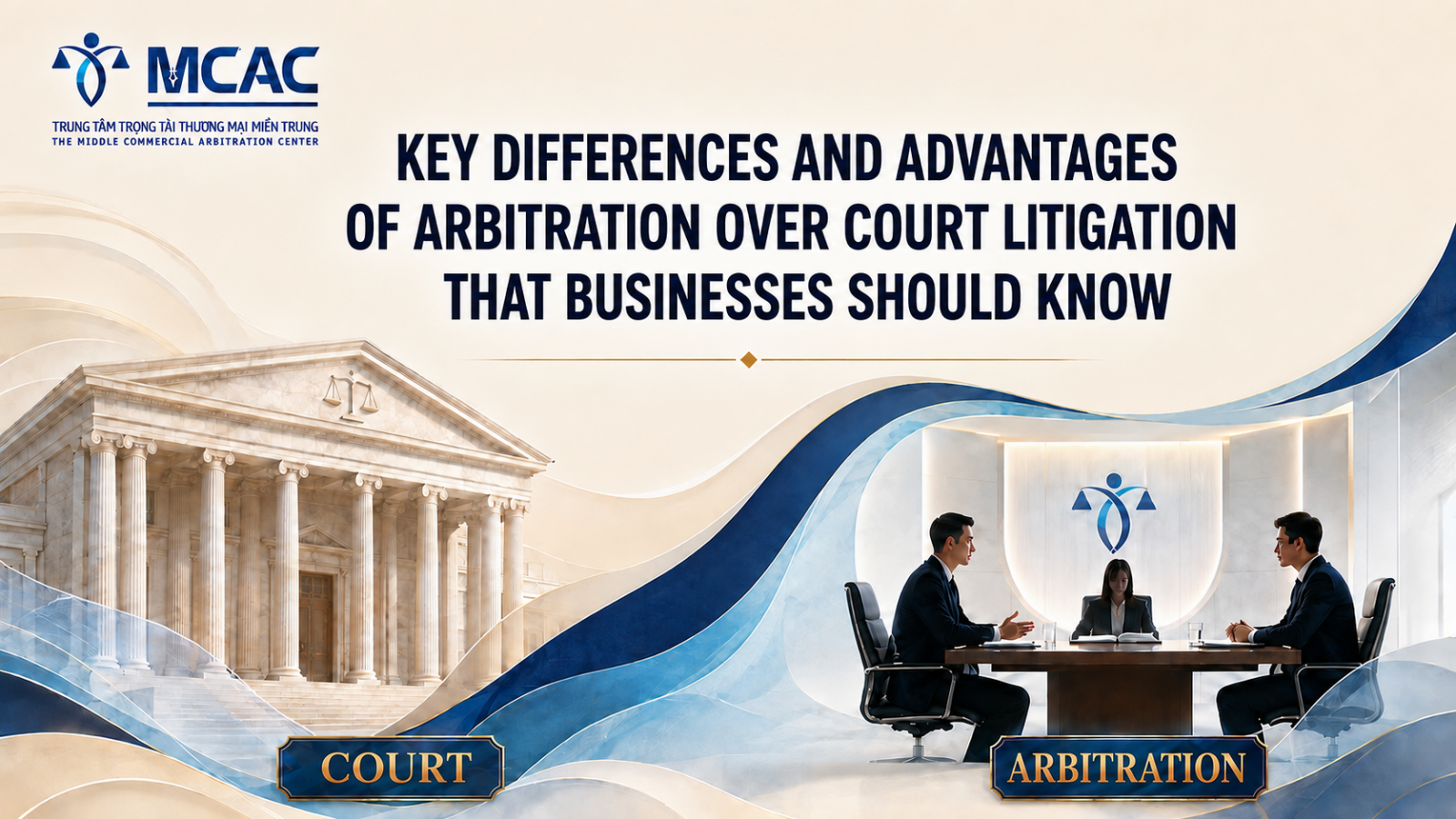
What distinguishes arbitration as a dispute resolution method that has been developed by the international community over centuries and embraced by Vietnam as a growing trend in recent decades?
By comparing Vietnamese civil procedure law and other relevant legal instruments with the LCA 2010 and its implementing instruments, and by reference to the Arbitration Rules of the Mien Trung Commercial Arbitration Center (the MCAC Arbitration Rules), this article highlights several significant differences between court proceedings and arbitral proceedings.
COMPARISON OF COURT AND ARBITRAL PROCEEDINGS
|
ISSUE |
COURT PROCEEDINGS |
ARBITRAL PROCEEDINGS |
|
Respondent's address and service of documents |
Statutory requirements: The Claimant must fully and accurately state the Respondent's residential address in the statement of claim and provide evidence showing that the address belongs to the Respondent. When court files and documents are served or notified, they must be delivered directly to the Respondent or through a lawful representative, with receipt acknowledged by signature. Legal basis: Articles 177 and 178 of the 2015 Civil Procedure Code (CPC 2015); Article 5.1 of Resolution No. 04/2017/NQ-HDTP. In practice: If the Respondent changes address, the actual address is difficult to identify, or the Respondent is absent, the Court may return the statement of claim, terminate the proceedings, or carry out numerous procedures through other authorities and organizations, thereby extending the resolution time. |
Law and Arbitration Rules: The Respondent's address is determined from the address stated in the contract or transaction, or an address provided by the parties to the arbitration center or arbitral tribunal. Procedural documents are deemed sent when received directly by the Respondent or its representative, or when sent to a party's address with valid confirmation of dispatch. Legal basis: Article 12 of the LCA 2010; Articles 3.2 and 3.3 of the MCAC Arbitration Rules. In practice: This facilitates the work of the Claimant and the arbitral tribunal and addresses attempts by the Respondent to avoid participating in hearings. |
|
Venue |
Under the CPC 2015, a dispute is resolved by the Court where the Respondent resides, works, or has its registered office; in certain cases, if the parties so agree, it may be resolved where the Claimant resides, works, or has its registered office. Disputes concerning immovable property fall within the jurisdiction of the Court where the property is located. Legal basis: Article 39 of the CPC 2015. In practice: If the Claimant is located far from the Respondent, additional time and costs will arise. If the Respondent has no clearly identifiable place of residence or work, determining the appropriate venue may be difficult. |
Hearings may be held at the arbitration center's premises, at another suitable venue, or at any place agreed by the parties. Legal basis: Article 11.1 of the LCA 2010; Article 22 of the MCAC Arbitration Rules. In practice: The arbitral tribunal may arrange hearings based on the parties' agreement or practical convenience, and the venue may be changed as circumstances require. |
|
Adjudicators |
Judges and People's Jurors are designated and assigned by the Chief Judge of the Court. Legal basis: Article 47.1 of the CPC 2015. |
Arbitrators are selected by the parties; if the parties do not make a selection, they may request the arbitration center to make the appointment. Legal basis: Article 40 of the LCA 2010; Article 12 of the MCAC Arbitration Rules. |
|
Resolution time |
First instance: 4-6 months (Article 203 of the CPC 2015). Appeal: 4-5 months (Article 286 of the CPC 2015). In addition, a Court may temporarily suspend a case without a fixed time limit, and a judgment may subsequently be reviewed under cassation or reopening procedures. In practice: Business and commercial disputes may continue for several years. |
Generally, 3-4 months from the commencement of proceedings until an award is issued. Legal basis: Articles 32-61 of the LCA 2010; Articles 10, 12, 13, 25, 26, and 32 of the MCAC Arbitration Rules. In practice: Arbitration centers prioritize prompt resolution and apply procedures flexibly to ensure efficiency. |
|
Expedited procedure |
A Court applies the expedited procedure only when the case satisfies the statutory conditions. The time may be reduced to three months at first instance and three months on appeal. Legal basis: Articles 191, 203, 286, 317, 318, 322, and 323 of the CPC 2015. In practice: The procedure is rarely applied, and specific guidance is lacking for many situations. Some judgments have been set aside because the applicable conditions were assessed inconsistently. |
The parties may agree to use an expedited procedure to shorten the resolution time. Legal basis: Article 3.6 of the LCA 2010; Article 37 of the MCAC Arbitration Rules. Many straightforward disputes administered by arbitration centers under an expedited procedure are resolved in approximately 40 days. |
|
Language of proceedings |
Vietnamese is the sole language of court proceedings. Legal basis: Article 20 of the CPC 2015. In practice: In disputes involving foreign elements, foreign-language documents may cause difficulties for the Court and the parties. |
Vietnamese is used; for disputes involving foreign elements, the parties may agree on the language of the proceedings. Legal basis: Article 10.2 of the LCA 2010; Article 23 of the MCAC Arbitration Rules. In practice: Arbitrators who are proficient in multiple languages facilitate the resolution of disputes. |
|
Levels of adjudication |
There are multiple levels of adjudication: first instance and appeal; judgments may also be reviewed under cassation or reopening procedures. Multiple stages of adjudication may prolong the resolution process. |
A dispute is adjudicated only once. An arbitral award is final and enforceable and is not subject to appeal or protest. This helps limit the parties' time and costs. |
|
Confidentiality |
Public hearings are a governing principle of court proceedings. Legal basis: Article 15 of the CPC 2015. Courts publish judgments on the website congbobanan.toaan.gov.vn. Publication may disclose trade secrets or adversely affect a business's reputation. |
Not open to the public. Legal basis: Article 4.4 of the LCA 2010; Article 25 of the MCAC Arbitration Rules. Arbitral proceedings preserve the confidentiality of case files, documents, and information. Arbitral awards are not published or made available to the media. |
|
Court costs and arbitration fees |
Court costs are specifically and uniformly prescribed by Resolution No. 326/2016/UBTVQH14. Court costs are generally lower than arbitration fees; however, if proceedings are prolonged, involve multiple levels of adjudication, or take place in different locations, the total cost may be higher. |
Arbitration fees are publicly disclosed in each arbitration center's fee schedule. They are generally higher than court costs but can be budgeted transparently and may help reduce other expenses. |
|
Reimbursement when the Claimant prevails |
If the Claimant prevails and there is no agreement to the contrary, the advance payment of court costs is refunded by the civil judgment enforcement authority in accordance with statutory procedures. Legal basis: Article 144 of the CPC 2015; Article 126 of the Law on Enforcement of Civil Judgments (as amended in 2014). Direct reimbursement by the civil judgment enforcement authority may give rise to practical procedural difficulties. |
The arbitration center does not directly refund the advance payment of arbitration fees to the Claimant; the Respondent is obliged to reimburse the Claimant. Legal basis: Article 34.3 of the LCA 2010. This amount is included in the Respondent's payment obligations. Businesses should also consider efficiency in terms of time, travel expenses, and legal fees. |
|
Setting aside judgments and awards |
A first-instance judgment may be set aside and remanded for retrial at the appellate level; an appellate judgment may be set aside under cassation or reopening procedures. Persons entitled to request a review include the Claimant, the Respondent, and competent officials of the People's Procuracy or the Court. Legal basis: Articles 308, 310, 311, 326, 331, 343, 345, 356, etc. of the CPC 2015. A judgment may be set aside for procedural violations, an incorrect determination on the merits, or misapplication of the law, and may be set aside more than once. |
A provincial-level Court may review an application to set aside an arbitral award primarily on grounds relating to procedure, the arbitration agreement, or the constitution of the arbitral tribunal. The Court does not rehear the merits of the dispute, except where fundamental principles of Vietnamese law have been violated. Time limit for resolution: 40 days, by a petition review panel composed of three judges. Legal basis: Article 4.4 of the LCA 2010; Article 414.3 of the CPC 2015. |
|
International enforceability |
Civil and commercial judgments of Vietnamese Courts may be recognized and enforced abroad where Vietnam has concluded a bilateral mutual judicial assistance treaty with the relevant country. Official Dispatch No. 33/TANDTC-HTQT dated 17 March 2021 of the Supreme People's Court refers to treaties concerning civil and commercial matters with countries including Algeria, France, Cambodia, and Hungary. |
Vietnam acceded in 1995 to the 1958 New York Convention on the Recognition and Enforcement of Foreign Arbitral Awards. Accordingly, arbitral awards may be recognized and enforced in member states under the Convention's framework, facilitating the resolution of disputes involving foreign elements. |
OBSERVATIONS
Once issued, a Vietnamese commercial arbitral award is not only effective in the same manner as a court judgment but may also be recognized and enforced internationally under treaties to which Vietnam is a party. Arbitral proceedings follow statutory procedures to ensure due process while remaining flexible, shortening the time required for dispute resolution and giving maximum effect to the parties' agreement and cooperation.
In light of the features presented and compared above, the author hopes that commercial arbitration will be an appropriate choice for parties engaged in business, commercial activities, and civil transactions, helping to reduce confrontation and advance the shared goal of development.
Related news
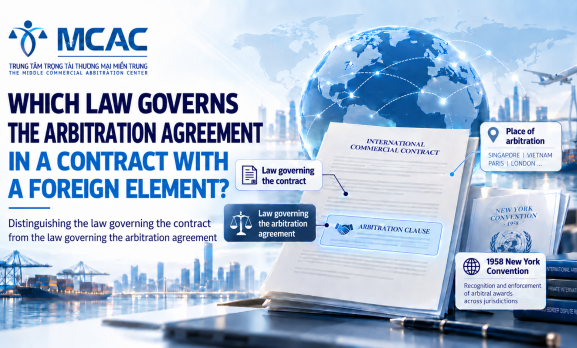
WHICH LAW GOVERNS AN ARBITRATION AGREEMENT IN A CONTRACT WITH FOREIGN ELEMENTS?
In international commercial transactions, parties often agree on the law governing their contract and on arbitration as the method of dispute resolution. However, does the law governing the contract automatically govern the arbitration agreement? If the parties have not agreed on the applicable law, which country's law is used to determine the validity of the arbitration agreement?
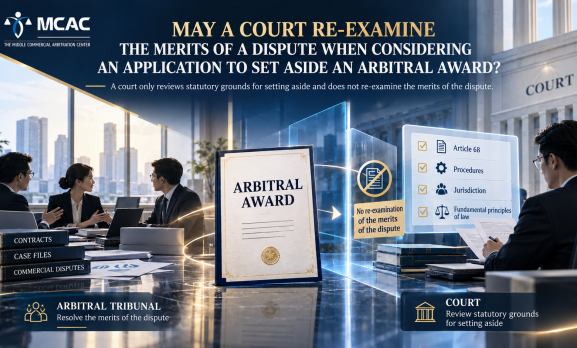
MAY A COURT RE-EXAMINE THE MERITS OF A DISPUTE WHEN CONSIDERING AN APPLICATION TO SET ASIDE AN ARBITRAL AWARD?
When considering an application to set aside an arbitral award, is the Court entitled to reassess evidence, reconsider the parties' rights and obligations, or alter the findings and decisions made by the Arbitral Tribunal?