Working hour: Monday – Friday/8AM – 5PM
|Email: contact@mcac.vn
|Hotline: (+84) 935 925 068 - 0236 3656799
| Language:



Điện thoại: (+84) 935 925 068
Language:

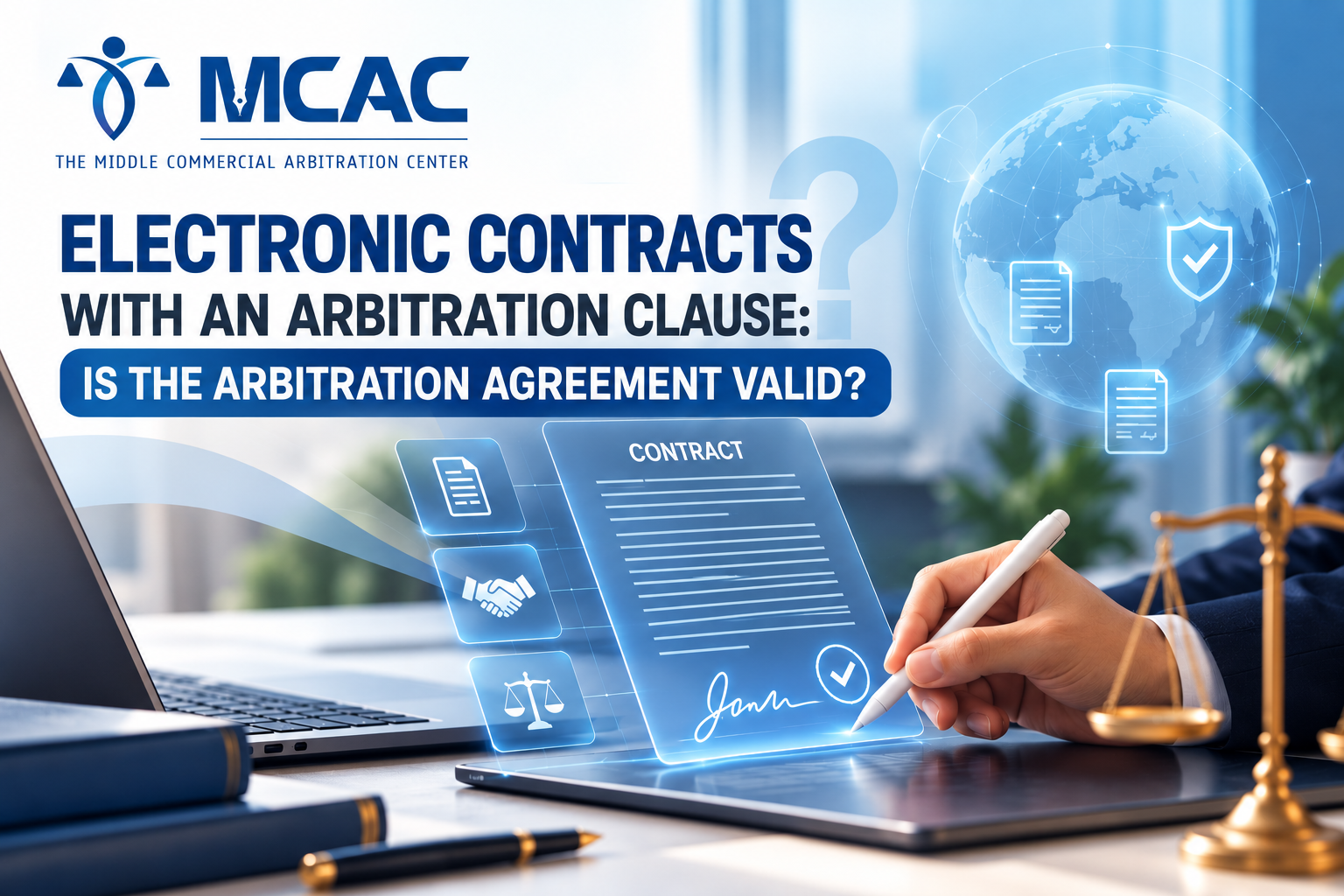
ARBITRATION CLAUSES IN ELECTRONICALLY SIGNED CONTRACTS: ARE ARBITRATION AGREEMENTS VALID?
12/10/2026


With the development of electronic transactions, commercial contracts concluded using electronic signatures, digital signatures, email or other electronic means have become increasingly common. Such contracts may contain an agreement between the parties to resolve disputes arising out of or in connection with the contract by arbitration.
The question is whether, where a contract is concluded electronically rather than signed in ink on paper, the arbitration clause contained in that contract satisfies the formal requirements and has legal effect.
1. Form of Arbitration Agreements under Vietnamese Law
Article 16(1) of the 2010 Law on Commercial Arbitration (LCA) provides that an arbitration agreement may take the form of an arbitration clause in a contract or a separate agreement.
Article 16(2) of the LCA requires arbitration agreements to be made in writing. The following forms are also deemed to constitute arbitration agreements in writing:
- An agreement established through exchanges between the parties by telegram, fax, telex, email or other forms prescribed by law;
- An agreement established through an exchange of written information between the parties;
- An agreement recorded in writing by a lawyer, notary public or competent organization at the parties’ request;
- A transaction in which the parties refer to a document containing an arbitration agreement, such as a contract, document, company charter or other similar instrument;
- An exchange of a statement of claim and a statement of defence in which one party asserts the existence of an arbitration agreement and the other party does not deny it.
Thus, the requirement that an arbitration agreement be “in writing” does not mean that it must be made on paper and bear the parties’ handwritten signatures. Commercial arbitration law recognizes various forms of establishment, including email and other exchanges of written information.
Accordingly, the inclusion of an arbitration agreement in a contract concluded electronically does not, in itself, prevent compliance with the formal requirements under Article 16 of the LCA.
2. Legal Effect of Arbitration Clauses in Electronic Contracts
Article 8 of the 2023 Law on Electronic Transactions (LET) provides that information in a data message shall not be denied legal validity solely because it is expressed in the form of a data message.
Furthermore, Article 9(1) of the LET provides that, where the law requires information to be in writing, a data message satisfies that requirement if the information it contains is accessible and usable for subsequent reference.
These provisions demonstrate that the law on electronic transactions recognizes the legal effect of information expressed in data messages and permits such messages to meet written-form requirements where statutory conditions are satisfied.
Read together with Article 16 of the LCA, where the parties conclude a contract electronically and include an arbitration clause, that clause may satisfy the written-form requirement for arbitration agreements if the electronic contract is accessible and usable for reference.
For example, Company A and Company B conclude a sales contract through an electronic contracting platform. The contract includes the following clause:
“Any dispute arising out of or in connection with this Contract shall be resolved by arbitration at the Central Vietnam Commercial Arbitration Center (MCAC) in accordance with its Rules of Arbitration.”
Where the electronic contract is duly established and retained and can be accessed and used for reference in accordance with the law, the mere fact that the arbitration clause appears in an electronic contract is not a ground for finding that the agreement fails to satisfy the written-form requirement.
3. Use of Electronic Signatures and Digital Signatures in Concluding Arbitration Agreements
Article 16 of the LCA does not make a digital signature a mandatory condition for concluding an arbitration agreement. Instead, it expressly recognizes that arbitration agreements may be established by email and other forms of written information exchange.
Article 23(1) of the LET provides that an electronic signature shall not be denied legal validity solely because it is in electronic form. Under Article 23(2), a secure specialized electronic signature or a digital signature has legal effect equivalent to that individual’s signature on a paper document.
These provisions indicate that using a digital signature is not mandatory for an arbitration agreement to satisfy the formal requirements under Article 16 of the LCA. The absence of a digital signature therefore does not automatically render an arbitration agreement invalid.
However, in the practice of concluding electronic contracts, a signing method capable of identifying the signatory, the time of signing and the content accepted is important from an evidentiary perspective. Such data may help establish the identity of the transacting party, the process by which the contract was concluded and the parties’ consent to the arbitration clause if a dispute arises.
4. Conditions for the Validity of Arbitration Agreements in Electronic Contracts
The inclusion of an arbitration clause in an electronic contract primarily concerns the formal requirements for an arbitration agreement. Whether the agreement is valid also depends on other conditions prescribed by law.
Under Article 18 of the LCA, an arbitration agreement is invalid in the following circumstances:
- The dispute arises in a field outside the jurisdiction of arbitration under Article 2 of the LCA;
- The person entering into the arbitration agreement lacks the authority required by law;
- The person entering into the arbitration agreement lacks civil act capacity under the Civil Code;
- The form of the arbitration agreement does not comply with Article 16 of the LCA;
- One party was deceived, threatened or coerced when concluding the arbitration agreement and requests that the agreement be declared invalid;
- The arbitration agreement violates a prohibition imposed by law.
Regarding arbitration agreements concluded by unauthorized persons, Article 3 of Resolution No. 01/2014/NQ-HDTP provides guidance for situations in which an agreement is subsequently accepted by an authorized person, or that person knows of it without objecting.
This is particularly relevant to electronic transactions because the person who signs, confirms or performs an action on an electronic platform may not be the legal representative or a duly authorized person empowered to enter into an arbitration agreement.
In addition, for disputes between suppliers of goods or services and consumers, Article 17 of the LCA provides that, where an arbitration clause is included in standard terms of supply prepared by the supplier, the consumer retains the right to choose arbitration or litigation before a court. The supplier may initiate arbitration only with the consumer’s consent.
Therefore, the inclusion of an arbitration agreement in an electronic contract does not mean that it is automatically valid. Its validity must still be assessed against the statutory requirements regarding the parties, authority, capacity, consent and substance of the agreement.
5. Separability of Arbitration Agreements from Electronic Contracts
Article 19 of the LCA provides: “An arbitration agreement is entirely independent of the contract. Any modification, extension or cancellation of the contract, or the contract being invalid or incapable of performance, shall not affect the validity of the arbitration agreement.”
This provision embodies the principle that an arbitration agreement is separable from the underlying contract. Accordingly, the validity of the arbitration agreement is assessed independently of the validity of the contract containing it.
Thus, where a party alleges that an electronic contract is invalid, has been cancelled or is incapable of performance, those circumstances do not automatically invalidate the arbitration clause. However, invalidity of the underlying contract must be distinguished from whether an arbitration agreement was actually formed.
Where there are grounds to believe that an electronic signature was forged, that the person signing or confirming lacked authority, or that there is insufficient evidence of a party’s consent to the arbitration clause, the issue is not merely the validity of the underlying contract but also the existence and validity of the arbitration agreement itself.
6. Practical Considerations When Including Arbitration Clauses in Electronic Contracts
Based on the foregoing provisions, businesses concluding contracts electronically should consider the following:
- Clearly and specifically state the parties’ choice of arbitration as the method of dispute resolution;
- State the chosen arbitral institution’s full and accurate name to reduce disputes over which institution has jurisdiction;
- Verify the authority of the person signing, confirming or approving the electronic contract;
- Use a signing method that identifies the transacting person, the time of the transaction and the content accepted;
- Retain the complete electronic contract, data messages, transaction logs, confirmation emails, electronic-signature data and related documents;
- Where the arbitration agreement is contained in standard terms and conditions, an appendix or another document, ensure that the reference is sufficiently clear to establish that the document forms part of the parties’ agreement;
- For consumer contracts, observe the consumer’s right to choose the dispute resolution method under Article 17 of the LCA.
Conclusion
An arbitration clause in an electronic contract may meet the written-form requirement and have legal effect if established in accordance with Article 16 of the LCA and the law on electronic transactions.
However, the validity of the arbitration agreement must still be assessed by reference to the parties’ authority, capacity and consent, as well as the grounds for invalidity under Article 18 of the LCA.
The article above has analyzed in detail is "ARBITRATION CLAUSES IN ELECTRONICALLY SIGNED CONTRACTS: ARE ARBITRATION AGREEMENTS VALID?". For more detailed information or legal assistance, please contact the MCAC Secretariat:
- Hotline: 0935 925 068 - 0236 3656799
- Email: contact@mcac.vn
- Read more:INSTITUTIONAL OR AD HOC ARBITRATION: WHAT SHOULD BUSINESSES CONSIDER WHEN CHOOSING?
Related news
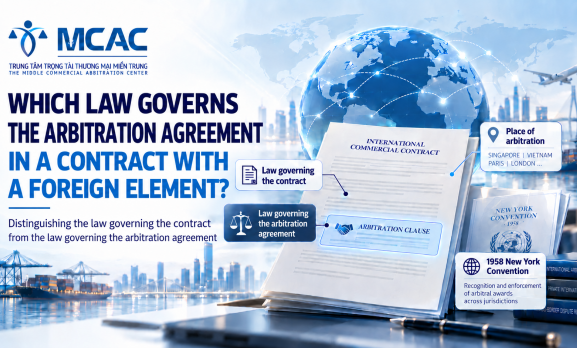
WHICH LAW GOVERNS AN ARBITRATION AGREEMENT IN A CONTRACT WITH FOREIGN ELEMENTS?
In international commercial transactions, parties often agree on the law governing their contract and on arbitration as the method of dispute resolution. However, does the law governing the contract automatically govern the arbitration agreement? If the parties have not agreed on the applicable law, which country's law is used to determine the validity of the arbitration agreement?
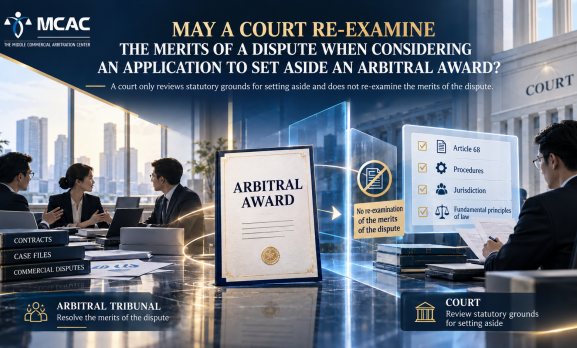
MAY A COURT RE-EXAMINE THE MERITS OF A DISPUTE WHEN CONSIDERING AN APPLICATION TO SET ASIDE AN ARBITRAL AWARD?
When considering an application to set aside an arbitral award, is the Court entitled to reassess evidence, reconsider the parties' rights and obligations, or alter the findings and decisions made by the Arbitral Tribunal?