Working hour: Monday – Friday/8AM – 5PM
|Email: contact@mcac.vn
|Hotline: (+84) 935 925 068 - 0236 3656799
| Language:



Điện thoại: (+84) 935 925 068
Language:

BENEFITS AND RISKS OF USING ARTIFICIAL INTELLIGENCE IN ARBITRATION
28/04/2026


The rapid development of Artificial Intelligence (AI) is fundamentally transforming the manner in which disputes are resolved in international commerce. In this context, the Chartered Institute of Arbitrators issued the Guideline on the Use of AI in Arbitration in 2025, with a view to establishing guiding principles for the transparent and responsible deployment of AI in arbitral proceedings.
The Guideline emphasises three core principles:
- Transparency
- Accountability
- Confidentiality
In Viet Nam, the adoption of technology in arbitration has gradually been implemented, notably through the eCase platform developed by the Vietnam International Arbitration Centre. However, the integration of AI into arbitral procedures remains limited and calls for an appropriate legal and regulatory framework.
.jpg)
1. Benefits of Using AI in Arbitration
The application of AI in arbitral proceedings offers several notable advantages, which may be summarised as follows:
- Enhancing procedural efficiency:
AI enables the automation of processes such as case management, document classification, and progress tracking, thereby reducing the time required for dispute resolution and lowering associated costs. - Improving the quality of legal research:
AI-powered tools utilising natural language processing facilitate the rapid and accurate identification and analysis of case law and legal rules, while also supporting the prediction of legal trends. - Supporting data and evidentiary analysis:
AI is capable of processing large volumes of data to identify inconsistencies, correlations, and behavioural patterns within case records, which is particularly valuable in complex disputes. - Optimising document drafting and management:
AI assists in drafting, editing, and summarising legal documents, ensuring consistency, clarity, and precision in legal reasoning. - Facilitating multilingual proceedings:
AI can perform document translation and real-time interpretation, thereby reducing language barriers in international disputes. - Enhancing predictive capabilities and strategic planning:
AI supports the assessment of the likelihood of success of legal arguments and the prediction of dispute outcomes, assisting parties in making informed decisions. - Contributing to equality of arms:
Access to AI tools at a reasonable cost may enable parties with limited resources to strengthen their advocacy capabilities, thereby narrowing disparities in resources.
2. Legal Risks Associated with the Use of AI in Arbitration
Notwithstanding its benefits, the use of AI in arbitration also raises a number of legal risks that must be properly identified and managed:
- Risks to the validity and enforceability of arbitral awards:
Improper use of AI may result in breaches of procedural rules or the principle of due process, thereby exposing the award to the risk of annulment or refusal of recognition and enforcement. - Confidentiality risks:
The use of third-party AI tools may give rise to data leakage, unauthorised access, or use of data beyond its intended purpose, potentially undermining the confidentiality inherent in arbitral proceedings. - Cybersecurity and data integrity risks:
AI systems may become targets of cyberattacks, compromising the integrity and reliability of evidence. - Algorithmic bias and impact on independence:
AI systems may reflect biases embedded in training data, which could influence analytical outputs and, indirectly, the decision-making process of arbitrators. - Due process concerns:
Uncontrolled use of AI may impair the parties’ rights to present their case and to respond, thereby affecting the fairness of the proceedings. - “Black box” problem:
The lack of transparency in AI systems may hinder verification, explanation, and justification of outcomes or recommendations generated by such systems. - Divergence of legal frameworks across jurisdictions:
The absence of harmonised regulations on AI at the international level may lead to conflicts of laws and affect procedural strategies. - Environmental considerations:
The operation of AI systems requires substantial energy consumption, raising concerns regarding sustainability in modern arbitral practice.
3. Recommendations for Viet Nam
In light of the opportunities and challenges outlined above, the development of an appropriate approach to the use of AI in arbitration is becoming increasingly necessary in Viet Nam.
3.1. Establishing a Legal Framework for AI in Arbitration
- Promulgating regulations governing the scope and conditions for the use of AI in arbitral proceedings;
- Clearly defining the responsibilities of parties and arbitrators when using AI;
- Integrating AI-related provisions into arbitration legislation or implementing guidelines.
3.2. Developing Ethical and Professional Standards
- Establishing guidelines or codes of conduct on the use of AI for arbitrators;
- Requiring disclosure of AI use in arbitral proceedings;
- Ensuring transparency and accountability.
3.3. Strengthening Data Protection and Cybersecurity
- Applying high-level security standards to AI systems;
- Encouraging the use of internal AI tools or systems with strict data control mechanisms;
- Clearly allocating liability in cases of data breaches.
3.4. Enhancing Capacity of the Arbitration Community
- Providing training for arbitrators and counsel on the use and assessment of AI;
- Raising awareness of the legal and ethical risks associated with AI;
- Promoting interdisciplinary integration between legal expertise and technology.
3.5. Aligning with International Standards
- Referring to guidelines issued by the Chartered Institute of Arbitrators;
- Drawing on best practices from leading international arbitral institutions;
- Gradually developing a digital arbitration ecosystem in Viet Nam.
Conclusion
The application of Artificial Intelligence in arbitration represents an inevitable trend in the context of global digitalisation. While AI offers significant benefits in terms of efficiency and quality of dispute resolution, it also raises substantial legal risks.
Accordingly, the use of AI should be approached with caution, subject to appropriate controls, and aligned with the fundamental principles of arbitral procedure, in order to ensure fairness, transparency, and the overall effectiveness of arbitration as a dispute resolution mechanism.
The article above has analyzed in detail is "Benefits and risks of using artificial Intelligence in Arbitration". For more detailed information or legal assistance, please contact the MCAC Secretariat:
- Hotline: 0935 925 068 - 0236 3656799
- Email: contact@mcac.vn
- Read more: Consolidation of multiple disputes in commercial arbitration
Related news

WHAT DOCUMENTS MUST ACCOMPANY A STATEMENT OF CLAIM FILED WITH AN ARBITRATION CENTER?
When initiating arbitration proceedings, properly preparing the Statement of Claim together with the accompanying documents and evidence is an important first step. The Statement of Claim sets out the Claimant’s requests; however, in order for the arbitration center to process the case and for the Arbitral Tribunal to have sufficient grounds to resolve the dispute, the Claimant should also submit documents establishing the Tribunal’s jurisdiction, the disputed legal relationship, and the basis for each claim.
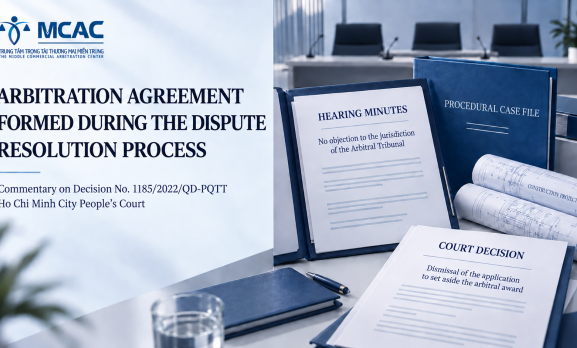
ARBITRATION AGREEMENT ARISING DURING THE DISPUTE RESOLUTION PROCESS: COMMENTARY ON DECISION NO. 1185/2022/QĐ-PQTT OF THE PEOPLE'S COURT OF HO CHI MINH CITY
An arbitration agreement serves as the basis for determining the jurisdiction of arbitration to resolve disputes. Under the Law on Commercial Arbitration, an arbitration agreement may be entered into either before or after a dispute arises and must be made in a form compliant with applicable law. Decision No. 1185/2022/QĐ-PQTT dated 29 July 2022 of the People’s Court of Ho Chi Minh City concerns the determination of an arbitration agreement during the dispute resolution process and the parties’ right to object to the jurisdiction of the Arbitral Tribunal.