Working hour: Monday – Friday/8AM – 5PM
|Email: contact@mcac.vn
|Hotline: (+84) 935 925 068 - 0236 3656799
| Language:


Điện thoại: (+84) 935 925 068
Language:

IDENTIFICATION OF TYPES OF ARBITRATION AGREEMENTS IN PRACTICE
11/05/2026


In the context of an increasingly globalized commercial environment, commercial arbitration has become a preferred dispute resolution mechanism by virtue of its confidentiality, flexibility, and the enforceability of arbitral awards. The resolution of disputes through commercial arbitration shall only arise where the disputing parties have entered into an arbitration agreement. In practice, arbitration agreements are established by the parties in various forms.
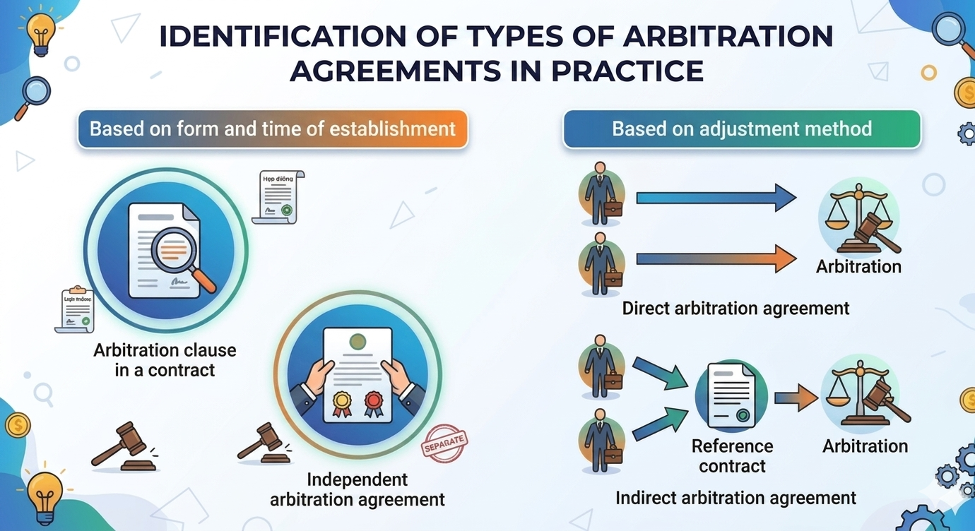
1. Identification of Arbitration Agreements Based on Their Form and the Time of Establishment
Pursuant to the provisions of the 2010 Law on Commercial Arbitration, an arbitration agreement constitutes the legal basis upon which the parties confer jurisdiction upon an arbitral tribunal to resolve their contractual disputes. An arbitration agreement may be established either in the form of an arbitration clause incorporated into a contract or in the form of a separate arbitration agreement.
In principle, arbitration agreements may be classified into two categories: an arbitration clause contained in a contract (“arbitration clause”) and an independent arbitration agreement (“submission agreement”). Each category reflects the parties’ intention at a different stage in the formation and development of their legal relationship.
An arbitration clause incorporated into a contract constitutes an integral part of the principal contract and is established at the time the principal contract is entered into, prior to the occurrence of any dispute; accordingly, it is preventive and anticipatory in nature. In practice, arbitration clauses are often drafted in relatively broad and general terms, as the parties at the contract formation stage are unable to foresee the exact nature of potential disputes or determine the most appropriate mechanism for resolving such disputes.
An arbitration clause is also regarded as a distinct and autonomous agreement, independent from the other provisions of the principal contract. The invalidity, termination, or breach of the principal contract shall not automatically invalidate or extinguish the arbitration clause, unless the arbitration clause itself is deemed invalid on separate legal grounds. This principle ensures that, even where the principal contract is declared invalid, the agreed dispute resolution mechanism remains effective to adjudicate the rights and obligations of the parties.
Conversely, an independent arbitration agreement is a written agreement established separately from the principal contract. Such agreement is commonly concluded after a dispute has arisen, at a stage where the parties have become fully aware that their respective rights and obligations are allegedly being infringed. Consequently, it is drafted in a manner specifically tailored to the factual circumstances of the case and the particular issues in dispute. In essence, this is no longer merely a preventive mechanism, but rather a procedural compromise through which the parties agree upon a specific method for dispute resolution.
However, the greatest limitation of this form of agreement lies in its very formation. Once the parties’ interests have become adverse and mutual goodwill has diminished, reaching a consensus on arbitration becomes considerably more difficult. From the perspective of law and economics, this circumstance increases transaction costs and explains why independent arbitration agreements are, in practice, far less common than arbitration clauses incorporated into contracts from the outset.
2. Identification of Arbitration Agreements Based on the Method of Regulation
When classified according to the manner in which the parties’ intention is expressed, arbitration agreements may be divided into two categories: direct arbitration agreements and indirect arbitration agreements. These two categories give rise to a deeper legal issue, namely the degree of certainty and definiteness of the parties’ consent.
A direct arbitration agreement refers to a situation where the parties expressly manifest their intention, through written instruments or equivalent forms, to submit disputes arising between them to arbitration. In practice, parties commonly adopt model arbitration clauses recommended by the arbitral institution whose services they intend to use. Such model clauses generally contain two principal elements: (i) the parties’ agreement to resolve disputes by arbitration; and (ii) the selection of the applicable arbitral procedural rules. Depending on the parties’ circumstances and intentions, additional provisions may also be included, such as the seat of arbitration, the language of arbitration, the number of arbitrators, and the governing law.
In contrast, an indirect arbitration agreement represents a more complex form of agreement and remains one of the most controversial issues in both legal theory and practice. The essence of this type of agreement lies in the inference of the parties’ intention through factors such as references to other documents, institutional rules, or legal provisions establishing arbitration as the mechanism for dispute resolution. For example, the dispute resolution clause in a contract may refer to the dispute resolution mechanism contained in a master agreement, where such master agreement provides for arbitration as the method of dispute resolution.
Another example arises where an arbitration agreement is incorporated by reference through provisions contained in a company’s charter. Where the company charter mandatorily provides that disputes relating to the rights and obligations among shareholders shall be resolved by arbitration, shareholder agreements must comply with such provisions of the charter. Accordingly, agreements concerning the transfer or sale of shares within the company are likewise subject to the charter, and the parties must accept the jurisdiction of the arbitral tribunal. In this respect, the provisions of the company charter operate as an arbitration agreement binding upon the parties to the shareholder agreement in relation to shareholder rights and obligations.
The distinction between direct and indirect arbitration agreements also reflects differing degrees of legal risk. While direct arbitration agreements provide a greater degree of certainty and legal stability, indirect arbitration agreements carry a higher risk of being declared invalid or denied recognition and enforcement of the arbitral award. The validity of an indirect arbitration agreement requires an exceptionally high level of caution; the reference must be specific, and the referenced document must genuinely exist. Where the reference is excessively vague, or where one party can demonstrate that it had no reasonable opportunity to access the referenced document, such agreement may be declared invalid by the competent dispute resolution authority on the ground that the parties’ intention was not expressed with sufficient clarity.
3. Conclusion
The two methods of classification discussed above do not exist independently but rather overlap in practice. An arbitration clause incorporated into a contract may be established indirectly through incorporation by reference, whereas an independent arbitration agreement represents the parties’ express written manifestation of consent during the course of dispute resolution proceedings. This demonstrates that the classification of arbitration agreements is not merely a matter of form, but also concerns the manner in which the parties’ intention is identified and interpreted in each particular case. Furthermore, in-depth research into these methods of classification is significant not only from a theoretical perspective, but also for resolving complex practical issues relating to the validity and scope of application of arbitration agreements.
The article above has analyzed in detail is "Identification of types of arbitration agreements in practice". For more detailed information or legal assistance, please contact the MCAC Secretariat:
- Hotline: 0935 925 068 - 0236 3656799
- Email: contact@mcac.vn
- Read more: Benefits and risks of using artificial intelligence in Arbitration
Related news
WHICH LAW GOVERNS AN ARBITRATION AGREEMENT IN A CONTRACT WITH FOREIGN ELEMENTS?
In international commercial transactions, parties often agree on the law governing their contract and on arbitration as the method of dispute resolution. However, does the law governing the contract automatically govern the arbitration agreement? If the parties have not agreed on the applicable law, which country's law is used to determine the validity of the arbitration agreement?
MAY A COURT RE-EXAMINE THE MERITS OF A DISPUTE WHEN CONSIDERING AN APPLICATION TO SET ASIDE AN ARBITRAL AWARD?
When considering an application to set aside an arbitral award, is the Court entitled to reassess evidence, reconsider the parties' rights and obligations, or alter the findings and decisions made by the Arbitral Tribunal?