Working hour: Monday – Friday/8AM – 5PM
|Email: contact@mcac.vn
|Hotline: (+84) 935 925 068 - 0236 3656799
| Language:



Điện thoại: (+84) 935 925 068
Language:

COUNTERCLAIMS IN ARBITRATION PROCEEDINGS: CAN THE RESPONDENT “SUE BACK” THE CLAIMANT?
15/05/2026


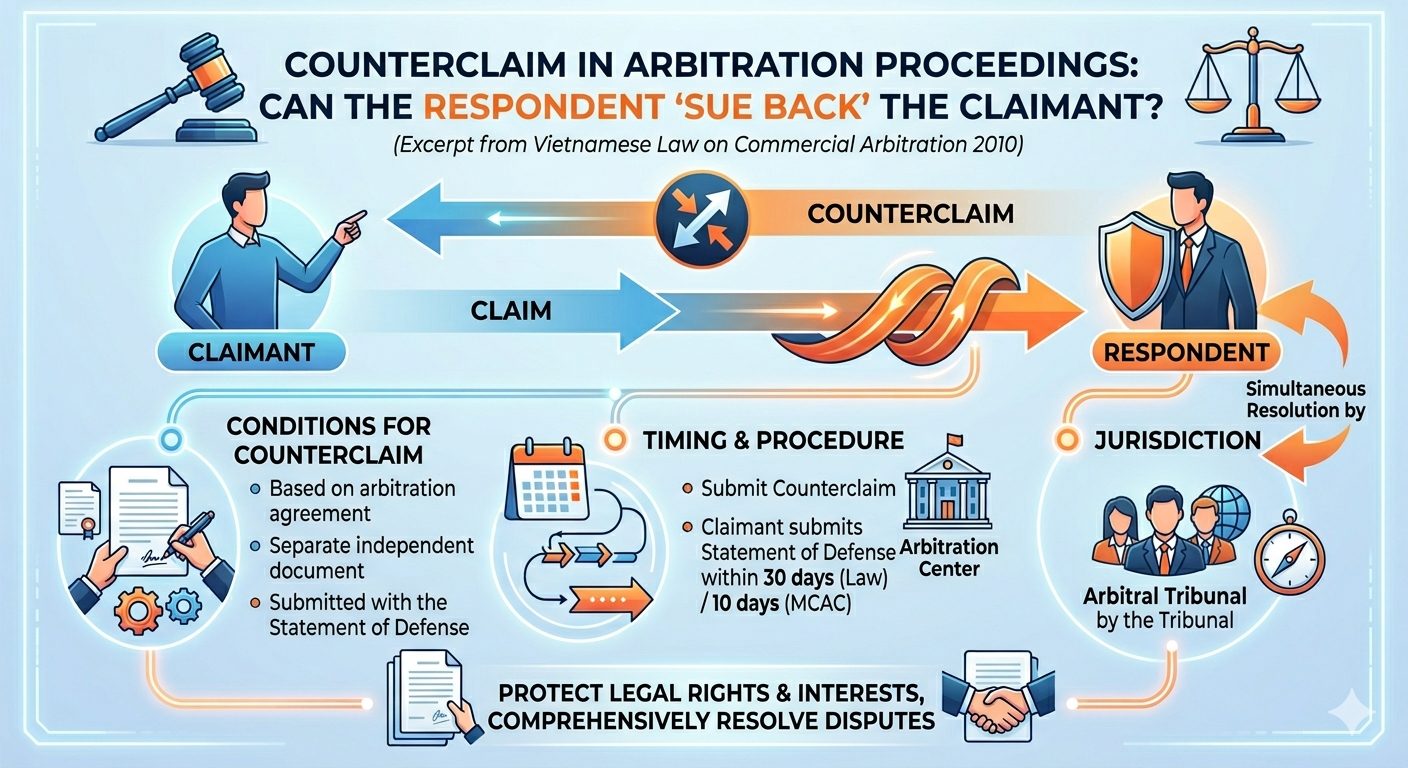
In the process of resolving disputes through commercial arbitration, many respondents believe that they are merely in the position of being sued and may only provide responses or objections to the claimant’s claims. However, under the law and the Arbitration Rules, respondents are fully entitled to bring claims against the claimant through a Counterclaim.
This is an important mechanism to protect the lawful rights and interests of the parties while enabling the Arbitral Tribunal to comprehensively resolve disputes arising from the same legal relationship.
1. Does the Respondent Have the Right to File a Counterclaim Against the Claimant?
Clause 1, Article 36 of the Law on Commercial Arbitration 2010 provides that:
“The respondent has the right to counterclaim against the claimant regarding matters related to the dispute.”
In addition, Clause 1, Article 10 of the MCAC Arbitration Rules also recognizes the respondent’s right to submit a Counterclaim against the claimant.
However, for the counterclaim to be considered and resolved by the Arbitral Tribunal, it must satisfy certain conditions, including:
- The counterclaim must be based on the arbitration agreement relied upon by the claimant when initiating arbitration against the respondent;
- The counterclaim must be made in a separate written document, independent from the Statement of Defense;
- The counterclaim must be submitted to the Center simultaneously with the Statement of Defense.
In practice, many respondents present their counterclaims directly within the Statement of Defense. However, this may result in the counterclaim not being considered in accordance with proper procedural requirements. Therefore, respondents should prepare the Counterclaim as an independent document in compliance with applicable regulations.
2. Time Limit and Procedures for Filing a Counterclaim
Clause 2, Article 36 of the Law on Commercial Arbitration 2010 stipulates:
“The respondent’s counterclaim must be sent to the arbitration center. In disputes resolved by ad hoc arbitration, the counterclaim must be sent to the arbitral tribunal and the claimant. The counterclaim must be submitted at the same time as the statement of defense.”
Furthermore, Clause 3, Article 36 of the Law on Commercial Arbitration 2010 provides:
“Within 30 days from the date of receipt of the counterclaim, the claimant must submit a statement of defense to the arbitration center. In disputes resolved by ad hoc arbitration, the claimant must send the statement of defense to the arbitral tribunal and the respondent.”
According to the MCAC Arbitration Rules:
“Unless otherwise agreed by the parties regarding the time limit, within 10 days from the date the Center receives the Counterclaim, relevant documents, and arbitration fees as prescribed in Article 35 of these Rules, the Center shall send to the Claimant a Notice, the Counterclaim, and other relevant documents.”
Therefore, filing the Counterclaim in a timely manner and in accordance with procedural requirements plays an important role in the consideration and resolution of the respondent’s counterclaim.
3. Contents of the Counterclaim
Pursuant to Clause 2, Article 10 of the MCAC Arbitration Rules, a Counterclaim should contain the following basic information:
- Date of the counterclaim;
- Names and addresses of the disputing parties;
- Summary of the counterclaim;
- Legal basis and grounds for the counterclaim;
- Value of the dispute and specific requests of the respondent;
- Valid signature of the authorized person.
In addition to the above contents, the respondent should also attach supporting documents and evidence substantiating the counterclaim so that the Arbitral Tribunal has sufficient grounds for consideration and assessment.
Preparing a complete and clear Counterclaim from the outset will help ensure a more efficient arbitration process while minimizing the need for repeated amendments or supplements to the case file.
4. Jurisdiction Over the Counterclaim
According to Clause 6, Article 10 of the MCAC Arbitration Rules:
“The Counterclaim shall be resolved simultaneously by the same Arbitral Tribunal handling the Claimant’s Statement of Claim.”
This means that if the Arbitral Tribunal determines that the counterclaim falls within its jurisdiction, both the claimant’s claims and the respondent’s counterclaims will be considered in the same arbitration proceeding.
This mechanism enables the Arbitral Tribunal to comprehensively resolve the rights and obligations of the parties while saving time and arbitration costs.
Conclusion
A Counterclaim is an important procedural right of the respondent in commercial arbitration proceedings. However, not every request made by the respondent will qualify as a valid counterclaim. The Arbitral Tribunal will examine the relevance between the counterclaim and the original dispute, as well as the scope of the arbitration agreement.
Therefore, correctly identifying the nature of the claim, preparing complete documentation, and complying with procedural deadlines are essential factors in protecting the lawful rights and interests of the respondent during arbitration proceedings.
Related news
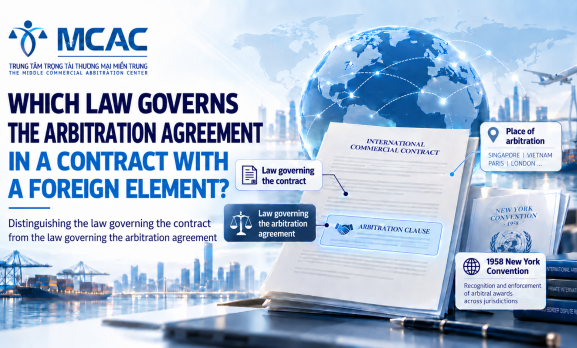
WHICH LAW GOVERNS AN ARBITRATION AGREEMENT IN A CONTRACT WITH FOREIGN ELEMENTS?
In international commercial transactions, parties often agree on the law governing their contract and on arbitration as the method of dispute resolution. However, does the law governing the contract automatically govern the arbitration agreement? If the parties have not agreed on the applicable law, which country's law is used to determine the validity of the arbitration agreement?
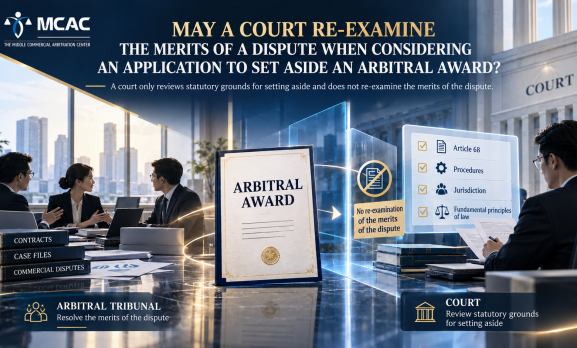
MAY A COURT RE-EXAMINE THE MERITS OF A DISPUTE WHEN CONSIDERING AN APPLICATION TO SET ASIDE AN ARBITRAL AWARD?
When considering an application to set aside an arbitral award, is the Court entitled to reassess evidence, reconsider the parties' rights and obligations, or alter the findings and decisions made by the Arbitral Tribunal?