Working hour: Monday – Friday/8AM – 5PM
|Email: contact@mcac.vn
|Hotline: (+84) 935 925 068 - 0236 3656799
| Language:



Điện thoại: (+84) 935 925 068
Language:

DEFENDANT’S “SILENCE” IN ARBITRATION PROCEEDINGS: DOES IT RESULT IN THE LOSS OF THE RIGHT TO DEFEND?
12/06/2026


Commercial arbitration proceedings are founded upon the principles of party autonomy and equality between disputing parties. In practice, it is not uncommon for a respondent to choose to remain “silent”, i.e., not submitting a counterclaim, not filing a statement of defence, not attending hearings, or not responding to notices issued by the Arbitral Tribunal. This raises an important legal question: does such “silence” mean that the respondent loses its right to defend itself in arbitration proceedings?
1. The Concept of the Respondent’s “Silence” in Commercial Arbitration Proceedings
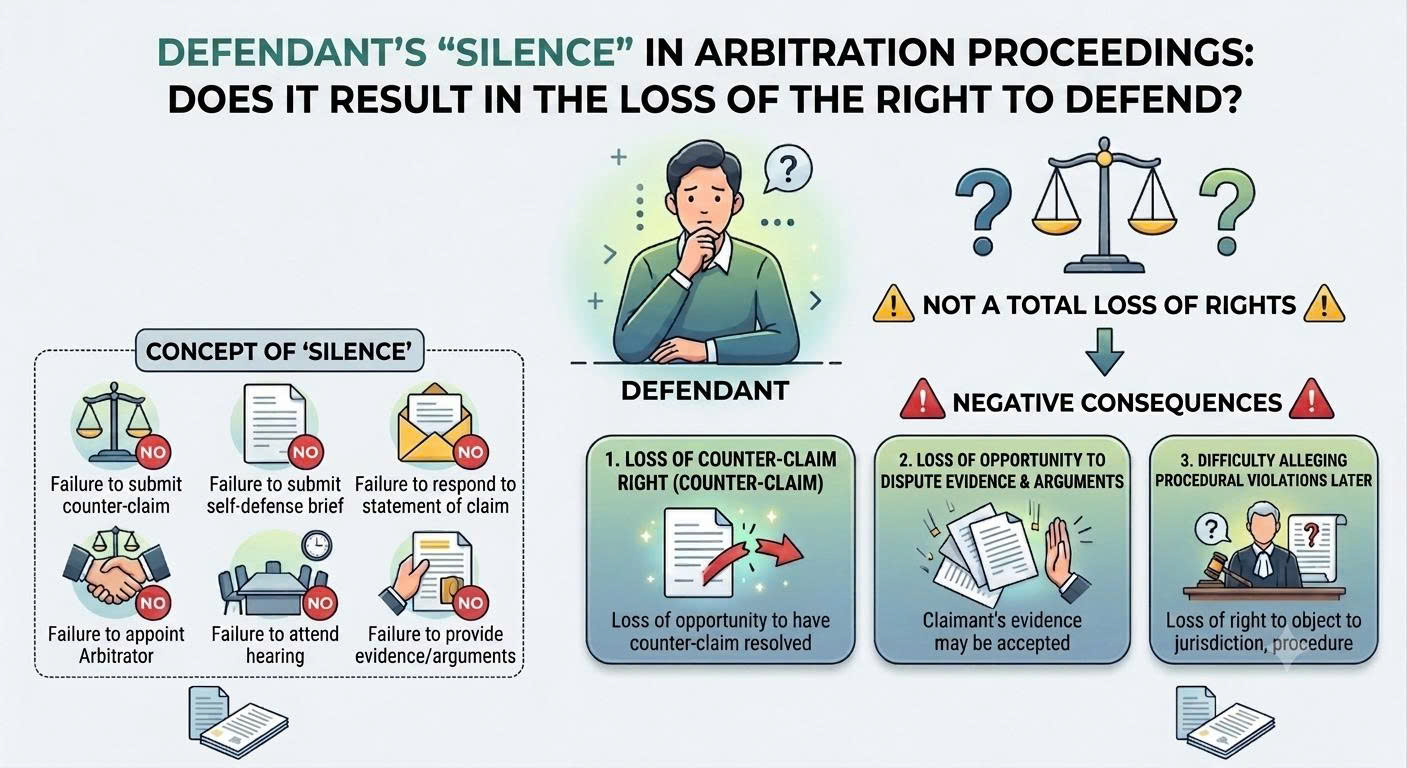
In commercial arbitration dispute resolution, the respondent’s “silence” may be understood as the respondent’s failure to exercise, or incomplete exercise of, its procedural rights, including:
- Failure to submit a counterclaim;
- Failure to submit a statement of defence;
- Failure to respond to the statement of claim;
- Failure to appoint an arbitrator;
- Failure to attend dispute resolution hearings;
- Failure to provide evidence or rebuttal arguments.
However, a distinction should be made between “silence” and waiver of procedural rights. A party’s failure to actively participate in the proceedings does not automatically result in the loss of all defence rights, as one of the fundamental principles of arbitration is to ensure that each party is afforded a reasonable opportunity to present its case.
2. Does the Respondent’s “Silence” Result in the Loss of the Right to Defend?
Pursuant to Clause 5, Article 35 of the Law on Commercial Arbitration 2010 of Vietnam: “In the event that the respondent fails to submit a statement of defence in accordance with Clauses 2 and 3 of this Article, the dispute resolution proceedings shall nevertheless continue.”
In addition, Clause 2, Article 56 of the Law on Commercial Arbitration 2010 provides: “If the respondent, having been duly summoned to attend the dispute resolution hearing, is absent without legitimate reasons or leaves the hearing without the approval of the Arbitral Tribunal, the Arbitral Tribunal shall continue to resolve the dispute on the basis of the available documents and evidence.”
Clause 4, Article 9 and Clause 1, Article 27 of the Arbitration Rules of the Central Commercial Arbitration Centre (MCAC) contain provisions of a similar nature.
Accordingly, the respondent’s silence in the above circumstances does not suspend or delay the arbitration proceedings. The legal framework empowers the Arbitral Tribunal to continue resolving the dispute to preserve the effectiveness of arbitration, protect the legitimate interests of the claimant, and prevent a party from abusing silence as a means to delay its obligations.
On the other hand, it should be noted that, in certain circumstances, silence may go beyond mere non-participation and give rise to legal consequences such as loss of the right to object or waiver of procedural rights. Article 13 of the Law on Commercial Arbitration 2010 provides: “In the event that a party becomes aware of a violation of this Law or of the arbitration agreement but continues to participate in the arbitration proceedings without raising an objection within the statutory time limit, such party shall lose the right to object before the Arbitral Tribunal or the Court.”
In practice, although silence does not entirely extinguish the respondent’s right to defend, it may still lead to adverse consequences:
First, loss of the right to file a counterclaim and loss of the opportunity to have such counterclaim considered and resolved by the Arbitral Tribunal.
Second, loss of the opportunity to challenge evidence and arguments. Where the respondent fails to present objections, the Arbitral Tribunal will primarily rely on the materials submitted by the claimant, significantly weakening the respondent’s ability to protect its interests.
Third, difficulty in relying on procedural violations at a later stage. A party that deliberately refrains from participating in the proceedings but subsequently seeks to set aside the award on the grounds that its right to be heard was not protected will generally face difficulty if the Arbitral Tribunal has duly provided notices and opportunities to participate.
3. Conclusion
The respondent’s “silence” in arbitration proceedings does not automatically constitute a loss of the right to defend or an admission of the claimant’s claims. The Arbitral Tribunal remains obliged to ensure that each party is afforded a reasonable opportunity to exercise its procedural rights in accordance with applicable law and the arbitration agreement.
However, the right of defence only has practical value when exercised proactively. Failure to participate in proceedings or to raise objections in a timely manner may deprive the respondent of the opportunity to protect its lawful rights and interests. Therefore, correctly identifying the legal nature of “silence” is important to maintaining the balance between the efficiency of arbitration proceedings and the guarantee of procedural fairness between the parties.
The article above has analyzed in detail is "DEFENDANT’S “SILENCE” IN ARBITRATION PROCEEDINGS: DOES IT RESULT IN THE LOSS OF THE RIGHT TO DEFEND?". For more detailed information or legal assistance, please contact the MCAC Secretariat:
- Hotline: 0935 925 068 - 0236 3656799
- Email: contact@mcac.vn
- Read more:CHECKLIST FOR DRAFTING ARBITRATION CLAUSES: COMMON ISSUES TO NOTE
Related news
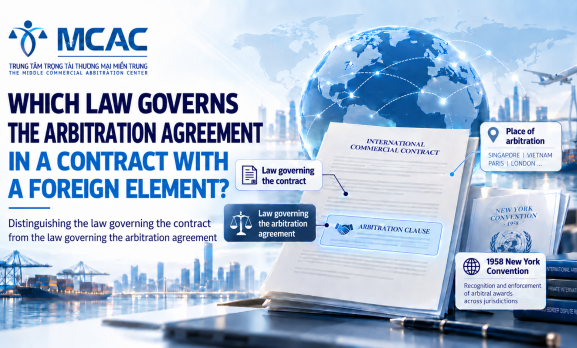
WHICH LAW GOVERNS AN ARBITRATION AGREEMENT IN A CONTRACT WITH FOREIGN ELEMENTS?
In international commercial transactions, parties often agree on the law governing their contract and on arbitration as the method of dispute resolution. However, does the law governing the contract automatically govern the arbitration agreement? If the parties have not agreed on the applicable law, which country's law is used to determine the validity of the arbitration agreement?
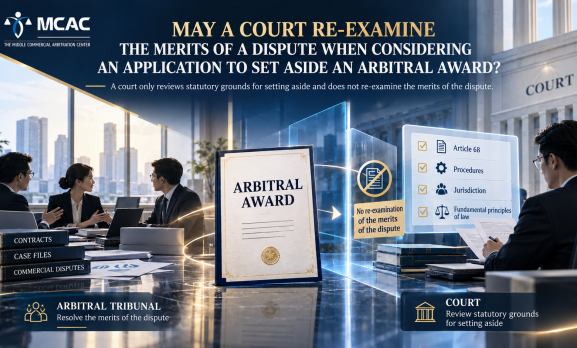
MAY A COURT RE-EXAMINE THE MERITS OF A DISPUTE WHEN CONSIDERING AN APPLICATION TO SET ASIDE AN ARBITRAL AWARD?
When considering an application to set aside an arbitral award, is the Court entitled to reassess evidence, reconsider the parties' rights and obligations, or alter the findings and decisions made by the Arbitral Tribunal?