Working hour: Monday – Friday/8AM – 5PM
|Email: contact@mcac.vn
|Hotline: (+84) 935 925 068 - 0236 3656799
| Language:



Điện thoại: (+84) 935 925 068
Language:

CHECKLIST FOR DRAFTING ARBITRATION CLAUSES: COMMON ISSUES TO NOTE
05/06/2026


In the practice of entering into commercial contracts, dispute resolution clauses are often not given adequate attention by the parties and are frequently added only at the final stage of contract drafting. However, once a dispute arises, such clauses become a critical basis for determining the competent dispute resolution authority, the applicable procedural framework, and the scope of protection of the parties’ lawful rights and interests.
In practice, numerous arbitration agreements become subject to disputes regarding their validity, jurisdiction, or encounter difficulties during implementation merely because the arbitration clause was drafted ambiguously, inconsistently, or without sufficient consideration of applicable legal requirements and arbitral practice.
Below are several issues that businesses should take into account when drafting arbitration clauses in commercial contracts.
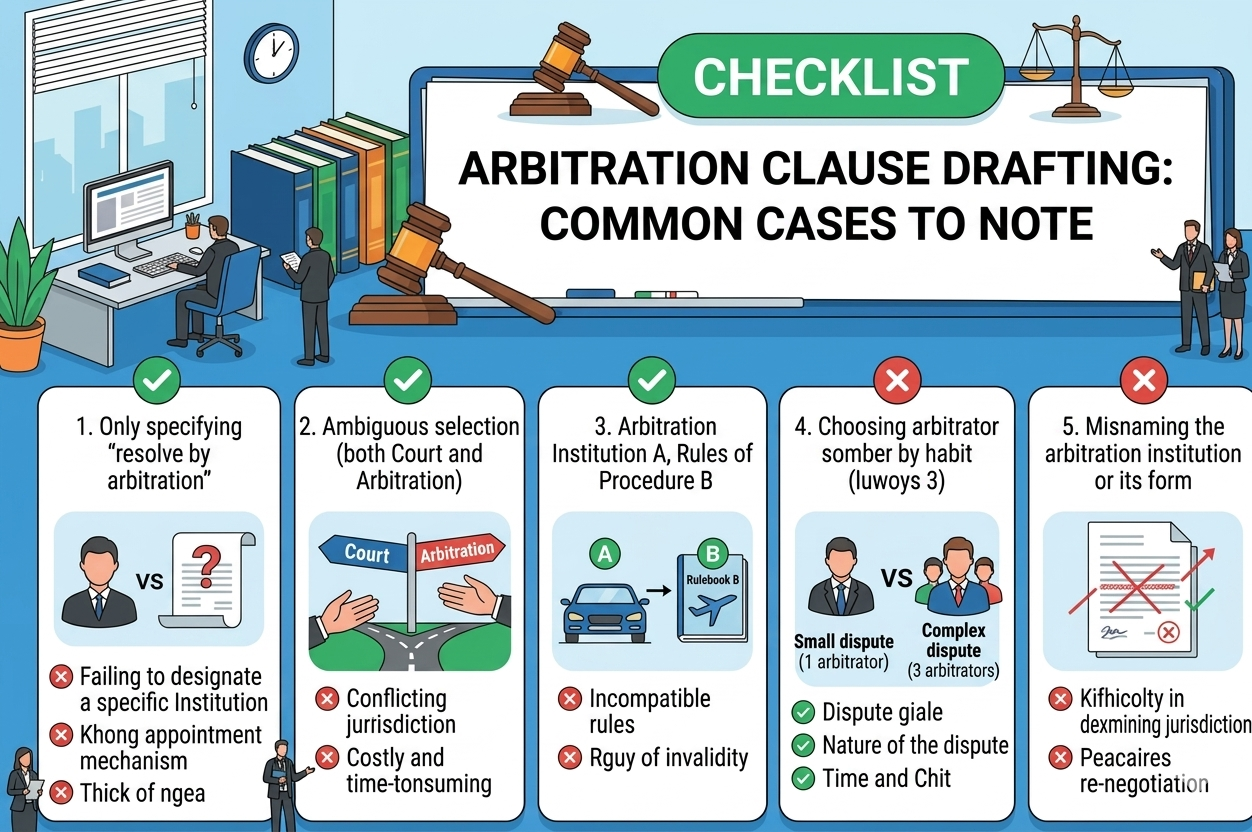
1. Providing only that disputes shall be resolved by arbitration without identifying a specific arbitral institution
Many contracts contain only a general provision such as: “Any dispute arising out of or in connection with this Agreement shall be resolved by arbitration.” Although such wording demonstrates the parties’ intention to select arbitration as the dispute resolution mechanism, it fails to clearly determine:
- the arbitral institution having jurisdiction;
- the mechanism for constituting the arbitral tribunal;
- the seat or place of arbitration.
In practice, failure to specify the arbitral institution may lead to disputes regarding the enforceability of the arbitration agreement or difficulties during the conduct of arbitral proceedings. Once a dispute arises, the parties may be required to negotiate again regarding the selection of a specific arbitral institution. To minimise such risks, the parties should identify the arbitral institution expressly in the contract.
Example:
“Any dispute arising out of or in connection with this Agreement shall be resolved by arbitration at the Middle Commercial Arbitration Center (MCAC) in accordance with its Rules of Arbitration.”
2. “Hybrid” arbitration clauses: selecting both courts and arbitration
A common issue in contract drafting is where parties simultaneously choose arbitration and court litigation for dispute resolution, for example:
“Any dispute shall be resolved by arbitration or by a competent court.”
Under the laws governing commercial arbitration, where one party has submitted the dispute to arbitration, the court may decline jurisdiction. Where both arbitration and court proceedings are contemplated, the agreement to arbitrate is generally given priority.
In practice, such “hybrid” clauses may prolong dispute resolution, increase procedural costs, and reduce procedural efficiency.
Accordingly, the parties should determine and agree upon a single dispute resolution mechanism at the time of contract execution.
3. Selecting one arbitral institution while referring to the procedural rules of another institution
A frequently encountered issue in contract drafting is where the parties choose one arbitral institution to administer disputes but refer to the arbitration rules of a different institution.
Example:
“The dispute shall be resolved by Arbitration Center A in accordance with the Arbitration Rules of Arbitration Center B.”
As a matter of principle, each arbitral institution promulgates and applies its own procedural rules to disputes falling within its jurisdiction. In practice, most arbitral institutions do not accept the application of another institution’s procedural rules.
This may lead to:
- difficulties in determining the applicable procedural framework;
- jurisdictional disputes;
- the risk that the arbitration agreement may be deemed incapable of being performed.
In certain cases, if no appropriate procedural mechanism or competent arbitral institution can be identified, jurisdiction over the dispute may ultimately fall to the courts pursuant to applicable law.
4. Selecting the Number of Arbitrators Based on Habit Rather Than Case Needs
Many businesses tend to default to appointing a three-member arbitral tribunal without giving sufficient consideration to:
- the value of the dispute;
- the nature and complexity of the case;
- the anticipated duration of proceedings;
- procedural costs.
In many ordinary commercial disputes, appointing a sole arbitrator may significantly optimise both time and costs while still ensuring an effective dispute resolution process.
Conversely, for disputes involving greater complexity or substantial value, a three-member tribunal may contribute to enhancing objectivity and improving the overall quality of the tribunal’s assessment.
5. Misidentifying the Arbitral Institution or Failing to Clearly Specify the Form and Name of Arbitration
In contract drafting practice, inaccurately identifying the arbitral institution or failing to clearly indicate the selected form of arbitration is relatively common. Such deficiencies may create difficulties in determining the arbitral institution having jurisdiction once a dispute arises.
Under the Law on Commercial Arbitration, the parties retain the right to reach a subsequent agreement to re-determine the appropriate arbitral institution or arbitration mechanism. If no agreement can be reached, the selection of the arbitral institution may be made upon the request of the claimant in accordance with applicable law.
6. RECOMMENDED MODEL ARBITRATION CLAUSES
The Middle Commercial Arbitration Center (MCAC) recommends that parties may refer to the following model arbitration clauses:
A. Model Arbitration Clause for Standard Proceedings
“Article …: Dispute Resolution
- Any dispute arising out of or in connection with this Agreement shall be resolved by arbitration at the Middle Commercial Arbitration Center (MCAC) in accordance with its Rules of Arbitration.
- The number of arbitrators shall be … (one or three).
- The seat of arbitration shall be … (city and/or country).
- The language of arbitration shall be … .
- This Agreement shall be governed by the laws of … .”
B. Model Arbitration Clause for Expedited Proceedings
“Article …: Dispute Resolution
- Any dispute arising out of or in connection with this Agreement shall be resolved by arbitration at the Middle Commercial Arbitration Center (MCAC) in accordance with its Rules of Arbitration.
The parties agree that the arbitral proceedings shall be conducted under the Expedited Procedure as prescribed under the MCAC Rules of Arbitration.
- The seat of arbitration shall be … .
- The language of arbitration shall be … .
- This Agreement shall be governed by the laws of … .”
Although an arbitration clause may occupy only a small portion of a contract, it has a direct impact on the entire dispute resolution process. Careful review during the negotiation and contract execution stages enables businesses to take a more proactive approach to managing legal risks and safeguarding their interests in the event of a dispute.
The article above has analyzed in detail is "Can a business audio- or video-record an arbitral hearing?". For more detailed information or legal assistance, please contact the MCAC Secretariat:
- Hotline: 0935 925 068 - 0236 3656799
- Email: contact@mcac.vn
- Read more: Benefits and risks of using artificial intelligence in Arbitration
Related news
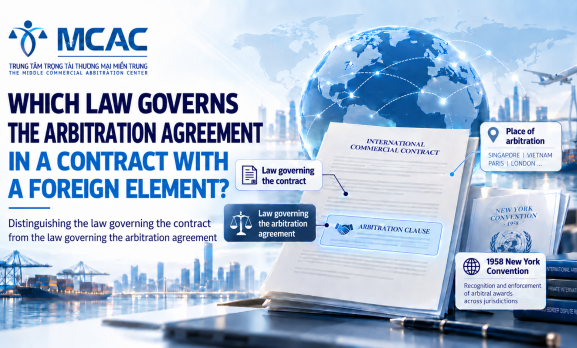
WHICH LAW GOVERNS AN ARBITRATION AGREEMENT IN A CONTRACT WITH FOREIGN ELEMENTS?
In international commercial transactions, parties often agree on the law governing their contract and on arbitration as the method of dispute resolution. However, does the law governing the contract automatically govern the arbitration agreement? If the parties have not agreed on the applicable law, which country's law is used to determine the validity of the arbitration agreement?
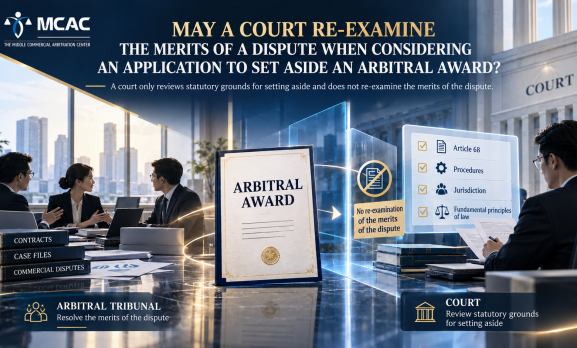
MAY A COURT RE-EXAMINE THE MERITS OF A DISPUTE WHEN CONSIDERING AN APPLICATION TO SET ASIDE AN ARBITRAL AWARD?
When considering an application to set aside an arbitral award, is the Court entitled to reassess evidence, reconsider the parties' rights and obligations, or alter the findings and decisions made by the Arbitral Tribunal?