Working hour: Monday – Friday/8AM – 5PM
|Email: contact@mcac.vn
|Hotline: (+84) 935 925 068 - 0236 3656799
| Language:


Điện thoại: (+84) 935 925 068
Language:

CONTRACT WITH THE ENGLISH VERSION PREVAILING: MUST ARBITRATION PROCEEDINGS BE CONDUCTED IN ENGLISH?
30/10/2026


The parties’ agreement that the English version of a contract shall prevail in the event of discrepancies between language versions does not mean that arbitration proceedings must be conducted in English. The prevailing language of a contract and the language of arbitration proceedings are two distinct legal matters that must be considered separately in light of the parties’ agreement and applicable law.
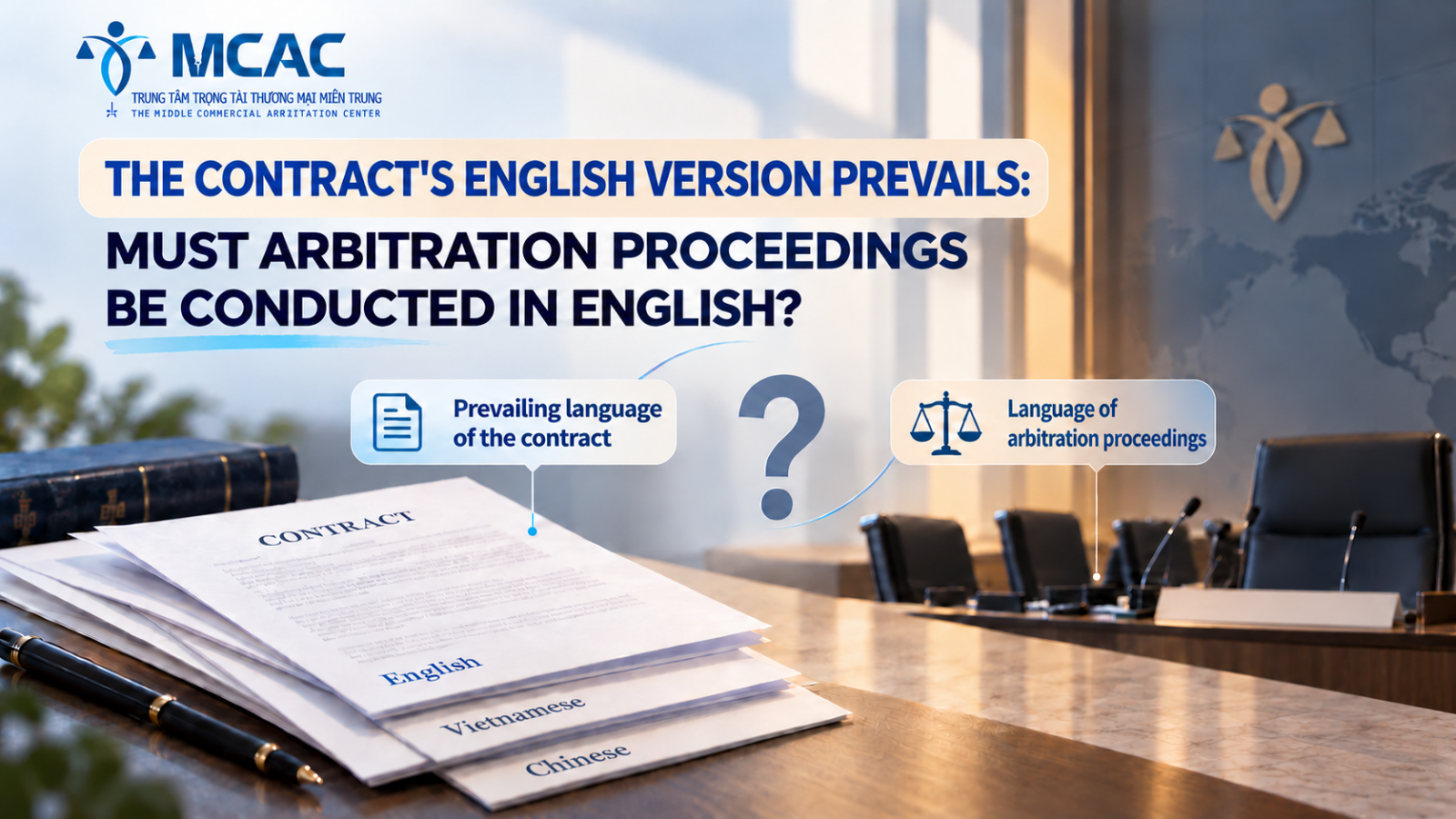
In commercial transactions involving foreign elements, contracts are often drawn up in two or more languages, such as Vietnamese and English or Chinese. To minimize disputes concerning the interpretation and performance of a contract, the parties may agree that one language version shall prevail in the event of discrepancies between versions.
However, choosing the prevailing language version of a contract does not mean that the parties have agreed to use that language in arbitration proceedings. The question is: If a contract provides that its English version shall prevail, must the dispute resolution process by arbitration necessarily be conducted in English?
1. Distinguishing the prevailing language of a contract from the language of arbitration proceedings
The prevailing language of a contract is the language of the contractual version designated by the parties as the basis for determining and interpreting the contents of the contract where discrepancies or inconsistencies arise between language versions.
By contrast, the language of arbitration proceedings is the language used throughout the arbitral dispute resolution process, including the presentation of submissions, exchange of procedural documents, conduct of hearings and issuance of the arbitral award.
Although related to a certain extent, an agreement on the prevailing language of a contract and an agreement on the language of arbitration proceedings have different scopes: the former governs the determination of contractual content, while the latter governs dispute resolution procedures and is commonly recorded in the arbitration agreement. Therefore, selecting the English version as the prevailing contractual version cannot automatically be interpreted as an agreement to use English as the language of arbitration proceedings.
2. Basis for determining the language of arbitration proceedings
Under Article 10 of the 2010 Law on Commercial Arbitration (LCA), the language used in arbitration proceedings is determined according to whether the dispute involves foreign elements and the status of the disputing parties, specifically:
For disputes without foreign elements: Vietnamese shall be the language of arbitration proceedings, except where at least one party is a foreign-invested enterprise. A disputing party unable to use Vietnamese may engage an interpreter to translate into Vietnamese.
For disputes involving foreign elements or where at least one party is a foreign-invested enterprise: The language of arbitration proceedings shall be agreed upon by the parties. In the absence of such agreement, the Arbitral Tribunal shall decide.
Further specifying Clause 2, Article 10 above, Clause 2, Article 23 of the Rules of Arbitration of the Central Vietnam Commercial Arbitration Center (MCAC) provides that, in the absence of an agreement on the language of proceedings, the Arbitral Tribunal shall determine the language or languages to be used in arbitration proceedings, taking into account relevant factors, including the language of the contract.
Accordingly, where the parties have not agreed on the language of arbitration proceedings, a provision giving priority to the English version of the contract may be one factor considered by the Arbitral Tribunal in determining the procedural language. However, it is neither the sole basis nor does it automatically require the proceedings to be conducted in English.
For disputes without foreign elements in which neither party is a foreign-invested enterprise, the language of proceedings shall be Vietnamese under Clause 1, Article 10 of the LCA and Clause 1, Article 23 of the MCAC Rules of Arbitration. In such cases, arbitration proceedings shall still be conducted in Vietnamese even if the contract gives priority to the English version.
3. Where the English version of the contract prevails but the parties agree that Vietnamese is the language of arbitration proceedings
Consider a Vietnamese enterprise and a foreign enterprise entering into a sale of goods contract in Vietnamese and English, containing the following agreements:
- Both language versions of the contract have equal legal validity; in the event of discrepancies between them, the English version shall prevail.
- All disputes arising from or relating to the contract shall be resolved by arbitration at MCAC; the language of arbitration proceedings shall be Vietnamese.
In this case, Vietnamese is the language of proceedings pursuant to the parties’ agreement, consistent with Clause 2, Article 10 of the LCA and Clause 2, Article 23 of the MCAC Rules of Arbitration. The parties’ selection of Vietnamese as the procedural language does not alter their agreement that the English contractual version shall prevail. Accordingly, where discrepancies arise between the two language versions, the Arbitral Tribunal shall consider the parties’ prevailing-language agreement when interpreting the contract in accordance with the applicable law.
For documents and evidence prepared in a language other than the language of arbitration proceedings, Clause 3, Article 23 of the MCAC Rules of Arbitration provides that the Arbitral Tribunal, or the Center before the Arbitral Tribunal is constituted, may request one or both parties to provide translations. Accordingly, if Vietnamese is determined to be the procedural language, the parties may be required to provide Vietnamese translations of documents and evidence prepared in English.
4. Practical considerations when drafting contractual language clauses
To minimize disagreements that may arise during dispute resolution, the parties should clearly and separately stipulate the prevailing language of the contract and the language of arbitration proceedings.
In particular, for contracts involving foreign elements or where at least one party is a foreign-invested enterprise, the parties should expressly specify the language of proceedings in their arbitration agreement. They should avoid addressing only the prevailing contractual language while leaving the procedural language unspecified, in which case the Arbitral Tribunal would have to decide it.
Where multiple procedural languages are selected, the parties should also clarify the scope of use of each language, translation of documents and evidence, arrangements for interpreters where necessary, and allocation of related costs, so as to safeguard the parties’ rights to participate in the proceedings.
Furthermore, the parties should distinguish between the prevailing contractual language, the language of arbitration proceedings and the law applicable to the dispute. Selecting the English version as the prevailing version does not mean that the parties have chosen English as the procedural language or foreign law to govern the contract.
Conclusion
In conclusion, a contractual provision giving priority to the English version does not mean that arbitration proceedings must be conducted in English. The language of arbitration proceedings is determined on the basis of the parties’ agreement and relevant legal provisions.
Accordingly, when entering into bilingual or multilingual contracts, the parties should clearly and separately address the prevailing language of the contract and the language of arbitration proceedings to minimize potential disagreements in the dispute resolution process.
The article above has analyzed in detail is "CONTRACT WITH THE ENGLISH VERSION PREVAILING: MUST ARBITRATION PROCEEDINGS BE CONDUCTED IN ENGLISH?". For more detailed information or legal assistance, please contact the MCAC Secretariat:
- Hotline: 0935 925 068 - 0236 3656799
- Email: contact@mcac.vn
- Read more: THE ROLE OF THE SECRETARY IN COMMERCIAL ARBITRATION PROCEEDINGS
Related news
THE ROLE OF THE SECRETARY IN COMMERCIAL ARBITRATION PROCEEDINGS
Explore the role, duties, and authority of the Arbitral Secretary in commercial arbitration proceedings at MCAC, including case file management, hearing support, document review, and the principles of impartiality and confidentiality.
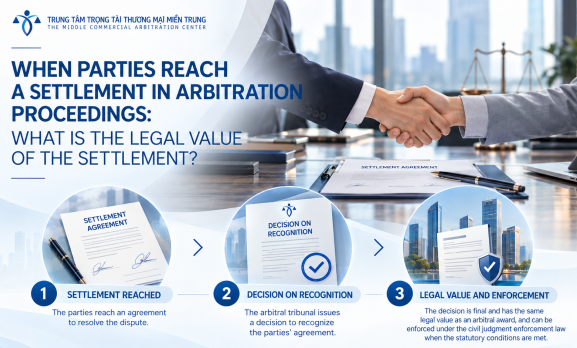
WHEN PARTIES REACH A SETTLEMENT THROUGH MEDIATION DURING ARBITRAL PROCEEDINGS: WHAT IS THE LEGAL EFFECT OF THE SETTLEMENT?
Where the parties successfully settle their dispute through mediation, what is the legal effect of the decision recognizing their agreement, and is such decision enforceable under the law on civil judgment enforcement?