Working hour: Monday – Friday/8AM – 5PM
|Email: contact@mcac.vn
|Hotline: (+84) 935 925 068 - 0236 3656799
| Language:


Điện thoại: (+84) 935 925 068
Language:

THE ROLE OF THE SECRETARY IN COMMERCIAL ARBITRATION PROCEEDINGS
28/10/2026


In the resolution of disputes through commercial arbitration, alongside the work of Arbitrators, the Secretary plays a supporting role in organising proceedings, managing case files and coordinating procedural tasks. The full and accurate performance of these tasks helps ensure that dispute resolution proceeds smoothly, in accordance with applicable procedures and efficiently.
What duties does the Secretary perform in arbitration proceedings? How is the boundary between the Secretary’s supporting role and the authority of the Arbitral Tribunal defined?
1. The position of the Secretary in arbitration proceedings
For the purposes of this article, the Secretary refers to the person assigned to assist the Arbitral Tribunal in a particular dispute. The title, method of appointment and duties of the Secretary are determined by the procedural rules and regulations of the arbitral institution. At the Central Vietnam Commercial Arbitration Center (hereinafter referred to as “MCAC” or the “Center”), this role is performed by a Secretary of the Center assigned to the case.
Under Article 38.7 of the MCAC Rules of Arbitration (hereinafter referred to as the “Rules”), the Secretary of the Center performs procedural tasks in accordance with the Rules and the Center’s regulations. At the same time, Article 38.1 provides that the Center does not itself resolve disputes; disputes are resolved by the Arbitral Tribunal.
Accordingly, the Secretary provides procedural support, whereas the examination and resolution of the dispute fall within the authority of the Arbitral Tribunal. Under Article 23 of the 2010 Law on Commercial Arbitration (hereinafter referred to as the “Law on Commercial Arbitration”), an arbitration center has the function of organising and coordinating dispute resolution by institutional arbitration and providing administrative and office support to Arbitrators.
2. Assistance with case-file management and procedural communications
A case file may comprise various documents, including the Statement of Claim, Statement of Defence, Counterclaim, evidence, written explanations and procedural requests. The proper receipt, organisation and transmission of these documents are important to the dispute resolution process.
Within the scope of the assigned duties, the Secretary provides the following assistance:
- Receiving, managing and updating the case file.
- Transmitting documents to the Arbitral Tribunal and the parties in accordance with Article 3 of the Rules.
- Monitoring procedural deadlines and reporting matters requiring attention.
- Forwarding the parties’ requests and submissions to the competent person for consideration.
- Coordinating the dispatch of notices, summonses and other procedural documents.
Through these tasks, the Secretary helps maintain communications among the Center, the Arbitral Tribunal and the parties, reducing the risk of documents being lost or overlooked or procedural requests not reaching the competent person. This work is linked to the Center’s responsibility to provide administrative and office services and retain case files under Clauses 6 and 11 of Article 28 of the Law on Commercial Arbitration.
3. Coordinating preparations for and assistance at hearings
The Secretary coordinates the necessary arrangements for a dispute resolution hearing (hereinafter referred to as the “hearing”), including scheduling, case documents and other assigned tasks. Under Clauses 1 and 2 of Article 25 of the Rules, the time and place of the hearing are determined by the Arbitral Tribunal unless the parties agree otherwise; the Center sends the hearing summonses to the parties.
At MCAC, assistance at hearings includes verifying attendance, identity documents and documents establishing the procedural capacity of participants; communicating the hearing rules; reporting to the Arbitral Tribunal on the attendance or absence of the parties and other participants and the reasons for any absence, if known; and assisting in recording the hearing proceedings as assigned.
Under Article 29 of the Rules, where the parties reach an agreement on the resolution of their dispute, the Arbitral Tribunal prepares a record of successful conciliation signed by the parties and certified by the Arbitrators. In such cases, the Secretary may assist in preparing the record at the request of the Arbitral Tribunal, ensuring that its contents are clearly recorded and accurately reflect the parties’ agreement.
These tasks are intended to provide information and the necessary conditions for the Arbitral Tribunal to conduct the hearing. Decisions on adjournment or on continuing the proceedings in the absence of a party fall within the authority of the Arbitral Tribunal under Articles 26 and 27 of the Rules.
4. Assistance with reviewing procedural documents and draft arbitral awards
When finalising procedural documents, the Secretary assists in checking information, spelling, figures and formatting to minimise errors. Careful checks in these areas help reduce requests for correction of spelling or numerical errors in an arbitral award under Article 33.1 of the Rules.
With respect to draft arbitral awards, under the Center’s regulations, the Secretary checks spelling and formatting and may offer professional observations for the Arbitral Tribunal’s consideration.
Such assistance is provided within the scope of assigned duties and is subject to the Arbitral Tribunal’s review. It is for the Arbitral Tribunal to decide whether to accept, modify or decline to adopt the Secretary’s suggestions. The Secretary’s views are for reference only and do not replace the independent and impartial assessment required of Arbitrators under Article 4.2 of the Law on Commercial Arbitration.
Under Article 60.1 and Point (i), Clause 1, Article 61 of the Law on Commercial Arbitration, decisions on an award by majority vote and the signing of the award are matters for the Arbitrators constituting the Arbitral Tribunal. As the Secretary is not a member of the Arbitral Tribunal (Article 39.1 of the Law on Commercial Arbitration), the Secretary has no right to vote or to determine the outcome of the dispute in place of the Arbitral Tribunal.
5. Principles of objectivity, equality and confidentiality in performing duties
Because the Secretary regularly has access to case files and information about the dispute, the Secretary must perform the assigned duties objectively, treat the parties equally and preserve confidentiality.
In particular, the Secretary shall:
- Provide procedural assistance to the parties on an equal basis.
- Provide procedural guidance only within the scope of assigned duties; not give legal advice or recommend strategies for protecting the interests of any party; and not express or predict the Arbitral Tribunal’s views on the resolution of the dispute.
- Keep confidential information obtained in the course of performing duties and disclose case files or documents only to persons entitled to access them under the applicable provisions.
These requirements are consistent with the principles of equality of the parties’ rights and obligations and non-public dispute resolution set out in Clauses 3 and 4 of Article 4 of the Law on Commercial Arbitration and Clause 2 of Article 38 of the Rules.
6. Points for the parties to note when working with the Secretary
The parties, particularly enterprises, should proactively cooperate with the Secretary to update contact details, send and submit documents, and prepare to attend hearings. They should also note the following:
- Notices and documents sent by the Center to the addresses provided by the parties are deemed received (Clauses 2 and 3, Article 3 of the Rules).
- Procedural requests must be clear and comply with the prescribed form and deadlines; for example, a request to adjourn a hearing must be made in writing, state the reasons and be accompanied by supporting evidence (Clause 1, Article 26 of the Rules).
- A party that becomes aware of a violation but fails to object within the prescribed time limit loses the right to object to that violation (Clause 4, Article 38 of the Rules).
- For matters falling within the decision-making authority of the Arbitral Tribunal or the President of the Center under the Rules (for example, where the Arbitral Tribunal has not yet been constituted), the parties must submit a written request for consideration. The Secretary’s receipt of documents or discussions about procedure do not mean that the request has been approved.
At MCAC, cooperation and proper observance of the respective roles and responsibilities of the Secretary, the Arbitral Tribunal and the parties help ensure that arbitration proceedings are conducted objectively, lawfully and effectively.
The article above has analyzed in detail is "THE ROLE OF THE SECRETARY IN COMMERCIAL ARBITRATION PROCEEDINGS". For more detailed information or legal assistance, please contact the MCAC Secretariat:
- Hotline: 0935 925 068 - 0236 3656799
- Email: contact@mcac.vn
- Read more:WHICH LAW GOVERNS AN ARBITRATION AGREEMENT IN A CONTRACT WITH FOREIGN ELEMENTS?
Related news
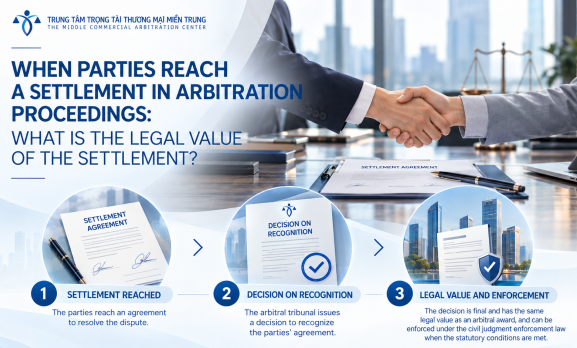
WHEN PARTIES REACH A SETTLEMENT THROUGH MEDIATION DURING ARBITRAL PROCEEDINGS: WHAT IS THE LEGAL EFFECT OF THE SETTLEMENT?
Where the parties successfully settle their dispute through mediation, what is the legal effect of the decision recognizing their agreement, and is such decision enforceable under the law on civil judgment enforcement?
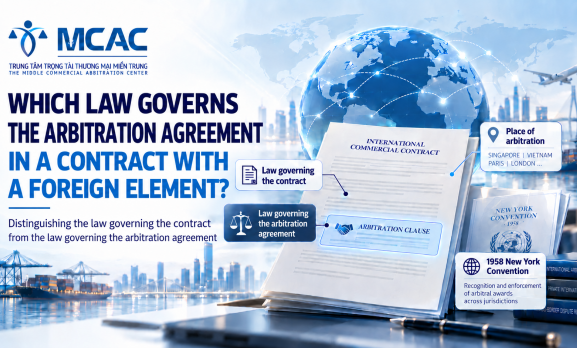
WHICH LAW GOVERNS AN ARBITRATION AGREEMENT IN A CONTRACT WITH FOREIGN ELEMENTS?
In international commercial transactions, parties often agree on the law governing their contract and on arbitration as the method of dispute resolution. However, does the law governing the contract automatically govern the arbitration agreement? If the parties have not agreed on the applicable law, which country's law is used to determine the validity of the arbitration agreement?