Working hour: Monday – Friday/8AM – 5PM
|Email: contact@mcac.vn
|Hotline: (+84) 935 925 068 - 0236 3656799
| Language:


Điện thoại: (+84) 935 925 068
Language:

WHICH LAW GOVERNS AN ARBITRATION AGREEMENT IN A CONTRACT WITH FOREIGN ELEMENTS?
23/10/2026


In international commercial transactions, parties often agree on the law governing their contract and on arbitration as the method of dispute resolution. However, does the law governing the contract automatically govern the arbitration agreement? If the parties have not agreed on the applicable law, which country's law is used to determine the validity of the arbitration agreement?

In principle, the law governing a contract does not automatically govern the arbitration agreement. The law applicable to each of these matters must be determined separately, based on the parties' agreement and the relevant legal provisions.
Properly identifying the law governing an arbitration agreement is important for assessing its validity, determining jurisdiction to resolve the dispute, and evaluating whether an arbitral award may be recognized and enforced.
Under Clause 4, Article 3 of the 2010 Law on Commercial Arbitration, as amended and supplemented in 2025 (LCA), disputes involving foreign elements are determined in accordance with the corresponding provisions of the Civil Code.
1. Does the law governing the contract also govern the arbitration agreement?
Under Clause 1, Article 683 of the 2015 Civil Code, parties to a contractual relationship may agree on the law applicable to their contract, except in the cases specified in Clauses 4, 5 and 6 of that Article. In the absence of an agreement on the applicable law, the law of the country most closely connected with the contract shall apply.
In addition, Article 19 of the LCA provides that an arbitration agreement is entirely independent of the contract. The amendment, extension or termination of the contract, or the fact that the contract is invalid or incapable of performance, does not invalidate the arbitration agreement.
Given the principle of separability of arbitration agreements, a distinction must be drawn between the law governing the substance of the contract and the law governing the arbitration agreement. Accordingly, the parties' choice of a country's law to govern their contract does not necessarily mean that the same law applies to determine the validity of the arbitration agreement.
This view is also discussed in Section 2.5.2 of the Handbook on Arbitration and Mediation Law jointly developed by the Supreme People's Court of Vietnam and the International Finance Corporation (IFC). Based on the principle of separability, the law applicable to an arbitration agreement is determined separately from the law governing the remainder of the contract.
Thus, the law governing an arbitration agreement should be determined by reference to the terms of the agreement, the parties' intentions and the relevant legal provisions, rather than by automatically applying the law governing the contract.
2. Which law applies to determine the validity of an arbitration agreement?
For an arbitration agreement contained in a contract with foreign elements, the law applicable to determining the agreement's validity must be considered in light of the parties' agreement and the relevant stage of the proceedings.
Where the parties have agreed on the law governing the arbitration agreement
The parties may expressly agree on the law governing the arbitration agreement, thereby establishing the legal basis for assessing its validity.
In proceedings for the recognition and enforcement of foreign arbitral awards, Article V(1)(a) of the 1958 New York Convention on the Recognition and Enforcement of Foreign Arbitral Awards provides for the validity of an arbitration agreement to be considered under the law chosen by the parties.
Correspondingly, Point b, Clause 1, Article 459 of the 2015 Civil Procedure Code (CPC) provides that an arbitration agreement having no legal validity under the law of the country chosen by the parties is one of the grounds on which a Vietnamese court may refuse to recognize a foreign arbitral award.
Under Clause 1, Article 459 of the CPC, refusal of recognition on this ground is considered where the evidence submitted by the party against whom enforcement is sought, in opposition to the application for recognition, is substantiated and lawful. At the same time, Clause 4, Article 458 of the CPC provides that, when considering an application for recognition and enforcement, the court must not retry a dispute that has already been decided by foreign arbitration.
Where the parties have not agreed on the law governing the arbitration agreement
Under Point b, Clause 1, Article 459 of the CPC, where the parties have not chosen the law applicable to the arbitration agreement, its legal validity is considered under the law of the country in which the award was made.
This provision is consistent with Article V(1)(a) of the 1958 New York Convention.
However, it must be emphasized that this rule applies to proceedings concerning the recognition and enforcement of foreign arbitral awards. Therefore, it cannot automatically be concluded that the law of the country in which the award was made governs every issue relating to the arbitration agreement at all stages of the proceedings.
3. Where the dispute is resolved by arbitration in Vietnam
For disputes involving foreign elements that are resolved by arbitration in Vietnam, a distinction must be made among the law applicable to the merits of the dispute, the law governing the arbitral procedure, and the law governing the validity of the arbitration agreement.
First, the law applicable to the merits of the dispute.
Under Clause 2, Article 14 of the LCA, for disputes involving foreign elements, the arbitral tribunal shall apply the law chosen by the parties. If the parties have not agreed on the applicable law, the arbitral tribunal shall decide to apply the law that it considers most appropriate.
This provision governs the determination of the law applicable to the merits of the dispute; it is not a direct basis for determining the law governing the validity of the arbitration agreement.
Second, examination of the validity of the arbitration agreement.
Under Clause 1, Article 43 of the LCA, before considering the merits of a dispute, the arbitral tribunal must examine the validity and enforceability of the arbitration agreement and its own jurisdiction to resolve the dispute.
Where a party requests the court to set aside an arbitral award on the ground that no arbitration agreement exists or that the arbitration agreement is invalid under Point a, Clause 2, Article 68 of the LCA, the court shall examine this ground on the basis of the relevant provisions of the LCA, particularly Articles 16, 18 and 19, and the guidance in Resolution No. 01/2014/NQ-HDTP.
The LCA currently does not provide a general conflict-of-laws rule for identifying the law governing the validity of arbitration agreements in all disputes involving foreign elements. The applicable law must therefore be determined on a case-by-case basis.
Third, the approach adopted in international arbitration practice.
According to Section 2.5.2 of the Handbook on Arbitration and Mediation Law, the law applicable to an arbitration agreement in a dispute involving foreign elements is, first and foremost, the law chosen by the parties. Where the parties have made no such choice, the law of the country where the arbitration takes place is identified as the applicable law.
Regarding the place of arbitration, Clause 8, Article 3 of the LCA defines it as the place where the arbitral tribunal conducts the dispute-resolution proceedings, as chosen by the parties or determined by the tribunal if the parties have not agreed.
It should be noted that the approach described in the Handbook serves as a professional and practical reference; it is not a generally binding rule of law.
Accordingly, to minimize differing interpretations of the law governing an arbitration agreement, the parties should expressly address this matter when entering into the contract.
4. What should businesses consider when drafting an arbitration agreement?
To minimize disputes concerning the validity of an arbitration agreement and the applicable law, businesses should consider the following:
- Clearly specify the applicable law: Distinguish the law governing the contract from the law governing the arbitration agreement. The parties may include a separate provision stating: “This arbitration agreement shall be governed by the laws of [chosen country/territory].”
- Specify the dispute-resolution mechanism: Clearly identify the competent arbitral institution or provide for ad hoc arbitration, and specify the arbitration rules and the place of arbitration.
- Ensure consistency among contractual provisions: Review the provisions on the applicable law, place of arbitration and arbitral institution to avoid inconsistencies or differing interpretations during performance of the contract.
- Assess the prospects for recognition and enforcement of the award: Consider the laws of the country where recognition and enforcement are expected to be sought, particularly where the assets of the party against whom enforcement is sought are located abroad.
Expressly identifying the law governing an arbitration agreement at the contract formation stage helps reduce disputes over the agreement's validity and jurisdiction to resolve disputes, while also mitigating legal risks in the recognition and enforcement of arbitral awards.
For contracts involving foreign elements, drafting an arbitration agreement that is precise, consistent and compliant with the relevant laws is an important foundation for businesses to proactively protect their lawful rights and interests in international commercial disputes
The article above has analyzed in detail is "WHICH LAW GOVERNS AN ARBITRATION AGREEMENT IN A CONTRACT WITH FOREIGN ELEMENTS?". For more detailed information or legal assistance, please contact the MCAC Secretariat:
- Hotline: 0935 925 068 - 0236 3656799
- Email: contact@mcac.vn
- Read more:MAY A COURT RE-EXAMINE THE MERITS OF A DISPUTE WHEN CONSIDERING AN APPLICATION TO SET ASIDE AN ARBITRAL AWARD?
Related news
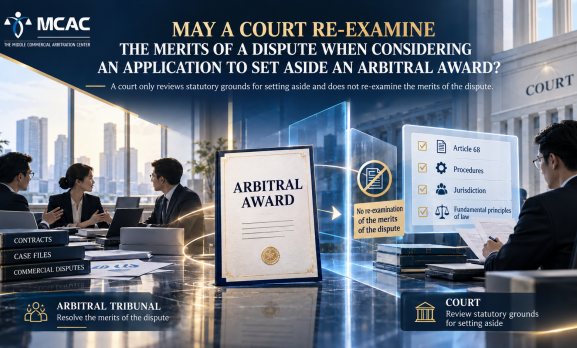
MAY A COURT RE-EXAMINE THE MERITS OF A DISPUTE WHEN CONSIDERING AN APPLICATION TO SET ASIDE AN ARBITRAL AWARD?
When considering an application to set aside an arbitral award, is the Court entitled to reassess evidence, reconsider the parties' rights and obligations, or alter the findings and decisions made by the Arbitral Tribunal?

AFTER FILING A LAWSUIT IN COURT, CAN A BUSINESS STILL REFER THE DISPUTE TO ARBITRATION?
In practice, a business may file a lawsuit in court only to discover subsequently that the contract between the parties contains an arbitration agreement. In other cases, the original contract contains no arbitration clause, but after a dispute arises, the parties agree to resolve it through arbitration. Does filing a lawsuit in court preclude the possibility of resolving the dispute through arbitration? The answer requires consideration of when the arbitration agreement was concluded, its validity and scope, and whether the court has formally accepted the case or is still at the stage of receiving and reviewing the statement of claim.