Working hour: Monday – Friday/8AM – 5PM
|Email: contact@mcac.vn
|Hotline: (+84) 935 925 068 - 0236 3656799
| Language:


Điện thoại: (+84) 935 925 068
Language:

MAY A COURT RE-EXAMINE THE MERITS OF A DISPUTE WHEN CONSIDERING AN APPLICATION TO SET ASIDE AN ARBITRAL AWARD?
21/10/2026


In commercial arbitration practice, after an Arbitral Tribunal renders an award, a party may disagree with the outcome and apply to a Court to set aside the arbitral award. However, an application to set aside an arbitral award does not mean that the dispute will be reconsidered and resolved by the Court from the beginning.
When considering an application to set aside an arbitral award, is the Court entitled to reassess evidence, reconsider the parties' rights and obligations, or alter the findings and decisions made by the Arbitral Tribunal?
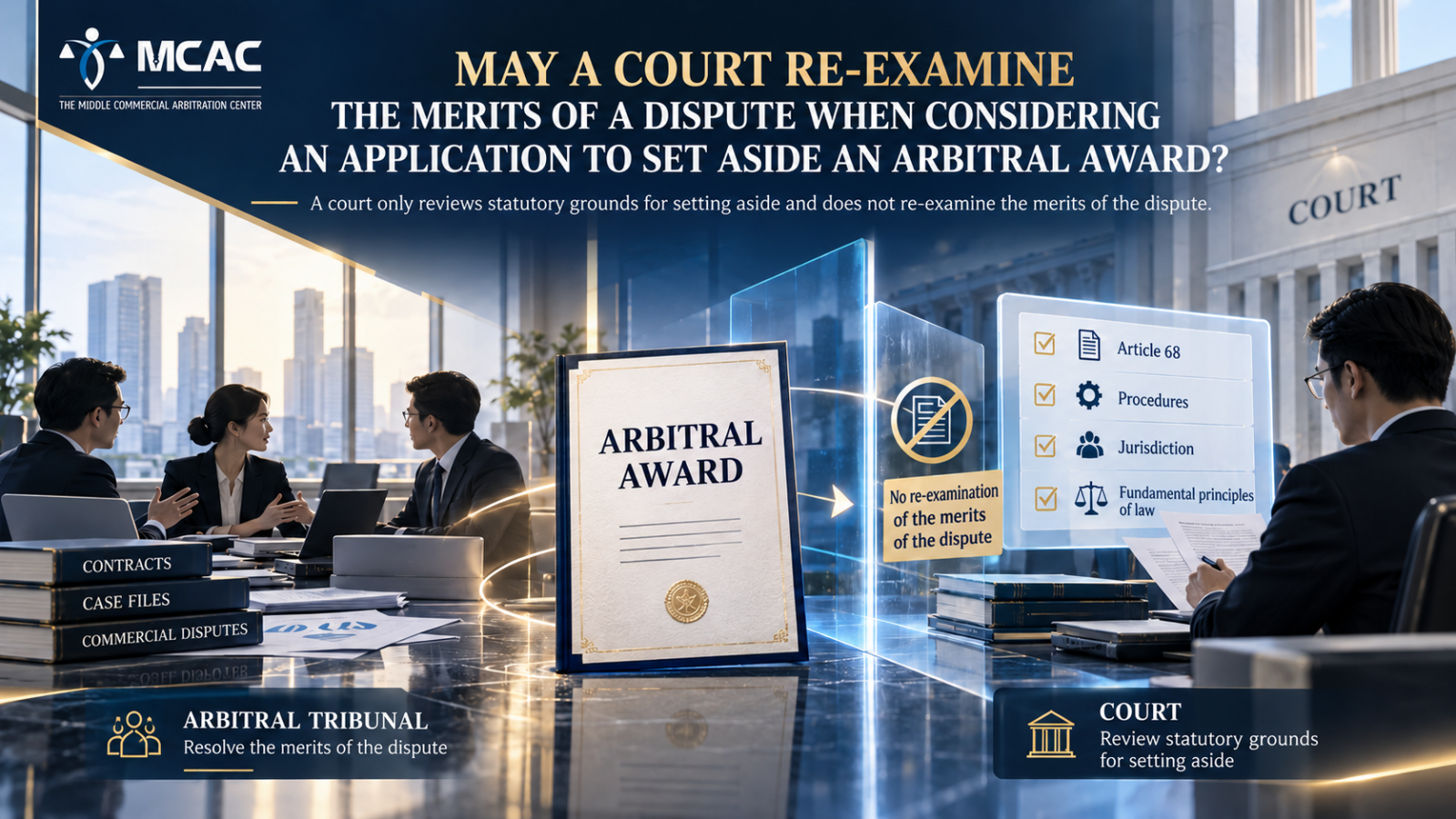
1. The Principle That Courts Do Not Re-examine the Merits of a Dispute
Under Article 61(5) of the Law on Commercial Arbitration 2010 (LCA), an arbitral award is final and takes effect from the date of its issuance.
Article 71(4) of the LCA provides:
"When considering an application, the Council considering the application shall rely on the provisions of Article 68 of this Law and the accompanying documents to examine and make a decision; it shall not re-examine the merits of the dispute already resolved by the Arbitral Tribunal."
Furthermore, Article 15(2) of Resolution No. 01/2014/NQ-HDTP dated March 20, 2014, of the Council of Justices of the Supreme People's Court provides that, when considering an application to set aside an arbitral award, the Court shall not re-examine the merits of the dispute but shall determine whether the award falls within any of the grounds prescribed in Article 68(2) of the LCA.
Accordingly, the Court does not act as an appellate body reviewing an arbitral award on its merits. Judicial review of an application to set aside an arbitral award is limited to the grounds expressly prescribed by law and is not intended to resolve again the claims and issues already considered and determined by the Arbitral Tribunal.
2. What Matters May a Court Examine When Considering an Application to Set Aside an Arbitral Award?
Under Article 68(2) of the LCA, an arbitral award may be set aside if it falls within any of the following circumstances:
- There is no arbitration agreement, or the arbitration agreement is invalid;
- The composition of the Arbitral Tribunal or the arbitral proceedings are inconsistent with the parties' agreement or contrary to the provisions of the LCA;
- The dispute falls outside the jurisdiction of the Arbitral Tribunal;
- The evidence submitted by the parties and relied upon by the Arbitral Tribunal in rendering the award is forged, or an arbitrator has received money, property, or other material benefits from a party to the dispute, thereby affecting the objectivity and fairness of the award;
- The arbitral award is contrary to the fundamental principles of Vietnamese law.
In examining an application, the Court may review relevant documents and evidence to determine whether the arbitral award falls within any of the above grounds.
In particular, where an arbitral award is alleged to be contrary to the fundamental principles of Vietnamese law, Article 14(2)(dd) of Resolution No. 01/2014/NQ-HDTP requires the Court to identify the fundamental principle that has been violated, establish its relevance to the resolution of the dispute, and determine the extent to which the violation seriously infringes upon interests protected by law.
Therefore, the Court's examination of documents relating to the substance of an arbitral award for the purpose of determining whether a ground for setting aside exists must be distinguished from a re-examination of the merits of the dispute.
3. Is Disagreement with the Arbitral Tribunal's Findings a Ground for Setting Aside an Arbitral Award?
In practice, a party may contend that the Arbitral Tribunal improperly assessed the evidence, incorrectly determined contractual obligations, or awarded damages without sufficient legal or factual grounds.
However, a party's disagreement with the Arbitral Tribunal's assessment of evidence, application of the law, or resolution of the dispute does not, in itself, constitute a ground for setting aside an arbitral award.
For example, where the Arbitral Tribunal has examined the evidence and ordered a party to pay an amount arising from a contract, the party subject to the payment obligation cannot seek to have the Court redetermine that obligation merely because it disagrees with the amount awarded.
A party applying to set aside an arbitral award must identify a corresponding legal ground under Article 68(2) of the LCA. The burden of proof is governed by Article 68(3) of the LCA. In particular, where an arbitral award is alleged to be contrary to the fundamental principles of Vietnamese law, the Court is responsible for proactively verifying and collecting evidence to determine whether the award should be set aside.
4. Legal Consequences of the Court's Decision on an Application to Set Aside an Arbitral Award
Under Article 15(2) of Resolution No. 01/2014/NQ-HDTP, where an arbitral award does not fall within any of the grounds specified in Article 68(2) of the LCA, the Council considering the application shall issue a decision refusing to set aside the arbitral award.
Where a statutory ground for setting aside exists and the Arbitral Tribunal fails to remedy, or is unable to remedy, the relevant defect in accordance with Article 71(7) of the LCA, the Court may decide to set aside the arbitral award.
Under Article 71(8) of the LCA, where an arbitral award is set aside, the parties may reach a new agreement to refer the dispute to arbitration, or either party may initiate proceedings before a competent Court. Conversely, where the Court decides not to set aside the arbitral award, the award shall be enforced in accordance with the law.
In conclusion, proceedings for setting aside an arbitral award constitute a mechanism of judicial supervision within the scope prescribed by law, rather than a procedure for re-examining the merits of the dispute. This principle helps safeguard the finality of arbitral awards while preserving the Court's role in reviewing the legality of commercial arbitration proceedings and awards.
The article above has analyzed in detail is "MAY A COURT RE-EXAMINE THE MERITS OF A DISPUTE WHEN CONSIDERING AN APPLICATION TO SET ASIDE AN ARBITRAL AWARD?". For more detailed information or legal assistance, please contact the MCAC Secretariat:
- Hotline: 0935 925 068 - 0236 3656799
- Email: contact@mcac.vn
- Read more:AFTER FILING A LAWSUIT IN COURT, CAN A BUSINESS STILL REFER THE DISPUTE TO ARBITRATION?
Related news
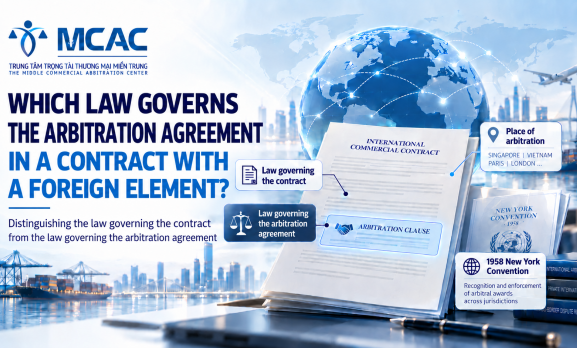
WHICH LAW GOVERNS AN ARBITRATION AGREEMENT IN A CONTRACT WITH FOREIGN ELEMENTS?
In international commercial transactions, parties often agree on the law governing their contract and on arbitration as the method of dispute resolution. However, does the law governing the contract automatically govern the arbitration agreement? If the parties have not agreed on the applicable law, which country's law is used to determine the validity of the arbitration agreement?

AFTER FILING A LAWSUIT IN COURT, CAN A BUSINESS STILL REFER THE DISPUTE TO ARBITRATION?
In practice, a business may file a lawsuit in court only to discover subsequently that the contract between the parties contains an arbitration agreement. In other cases, the original contract contains no arbitration clause, but after a dispute arises, the parties agree to resolve it through arbitration. Does filing a lawsuit in court preclude the possibility of resolving the dispute through arbitration? The answer requires consideration of when the arbitration agreement was concluded, its validity and scope, and whether the court has formally accepted the case or is still at the stage of receiving and reviewing the statement of claim.