Working hour: Monday – Friday/8AM – 5PM
|Email: contact@mcac.vn
|Hotline: (+84) 935 925 068 - 0236 3656799
| Language:



Điện thoại: (+84) 935 925 068
Language:

DOES AN ASSIGNMENT OF A RIGHT TO CLAIM ALSO TRANSFER THE ARBITRATION AGREEMENT?
03/07/2026


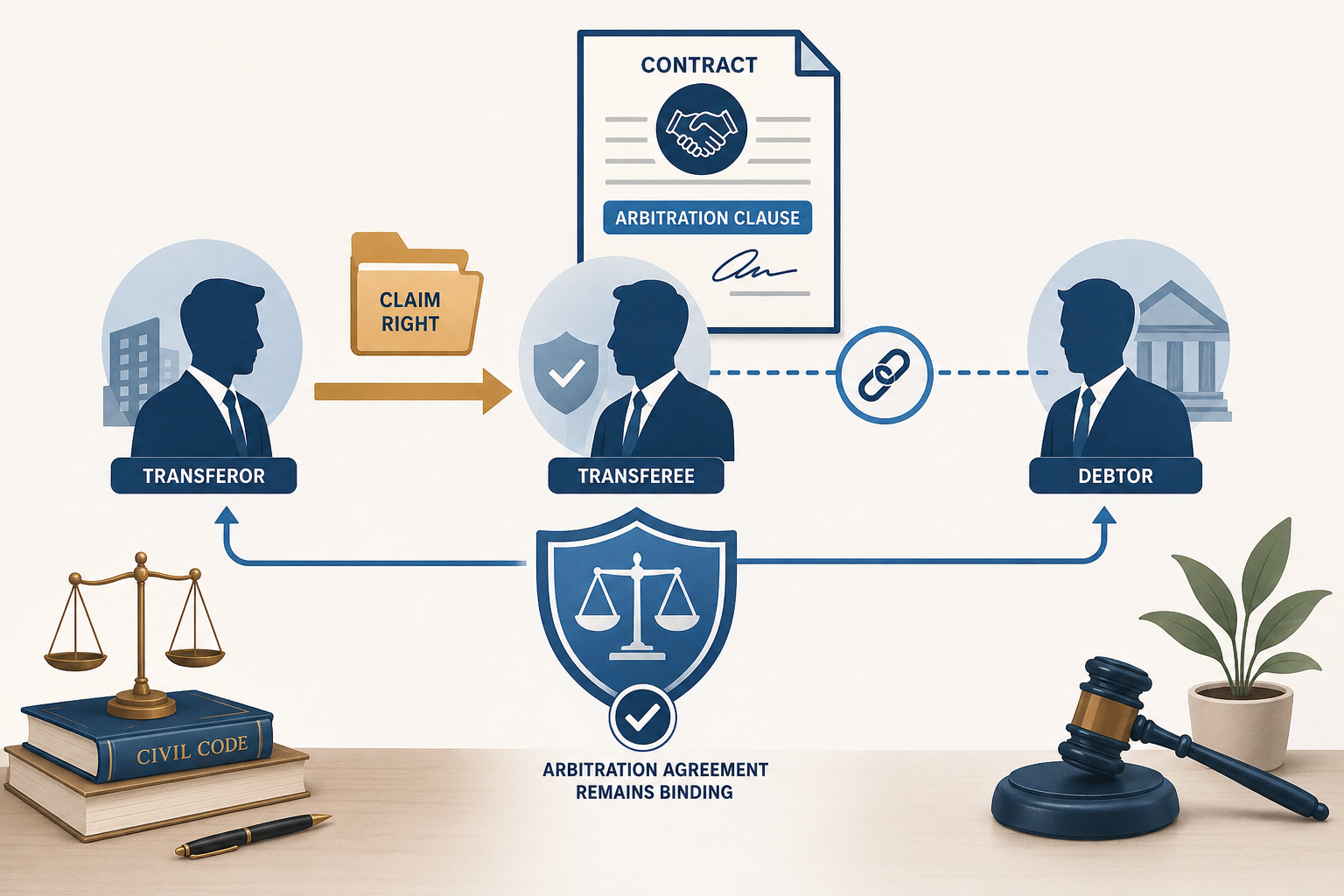
During the performance of a contract, a party may assign its right to claim to another person in accordance with the law. In such circumstances, an important legal issue arises: Is the assignee of the right to claim bound by the arbitration agreement contained in the contract?
1. Legal Basis
The assignment of a right to claim is governed by Article 365 of the 2015 Civil Code of Vietnam, which provides that a party entitled to demand the performance of an obligation may assign such right to an assignee by agreement, except in the following cases:
a) Rights to claim for maintenance, or compensation for damage caused to life, health, honour, dignity or reputation;
b) Where the obligee and the obligor have agreed, or the law provides, that the right to claim may not be assigned.
Upon a lawful assignment of the right to claim, the assignee becomes the new obligee. Such assignment does not require the consent of the obligor. However, the assignor must notify the obligor in writing of the assignment, unless otherwise agreed by the parties. If the assignor fails to provide such notice and the obligor thereby incurs additional expenses, the assignor shall be liable for those expenses.
With respect to arbitration agreements, Clause 3, Article 7 of Resolution No. 01/2014/NQ-HĐTP dated 20 March 2014 of the Council of Judges of the Supreme People's Court provides that:
"Where rights and obligations arising from a transaction or contract are assigned, and such transaction or contract contains a valid arbitration agreement, the arbitration agreement shall remain effective and binding upon both the assignor and the assignee, unless otherwise agreed by the parties."
Accordingly, Vietnamese law recognizes the principle that an arbitration agreement does not cease to be effective merely because contractual rights or obligations have been assigned. Where a contractual right to claim is lawfully assigned, the arbitration agreement incorporated in the contract continues to bind both the assignor and the assignee, unless the parties have expressly agreed otherwise.
This means that the assignee acquires not only the substantive right to claim under the contract but also succeeds to the dispute resolution mechanism previously agreed upon by the original contracting parties.
2. Practical Application
This principle has also been affirmed in arbitral practice.
In one dispute, the lender of property and the borrower had agreed to resolve disputes through arbitration. After the property was damaged, the lender assigned its right to claim compensation to an insurance company.
Although the insurance company and the borrower had never entered into an arbitration agreement directly with each other, the Arbitral Tribunal held that it had jurisdiction over the dispute. The Tribunal reasoned that the right to claim had been validly assigned and, pursuant to Clause 3, Article 7 of Resolution No. 01/2014/NQ-HĐTP, the arbitration agreement contained in the original contract remained effective and binding upon both the assignor and the assignee.
3. Practical Considerations for Businesses
When assigning contractual rights or obligations, businesses should not focus solely on the substantive rights and obligations being transferred. They should also carefully review the dispute resolution clause contained in the underlying contract.
Where the contract includes a valid arbitration agreement, the assignment of contractual rights or obligations will generally result in the arbitration agreement being transferred together with such rights or obligations, unless the parties have agreed otherwise.
4. Conclusion
Where rights or obligations arising from a transaction or contract containing a valid arbitration agreement are assigned, the arbitration agreement continues to be effective and binding upon both the assignor and the assignee, unless otherwise agreed by the parties.
Therefore, an assignment of a right to claim not only changes the holder of the substantive contractual right but may also result in the transfer of the agreed dispute resolution mechanism. This is an important legal issue that businesses should carefully consider when undertaking assignments of rights, transfers of obligations, mergers and acquisitions, or corporate restructuring transactions.
The article above has analyzed in detail is "DOES AN ASSIGNMENT OF A RIGHT TO CLAIM ALSO TRANSFER THE ARBITRATION AGREEMENT?". For more detailed information or legal assistance, please contact the MCAC Secretariat:
- Hotline: 0935 925 068 - 0236 3656799
- Email: contact@mcac.vn
- Read more: Benefits and risks of using artificial intelligence in Arbitration
Related news
WHICH LAW GOVERNS AN ARBITRATION AGREEMENT IN A CONTRACT WITH FOREIGN ELEMENTS?
In international commercial transactions, parties often agree on the law governing their contract and on arbitration as the method of dispute resolution. However, does the law governing the contract automatically govern the arbitration agreement? If the parties have not agreed on the applicable law, which country's law is used to determine the validity of the arbitration agreement?
MAY A COURT RE-EXAMINE THE MERITS OF A DISPUTE WHEN CONSIDERING AN APPLICATION TO SET ASIDE AN ARBITRAL AWARD?
When considering an application to set aside an arbitral award, is the Court entitled to reassess evidence, reconsider the parties' rights and obligations, or alter the findings and decisions made by the Arbitral Tribunal?