Working hour: Monday – Friday/8AM – 5PM
|Email: contact@mcac.vn
|Hotline: (+84) 935 925 068 - 0236 3656799
| Language:


Điện thoại: (+84) 935 925 068
Language:

EXPEDITED ARBITRATION WITH A SOLE ARBITRATOR: WHEN SHOULD BUSINESSES CHOOSE THIS OPTION?
02/11/2026


In resolving disputes through commercial arbitration, the parties may agree not only on the arbitral institution but also on the number of arbitrators and the applicable procedural rules. In this regard, expedited arbitration conducted by a sole arbitrator is an option that may be considered to address the dispute resolution requirements arising from the nature and particular circumstances of each case.
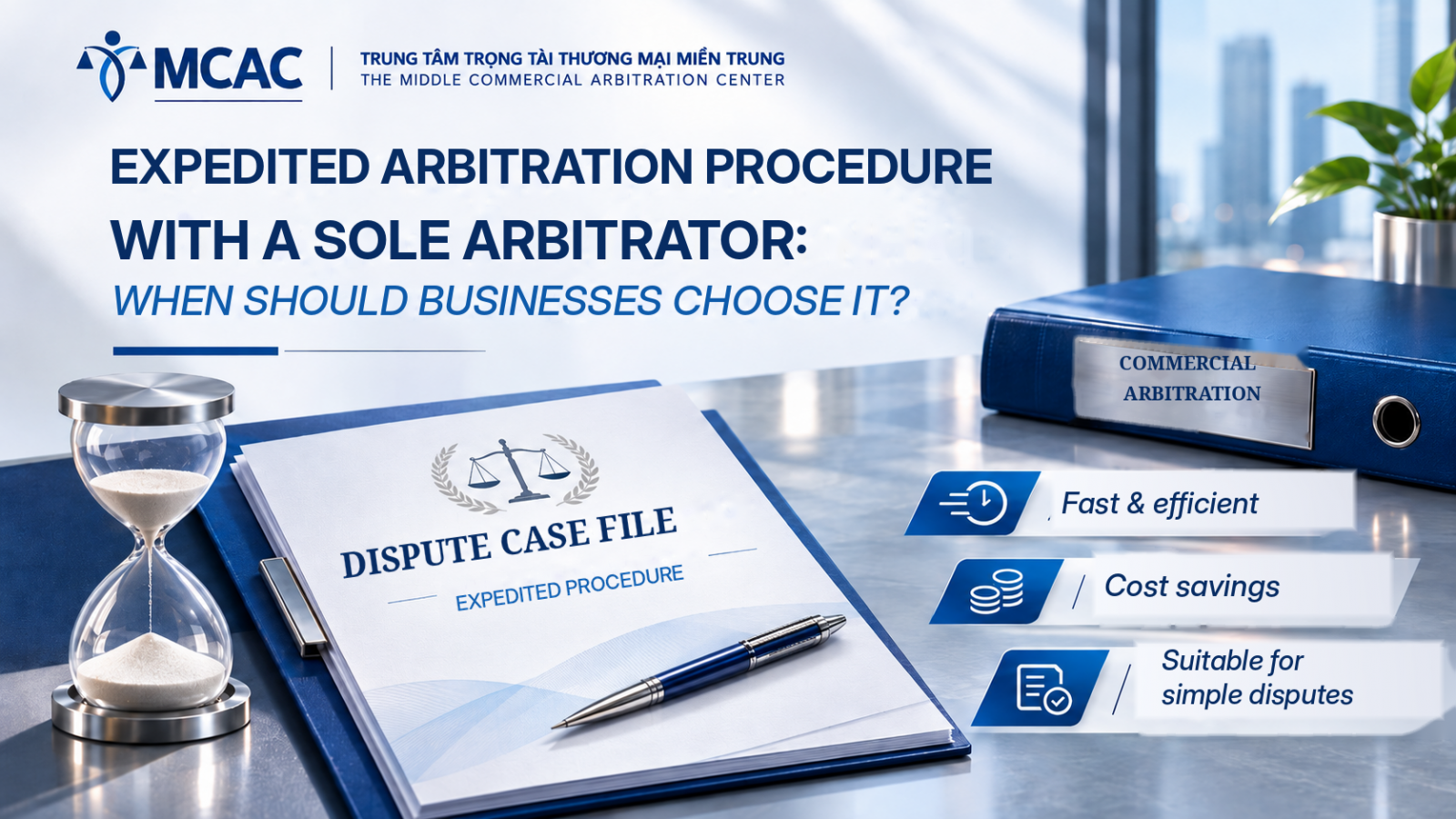
The selection of expedited procedures and an arbitral tribunal composed of a sole arbitrator must be considered in light of the parties’ agreement, applicable law, and the relevant arbitration rules. However, resolution of a dispute by a sole arbitrator does not necessarily mean that expedited procedures will apply. The questions, therefore, are under what conditions such procedures may be applied, what their distinguishing features are, and what factors businesses should consider when selecting an appropriate dispute resolution procedure.
1. How are expedited arbitration procedures with a sole arbitrator applied?
Under Article 39 of the 2010 Law on Commercial Arbitration, the arbitral tribunal may comprise one or more arbitrators as agreed by the parties. In the absence of an agreement on the number of arbitrators, the arbitral tribunal shall comprise three arbitrators.
For disputes administered by the Mien Trung Commercial Arbitration Center (MCAC), Clause 1 and Point (a), Clause 2, Article 37 of the MCAC Rules of Arbitration provide that expedited procedures apply where the parties so agree. In such cases, the arbitral tribunal shall comprise a sole arbitrator unless otherwise agreed by the parties. Under Points (b) and (c), Clause 2, Article 37, these procedures have the following features:
- The Center or the arbitral tribunal may shorten any time limit prescribed under the Rules of Arbitration.
- The arbitral tribunal may conduct a hearing to resolve the dispute on the basis of the available documents and evidence without the parties being present, unless either party objects.
- The arbitral tribunal may conduct a hearing by telephone, online, or by other appropriate means, unless either party objects.
Under Article 11 of the Rules of Arbitration, the parties may choose an arbitral tribunal consisting of three arbitrators or a sole arbitrator. In the absence of an agreement, the dispute shall be resolved by a three-member arbitral tribunal. Accordingly, the selection of a sole arbitrator does not automatically entail the application of expedited procedures.
2. Benefits of expedited procedures with a sole arbitrator
First, contributing to a shorter dispute resolution process.
Resolving a dispute through a sole arbitrator may simplify the constitution of the arbitral tribunal compared with a three-member tribunal. In addition, expedited procedures may permit shorter procedural time limits under the applicable rules. Nevertheless, the actual duration of proceedings depends on the nature of the dispute, the documents and evidence, and the procedural developments in each case.
Second, reducing dispute resolution costs.
Dispute resolution costs are among the factors to be considered when selecting the number of arbitrators and the applicable procedures. The specific fees depend on the fee schedule of the arbitral institution administering the dispute. At MCAC, under Section I.1.2 of the Schedule of Arbitration Fees, where the Statement of Claim or Counterclaim specifies the amount in dispute and the dispute is resolved by a sole arbitrator, the arbitration fee is 70% of the fee applicable to a three-member arbitral tribunal for the same amount in dispute.
The 70% fee rate referred to above applies only to fees determined under Section I.1 of the Schedule of Arbitration Fees; it does not cover all expenses incurred during dispute resolution. Expenses prescribed in Section I.4, such as travel, accommodation, expert examination, valuation, and expert consultation costs, are not subject to this reduction.
3. When should businesses consider expedited procedures?
First, where the dispute is relatively straightforward.
For disputes involving payment obligations, outstanding debts, or the performance of a specific contractual obligation, expedited procedures may be considered where the issues in dispute and the grounds for resolution are relatively clear.
Second, where costs need to be balanced against the amount in dispute.
For disputes involving relatively modest amounts, procedural costs may represent a significant proportion of the amount in dispute. Businesses should therefore assess the relationship between arbitration fees and the amount in dispute when selecting an appropriate procedure.
Third, where the documents and evidence are relatively complete and clear.
Where the case file contains essential documents and evidence, such as contracts, invoices, payment records, and delivery and acceptance records, and does not require complex verification or expert examination, expedited proceedings may be more practicable. However, this is a practical consideration in assessing suitability, not a separate condition for applying every form of expedited procedure.
Fourth, where the parties seek prompt resolution to stabilize business operations.
Where a dispute affects cash flow, commercial relationships, or the performance schedule of a contract, the parties may consider expedited procedures to resolve the dispute promptly and stabilize business operations, provided they have agreed to their application and cooperate during the proceedings.
4. Matters businesses should consider before making a choice
For disputes involving multiple parties, arising from multiple contracts, or raising complex legal or technical issues, businesses should assess whether resolution by a sole arbitrator is appropriate. In such circumstances, a three-member arbitral tribunal may be more suitable where the case calls for examination and assessment from different areas of expertise.
The application of expedited procedures does not dispense with the requirement to safeguard the parties’ rights to present their positions, submit evidence, and protect their lawful rights and interests. In proceedings at MCAC, Point (c), Clause 2, Article 37 of the Rules of Arbitration permits either party to object to a hearing being conducted in the parties’ absence or by telephone, online, or other appropriate means.
As the conditions and scope of expedited procedures depend on the parties’ agreement and the applicable arbitration rules, businesses should clearly specify their chosen procedures in the arbitration clause of the contract or in a separate agreement after a dispute has arisen.
The article above has analyzed in detail is "EXPEDITED ARBITRATION WITH A SOLE ARBITRATOR: WHEN SHOULD BUSINESSES CHOOSE THIS OPTION?". For more detailed information or legal assistance, please contact the MCAC Secretariat:
- Hotline: 0935 925 068 - 0236 3656799
- Email: contact@mcac.vn
- Read more:CONTRACT WITH THE ENGLISH VERSION PREVAILING: MUST ARBITRATION PROCEEDINGS BE CONDUCTED IN ENGLISH?
Related news
PARTY AUTONOMY IN COMMERCIAL ARBITRATION: SCOPE AND LIMITS
Party autonomy allows parties to determine the method and procedure for resolving their disputes through arbitration. However, this autonomy must be exercised within the limits of the law and the applicable arbitration rules.
APPLICATION OF EQUITY IN DISPUTE RESOLUTION THROUGH COMMERCIAL ARBITRATION
In international commercial arbitration, certain legal frameworks permit an arbitral tribunal to decide disputes on the basis of equity where the parties have expressly authorised it to do so. In Vietnam, the application of equity must be considered within the framework of the applicable law. This article examines the concept, legal basis and limitations of applying equity in commercial arbitration and highlights certain considerations for parties to disputes and arbitral tribunals.