Working hour: Monday – Friday/8AM – 5PM
|Email: contact@mcac.vn
|Hotline: (+84) 935 925 068 - 0236 3656799
| Language:



Điện thoại: (+84) 935 925 068
Language:

MATTERS RELATING TO THE ARBITRATION AGREEMENT CONSIDERED BY THE ARBITRAL TRIBUNAL
02/04/2026


In commercial arbitration proceedings, the arbitration agreement not only serves as the basis for establishing the jurisdiction of the Arbitral Tribunal but also guides the conduct of the proceedings and the resolution of the dispute. Therefore, prior to examining the merits of the case, the Arbitral Tribunal must consider issues related to the arbitration agreement in accordance with the law.
Based on the parties’ agreement, the Arbitral Tribunal reviews the contents of the arbitration agreement relevant to the dispute resolution, including: the place of arbitration, the number of arbitrators, the language of the arbitration proceedings, the applicable law, and other related matters.
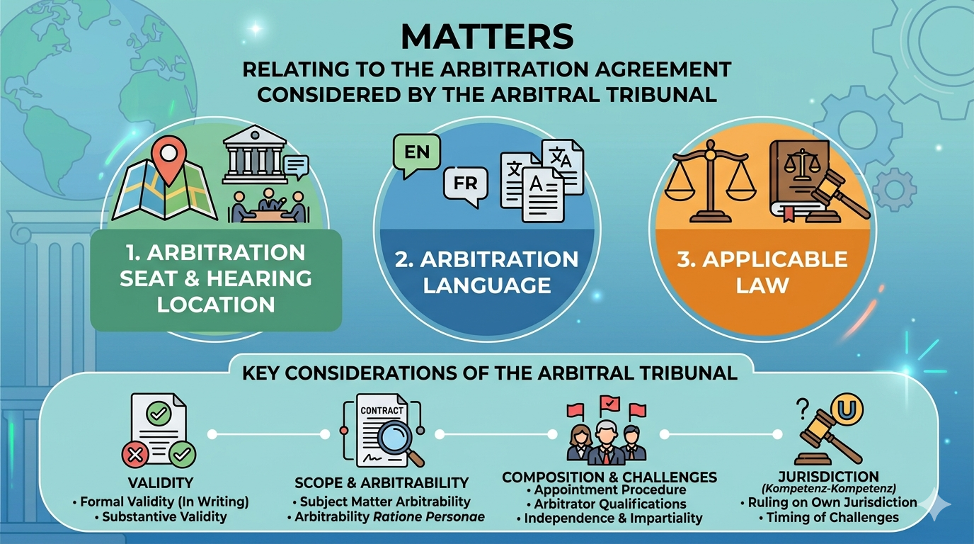
1.Determination of the place of arbitration and the venue of hearings
The place of arbitration depends on the agreement of the parties. In the absence of such agreement, the Arbitral Tribunal shall determine the place of arbitration as it deems appropriate.
- Where the parties have an agreement: The Arbitral Tribunal respects and applies such agreement.
- Where there is no agreement: The Arbitral Tribunal determines the place of arbitration based on the nature of the dispute and the convenience of the parties.
2.Determination of the language of arbitration
For disputes without foreign elements, the language used in arbitration proceedings is Vietnamese.
For disputes involving foreign elements or where at least one party is a foreign-invested enterprise:
- The language of arbitration shall be agreed upon by the parties.
- In the absence of such agreement, the Arbitral Tribunal shall determine the language(s) of the arbitration, taking into account relevant factors, including the language of the contract.
- If any document is made in a language other than the language of arbitration, the Arbitral Tribunal or the arbitral institution (if the Tribunal has not yet been constituted) may require a party or the parties to provide a translation.
3. Determination of the applicable law
- For disputes without foreign elements, Vietnamese law shall be applied by the Arbitral Tribunal.
- For disputes involving foreign elements, the Arbitral Tribunal shall apply the law chosen by the parties; in the absence of such choice, the Tribunal shall apply the law it considers most appropriate.
- The Arbitral Tribunal may also apply relevant trade usages to resolve the dispute.
In considering matters related to the arbitration agreement, the Arbitral Tribunal must adhere to the following principles:
- Respect for party autonomy;
- Independence, impartiality, and fairness;
- Efficiency, and saving time and costs;
- Compliance with relevant legal provisions.
Conclusion
The Arbitral Tribunal’s consideration of matters related to the arbitration agreement is a fundamental step with decisive significance for the entire proceedings. Proper determination of elements such as the place of arbitration, language, applicable law, and composition of the Tribunal not only ensures the legality of the procedure but also contributes to protecting the lawful rights and interests of the parties in dispute.
The article above has analyzed in detail is "Matters relating to the arbitration agreement considered by the arbitral tribunal". For more detailed information or legal assistance, please contact the MCAC Secretariat:
- Hotline: 0935 925 068 - 0236 3656799
- Email: contact@mcac.vn
- Read more: Procedures for resolution of disputes by arbitration at the middle commercial arbitration center (mcac)
Related news

WHICH LAW GOVERNS AN ARBITRATION AGREEMENT IN A CONTRACT WITH FOREIGN ELEMENTS?
In international commercial transactions, parties often agree on the law governing their contract and on arbitration as the method of dispute resolution. However, does the law governing the contract automatically govern the arbitration agreement? If the parties have not agreed on the applicable law, which country's law is used to determine the validity of the arbitration agreement?
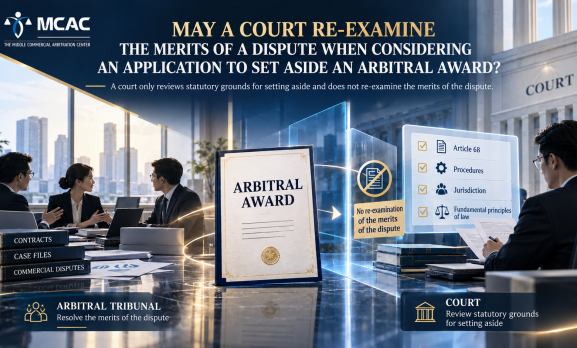
MAY A COURT RE-EXAMINE THE MERITS OF A DISPUTE WHEN CONSIDERING AN APPLICATION TO SET ASIDE AN ARBITRAL AWARD?
When considering an application to set aside an arbitral award, is the Court entitled to reassess evidence, reconsider the parties' rights and obligations, or alter the findings and decisions made by the Arbitral Tribunal?