Working hour: Monday – Friday/8AM – 5PM
|Email: contact@mcac.vn
|Hotline: (+84) 935 925 068 - 0236 3656799
| Language:



Điện thoại: (+84) 935 925 068
Language:

SELECTING THE NUMBER OF ARBITRATORS: BALANCING COST OPTIMISATION AND THE COMPREHENSIVENESS OF THE AWARD
17/08/2026


Commercial arbitration respects the parties’ freedom of agreement. In particular, selecting an arbitral tribunal composed of one Arbitrator or three Arbitrators directly affects two core objectives: the speed/cost of the proceedings and the quality/impartiality of the award.
.png)
1. Legal basis
When drafting an arbitration clause, businesses often focus on choosing an arbitration centre while paying little attention to agreeing on the number of Arbitrators who will resolve the dispute. Article 39 of the 2010 Law on Commercial Arbitration (LCA 2010) provides specifically:
“1. The arbitral tribunal may consist of one or more Arbitrators, as agreed by the parties.
2. Where the parties have no agreement on the number of Arbitrators, the arbitral tribunal shall consist of three Arbitrators.”
Accordingly, the law grants the parties the freedom to agree on the number of Arbitrators, thereby safeguarding their autonomy in arbitral proceedings. However, if the parties do not proactively address this matter in their arbitration agreement, the selection of Arbitrators will follow the statutory default mechanism: an arbitral tribunal composed of three members. This is also reflected in Article 11 of the Arbitration Rules of the Middle Commercial Arbitration Center (MCAC), ensuring that proceedings are conducted continuously, effectively, and without delay:
“1. A dispute shall be resolved by an Arbitral Tribunal consisting of three Arbitrators or a sole Arbitrator.
2. The parties have the right to select an Arbitral Tribunal consisting of three Arbitrators or a sole Arbitrator. In the absence of an agreement between the parties, the dispute shall be resolved by an Arbitral Tribunal consisting of three Arbitrators.”
2. Practical considerations in selecting Arbitrators in commercial arbitration proceedings
2.1. A sole Arbitrator – An optimal choice for straightforward disputes
For disputes of relatively low value or without overly complex legal issues, an arbitral tribunal composed of a sole Arbitrator often offers considerable benefits.
- Advantages: Procedural costs are significantly reduced because only one Arbitrator’s remuneration is incurred. The duration of the proceedings may also be considerably shortened, as there is no need for deliberation and consensus-building among Arbitrators. Scheduling consultations and hearings is likewise more convenient because there are no conflicting schedules among multiple Arbitrators.
- Legal limitations: An arbitral award is final and not subject to appeal. Therefore, entrusting the assessment of evidence and legal analysis entirely to a single individual may not sufficiently persuade the parties to the dispute. The absence of discussion and deliberation among Arbitrators may reduce the comprehensiveness of the case assessment.
2.2. Three Arbitrators – Enhancing impartiality in complex disputes
Conversely, an arbitral tribunal composed of three Arbitrators is considered more suitable for disputes involving multiple technical issues or significant economic value. Under Article 40 of LCA 2010, each party may appoint one Arbitrator, and the two Arbitrators shall then agree on the appointment of the Chairperson of the Arbitral Tribunal.
- Advantages: The exchange and deliberation among three Arbitrators require critical review and consideration of multiple legal perspectives, thereby enhancing the quality of reasoning, reducing errors in the assessment of evidence, and increasing the persuasiveness of the arbitral award. This helps minimise technical errors, misapplication of substantive law, or procedural violations – all of which may create a risk of the award being set aside by a court under Article 68 of LCA 2010.
- Limitations: Procedural costs are higher, and the time required to constitute the arbitral tribunal is longer than in a case with only one Arbitrator.
3. Conclusion
Selecting the number of Arbitrators is not merely a procedural matter; it is a strategic decision that directly affects the effectiveness of dispute resolution between the parties. While a sole-Arbitrator tribunal meets the need for speed and cost efficiency, a three-Arbitrator tribunal offers greater balance, impartiality, and reliability for complex cases. Businesses should therefore carefully consider the characteristics of the transaction from the contract-negotiation stage in order to select the appropriate option, rather than waiting until a dispute arises.
A well-drafted arbitration clause not only shortens the time required to constitute the arbitral tribunal but also limits procedural disputes from the outset of the proceedings.
The article above has analyzed in detail is "SELECTING THE NUMBER OF ARBITRATORS: BALANCING COST OPTIMISATION AND THE COMPREHENSIVENESS OF THE AWARD". For more detailed information or legal assistance, please contact the MCAC Secretariat:
- Hotline: 0935 925 068 - 0236 3656799
- Email: contact@mcac.vn
- Read more: CHANGES TO CORPORATE INFORMATION – KEY CONSIDERATIONS IN COMMERCIAL ARBITRATION PROCEEDINGS
Related news

WHICH LAW GOVERNS AN ARBITRATION AGREEMENT IN A CONTRACT WITH FOREIGN ELEMENTS?
In international commercial transactions, parties often agree on the law governing their contract and on arbitration as the method of dispute resolution. However, does the law governing the contract automatically govern the arbitration agreement? If the parties have not agreed on the applicable law, which country's law is used to determine the validity of the arbitration agreement?
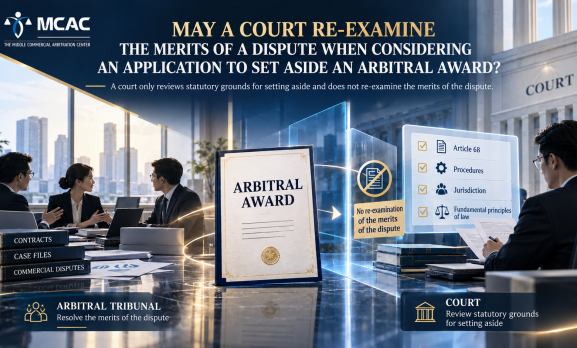
MAY A COURT RE-EXAMINE THE MERITS OF A DISPUTE WHEN CONSIDERING AN APPLICATION TO SET ASIDE AN ARBITRAL AWARD?
When considering an application to set aside an arbitral award, is the Court entitled to reassess evidence, reconsider the parties' rights and obligations, or alter the findings and decisions made by the Arbitral Tribunal?