Working hour: Monday – Friday/8AM – 5PM
|Email: contact@mcac.vn
|Hotline: (+84) 935 925 068 - 0236 3656799
| Language:



Điện thoại: (+84) 935 925 068
Language:

A PROPER UNDERSTANDING OF THE LIMITATION PERIOD FOR COMMENCING ARBITRATION PROCEEDINGS IN COMMERCIAL DISPUTES
24/07/2026


In commercial transactions, the right to initiate legal proceedings is meaningful only if exercised within the statutory limitation period prescribed by law. Accordingly, the limitation period serves not only as a legal mechanism to ensure certainty and stability in commercial transactions but also as an incentive for parties to proactively protect their lawful rights and interests. In the context of commercial arbitration, the proper identification and application of the limitation period are of particular importance, as they directly affect a party's right to seek dispute resolution through arbitration.
1. Overview of the Limitation Period for Arbitration Proceedings
1.1. Legal Basis
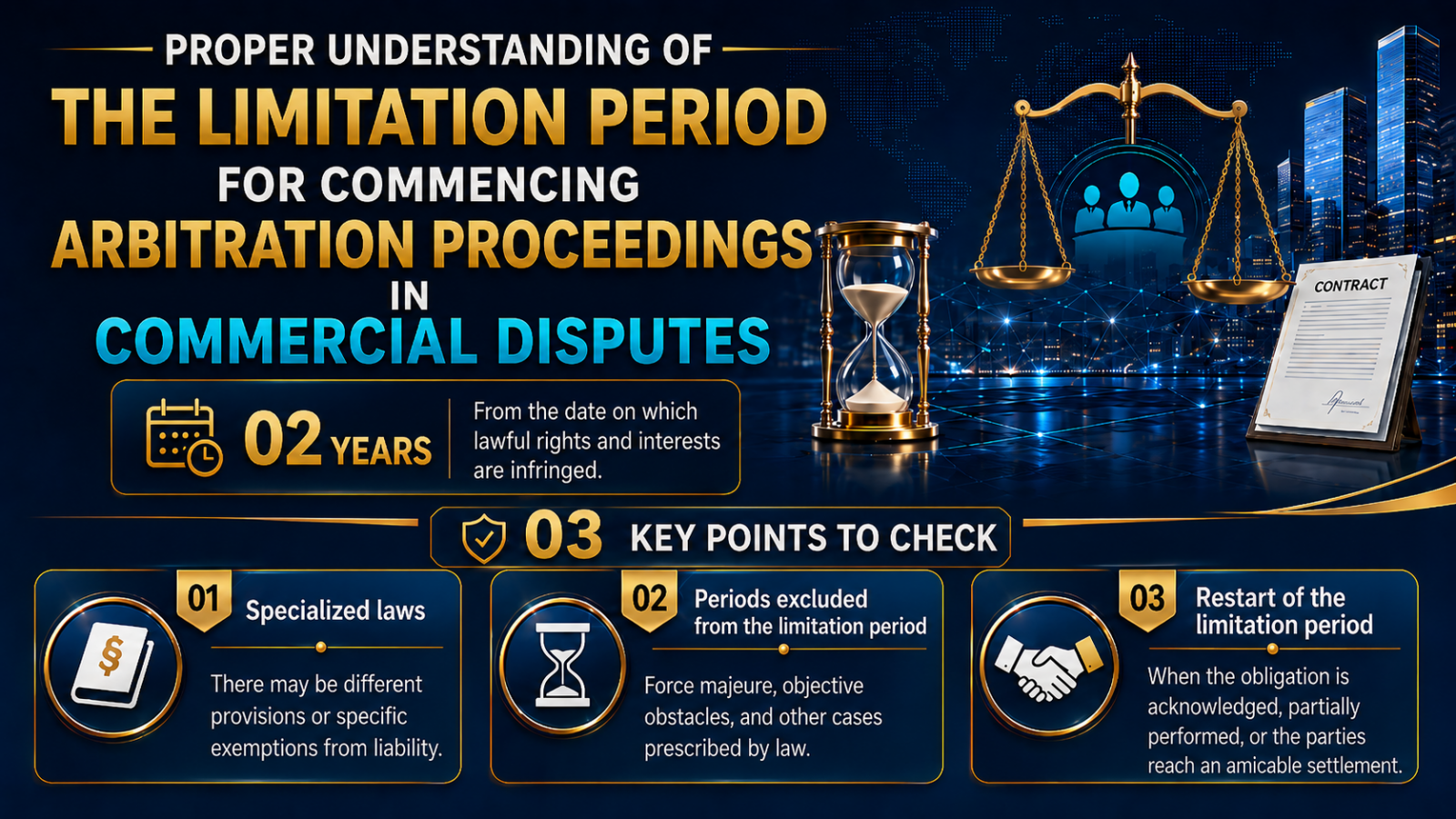
The limitation period for commencing legal proceedings refers to the period prescribed by law during which an entitled party may request a competent authority to resolve a dispute in order to protect its lawful rights and interests.
With respect to commercial arbitration, Article 33 of the Law on Commercial Arbitration 2010 ("LCA 2010") provides that:
"Unless otherwise provided by specialized laws, the limitation period for initiating arbitration proceedings shall be two (02) years from the date on which the lawful rights and interests are infringed."
Accordingly, the limitation period in arbitration proceedings is not determined by the date on which the contract is concluded, but rather by the date on which the claimant knew or should reasonably have known that its lawful rights and interests had been infringed.
1.2. Principle of Applying Specialized Laws in Determining the Limitation Period
A noteworthy aspect of Article 33 of the LCA 2010 is the phrase "unless otherwise provided by specialized laws." This reflects the principle that specialized legislation prevails where it prescribes a specific limitation period applicable to a particular legal relationship.
Accordingly, in determining the applicable limitation period, disputing parties should not rely solely on the LCA 2010 but must also examine any relevant specialized legislation governing the underlying legal relationship.
For example, Article 319 of the Commercial Law 2005 stipulates a limitation period of two (02) years for commercial disputes, commencing from the date on which the lawful rights and interests are infringed. However, disputes arising from logistics services are subject to a different regime. Pursuant to Point (e), Clause 1, Article 237 of the Commercial Law, where, after a complaint has been lodged, a logistics service provider does not receive notice of arbitration or court proceedings within nine (09) months from the date of delivery of the goods, the logistics service provider shall no longer be liable for any loss or damage to the goods.
2. Periods Excluded from the Limitation Period
Although the LCA 2010 prescribes the limitation period for commencing arbitration proceedings, it does not expressly regulate circumstances in which certain periods are excluded from the calculation of such limitation period.
In practice, arbitral tribunals often refer to Article 156 of the Civil Code 2015 in determining periods that should not be counted toward the limitation period.
Under Article 156 of the Civil Code 2015, the following periods are excluded from the limitation period:
(a) The period during which a force majeure event or an objective impediment prevents the person entitled to initiate legal proceedings from exercising such right within the statutory limitation period.
- A force majeure event refers to an event occurring objectively, which is unforeseeable and cannot be remedied despite the application of all necessary measures within the affected party's capacity.
- An objective impediment refers to circumstances beyond a person's control that prevent such person from knowing that his or her lawful rights and interests have been infringed or from exercising his or her civil rights or performing civil obligations.
(b) The period during which the person entitled to initiate legal proceedings is a minor, a person lacking civil act capacity, a person with difficulties in cognition or behavioral control, or a person with limited civil act capacity, and no legal representative has been appointed.
(c) The period during which the legal representative of the above-mentioned persons no longer exists and no replacement representative has been appointed because:
(i) the representative dies (if an individual) or ceases to exist (if a legal entity); or
(ii) the representative is unable to continue acting for legitimate reasons.
3. Circumstances in Which the Limitation Period Recommences
Article 157 of the Civil Code 2015 further provides that the limitation period shall recommence in any of the following circumstances:
- the obligor acknowledges all or part of its obligations toward the claimant;
- the obligor performs part of its obligations toward the claimant or otherwise acknowledges such obligations; or
- the parties successfully reach an amicable settlement.
In such cases, the limitation period recommences on the day immediately following the occurrence of one of the above events.
These provisions safeguard a party's right to commence proceedings where the underlying obligation continues to be acknowledged or where the parties are actively seeking to resolve their dispute, while also encouraging good faith performance of obligations and amicable settlement.
4. Practical Application of the Limitation Period in Arbitration Proceedings
In practice, the issue of limitation is generally considered by the arbitral tribunal only upon the request of a party to the dispute.
Where a respondent believes that the claimant's request is time-barred, it may raise such objection in its Statement of Defence or at any stage of the proceedings before the arbitral tribunal renders its final award. In the absence of such request, the arbitral tribunal will not, on its own initiative, invoke the expiration of the limitation period as a ground for refusing to hear the dispute and will continue with the arbitration proceedings.
The LCA 2010 does not authorize an arbitration center to reject a Statement of Claim or refuse to administer a case solely because the claim appears to be time-barred. The arbitration center is responsible only for receiving the Statement of Claim and handling the initial administrative procedures.
Once constituted, the arbitral tribunal is responsible for examining substantive issues, including the date on which the claimant's lawful rights and interests were infringed, the applicability of specialized legislation, any periods excluded from the limitation period, and any grounds for recommencement of the limitation period. The issue of limitation will be considered only if a party requests its application.
Where such a request is made and the arbitral tribunal concludes that the claim has been brought after the expiration of the applicable limitation period, with no grounds for excluding any period or recommencing the limitation period, the tribunal shall address this issue in its arbitral award and decline to grant or consider the time-barred claim.
It should be noted that the expiration of the limitation period does not constitute a ground for terminating arbitration proceedings under Article 59 of the LCA 2010.
5. Conclusion
The provisions governing the limitation period under the LCA 2010 are generally considered appropriate, striking a balance between protecting a party's right to seek dispute resolution and ensuring certainty and stability in commercial transactions.
Nevertheless, practical application continues to give rise to disputes regarding the determination of the commencement of the limitation period, particularly in disputes involving construction contracts, long-term service agreements, or obligations performed in multiple stages.
To minimize legal risks, businesses should carefully record the date on which any breach occurs, promptly initiate arbitration proceedings within the applicable limitation period, and strictly comply with procedural requirements in order to effectively safeguard their lawful rights and interests.
The article above has analyzed in detail is "PROPER UNDERSTANDING OF THE LIMITATION PERIOD FOR COMMENCING ARBITRATION PROCEEDINGS IN COMMERCIAL DISPUTES ". For more detailed information or legal assistance, please contact the MCAC Secretariat:
- Hotline: 0935 925 068 - 0236 3656799
- Email: contact@mcac.vn
- Read more: 10 COMMON LATIN TERMS IN INTERNATIONAL ARBITRATION
Related news
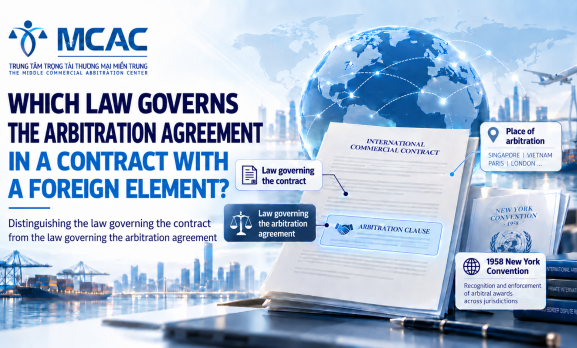
WHICH LAW GOVERNS AN ARBITRATION AGREEMENT IN A CONTRACT WITH FOREIGN ELEMENTS?
In international commercial transactions, parties often agree on the law governing their contract and on arbitration as the method of dispute resolution. However, does the law governing the contract automatically govern the arbitration agreement? If the parties have not agreed on the applicable law, which country's law is used to determine the validity of the arbitration agreement?
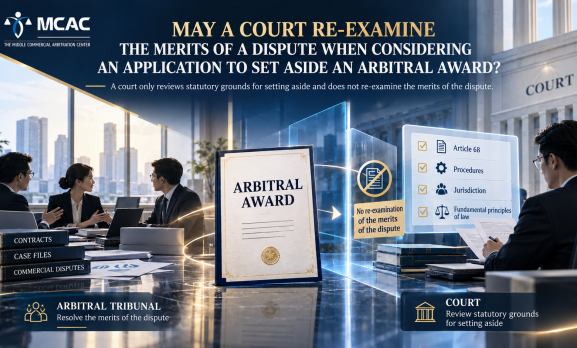
MAY A COURT RE-EXAMINE THE MERITS OF A DISPUTE WHEN CONSIDERING AN APPLICATION TO SET ASIDE AN ARBITRAL AWARD?
When considering an application to set aside an arbitral award, is the Court entitled to reassess evidence, reconsider the parties' rights and obligations, or alter the findings and decisions made by the Arbitral Tribunal?