Working hour: Monday – Friday/8AM – 5PM
|Email: contact@mcac.vn
|Hotline: (+84) 935 925 068 - 0236 3656799
| Language:



Điện thoại: (+84) 935 925 068
Language:

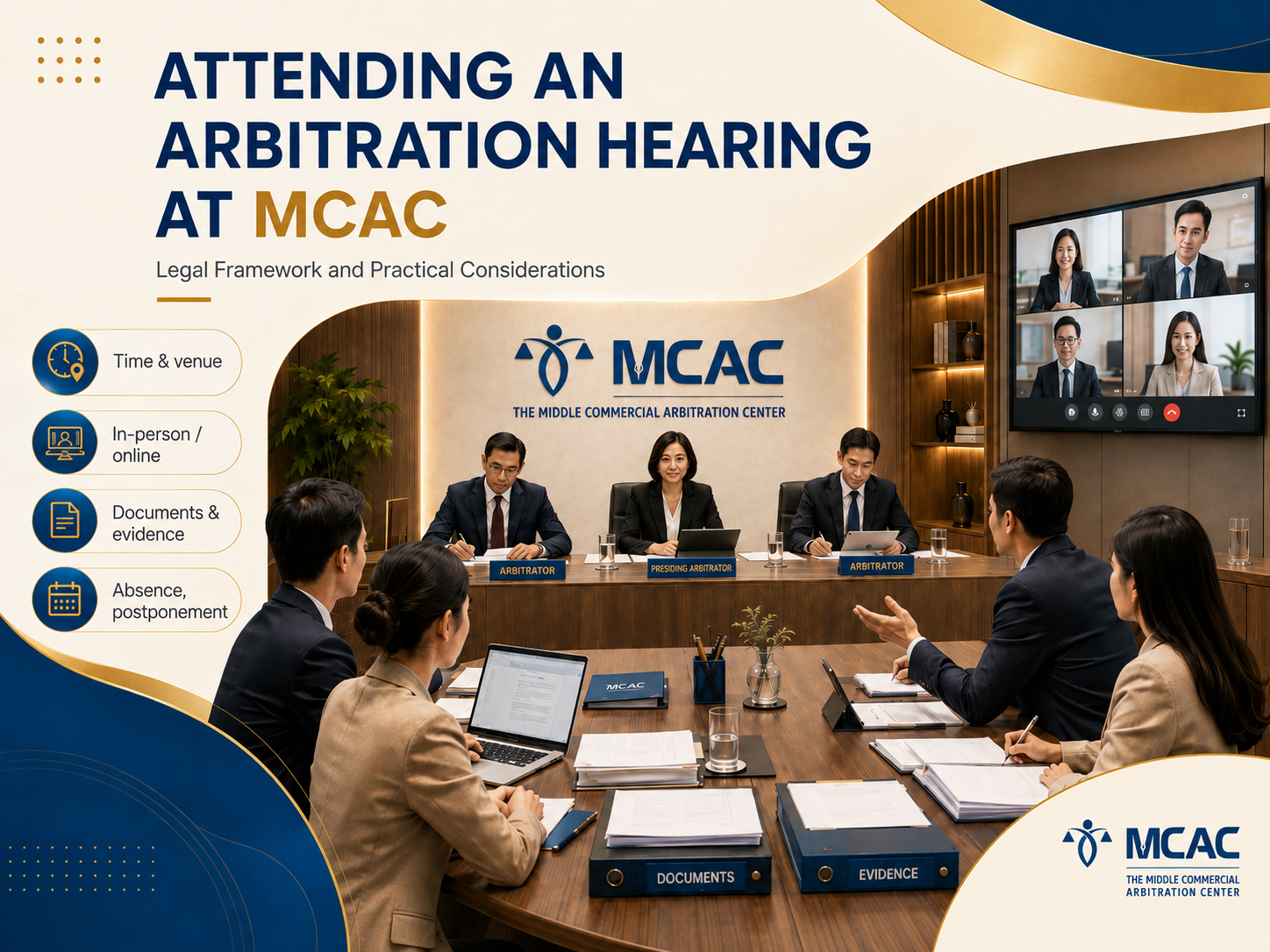
ATTENDING AN ARBITRATION HEARING AT MCAC: LEGAL FRAMEWORK AND PRACTICAL CONSIDERATIONS
07/08/2026


The arbitral hearing is a crucial stage in the arbitration proceedings, providing the parties with an opportunity to directly present their arguments, clarify their claims, counterclaims, statements of defense, and explain the documents and evidence before the Arbitral Tribunal. To participate effectively and minimize legal risks, parties should pay attention to the following key issues.
1. Time and Venue of the Hearing
Pursuant to Article 54(1) of the Law on Commercial Arbitration 2010 (the LCA), unless otherwise agreed by the parties, the time and venue of the hearing shall be determined by the Arbitral Tribunal. Article 22 of the MCAC Rules of Arbitration likewise provides that the place of arbitration shall be agreed upon by the parties; failing such agreement, the Arbitral Tribunal shall determine an appropriate venue. Accordingly, the hearing is not required to be held at the headquarters of the Middle Commercial Arbitration Center (MCAC) and may take place at another suitable location, depending on the nature of the dispute and the parties' circumstances.
Regarding the notice period, Article 54(2) of the LCA provides that, unless otherwise agreed by the parties or stipulated in the arbitration rules of the arbitral institution, the notice of hearing must be sent at least thirty (30) days before the hearing date. For disputes administered by MCAC, Article 25(1) of the MCAC Rules of Arbitration requires that the Notice of Hearing be sent at least fifteen (15) days before the hearing, unless the parties agree otherwise. If the hearing is adjourned or a subsequent hearing is scheduled, the notice period shall be determined by the Arbitral Tribunal pursuant to Article 25(2) of the MCAC Rules.
2. Forms of Hearing
Hearings may be conducted either in person or by virtual means. Under Article 22 of the MCAC Rules of Arbitration, where the parties so agree, the Arbitral Tribunal may conduct the hearing by telephone conference, video conference, or any other appropriate means. Virtual hearings facilitate participation when the parties, their representatives, or members of the Arbitral Tribunal are located in different places, while also reducing time and costs.
Regardless of the format, the hearing must ensure equality of the parties, the right to present arguments, the right to submit evidence, and the confidentiality requirements set out in Article 4 of the Law on Commercial Arbitration 2010.
3. Confidentiality and Participants
Articles 4(4) and 55(1) of the LCA provide that arbitration proceedings, including arbitral hearings, shall be conducted in private unless the parties agree otherwise. This principle is also reflected in Article 25(3) of the MCAC Rules of Arbitration. The confidential nature of arbitration helps protect trade secrets, internal business information, corporate reputation, and other legitimate interests of the parties.
Pursuant to Article 55(2) of the LCA, parties may attend the hearing in person or authorize representatives in writing. Article 4 of the MCAC Rules also recognizes the parties' right to participate personally or through lawful representatives and to engage legal counsel or other persons to protect their lawful rights and interests.
Experts, appraisers, valuers, or other specialists may attend the hearing if invited or approved by the Arbitral Tribunal under Article 55(3) of the LCA and Article 19 of the MCAC Rules. Other persons may attend only with the permission of the Arbitral Tribunal and the consent of the parties pursuant to Article 55(4) of the LCA and Article 25(3) of the MCAC Rules.
4. Preparation and Submission of Documents and Evidence
Under Article 46(1) of the LCA and Article 18 of the MCAC Rules of Arbitration, each party has both the right and the obligation to submit documents and evidence supporting its statement of claim, counterclaim, statement of defense, and other relevant issues.
The Arbitral Tribunal may request the parties to provide additional evidence, appoint experts, conduct property valuation, or consult specialists pursuant to Article 45 of the LCA and Article 19 of the MCAC Rules. Where necessary measures have been taken but evidence cannot be obtained independently, the Arbitral Tribunal or the parties may request assistance from the competent court under Article 46 of the LCA.
Before the hearing, parties should review and organize their evidence according to each claim or issue to be proven and arrange documents chronologically or by subject matter for ease of presentation and reference.
Pursuant to Article 25(4) of the MCAC Rules, if the Arbitral Tribunal determines that the parties have no further documents or evidence to submit, it may declare the hearing to be the final hearing. After that point, the Tribunal is under no obligation to consider additional evidence unless otherwise agreed by the parties. Accordingly, parties should avoid waiting until after the final hearing to submit important documents.
Under Article 61(3) of the LCA and Article 32(3) of the MCAC Rules, the arbitral award must be rendered within thirty (30) days from the conclusion of the final hearing.
5. Consequences of a Party's Absence
Under Article 56(1) of the LCA, if the claimant, after having been duly summoned, fails to appear without a legitimate reason or leaves the hearing without the consent of the Arbitral Tribunal, the claimant shall be deemed to have withdrawn its Statement of Claim. Article 27(1) of the MCAC Rules provides that the Tribunal shall continue the proceedings only if the respondent requests continuation or has filed a counterclaim.
With respect to the respondent, Article 56(2) of the LCA provides that if the respondent, after being duly summoned, fails to appear without a legitimate reason or leaves the hearing without approval, the Arbitral Tribunal shall continue the proceedings on the basis of the available documents and evidence.
Where the respondent has filed a counterclaim but is absent under these circumstances, the respondent shall be deemed to have withdrawn the counterclaim. Under Article 27(2) of the MCAC Rules, the Tribunal shall continue considering the counterclaim only if the claimant so requests.
Furthermore, Article 56(3) of the LCA and Article 27(3) of the MCAC Rules permit the Tribunal to proceed with the hearing where a party has submitted a written request to be absent. If the parties agree that no hearing is necessary, the Tribunal may decide the dispute solely on the basis of the case file, documents, and evidence pursuant to Article 27(4) of the MCAC Rules.
6. Request for Adjournment
Article 57 of the LCA provides that where there are legitimate grounds, either party or both parties may request an adjournment of the hearing.
Article 26 of the MCAC Rules requires such request to be made in writing, clearly stating the reasons, accompanied by supporting documents, and submitted to MCAC no later than seven (7) working days before the scheduled hearing. If the request is submitted after the prescribed deadline, the requesting party shall bear any additional costs arising from the adjournment, if any.
The Arbitral Tribunal shall decide whether to grant the request, determine the duration of the adjournment, and fix the date of the resumed hearing. The Tribunal may also adjourn the hearing on its own initiative where objective obstacles arise.
Submitting a request for adjournment does not automatically postpone the hearing. Parties should only change their attendance arrangements after receiving the Tribunal's official notification.
7. Settlement During the Arbitration Proceedings
Article 9 of the LCA recognizes the parties' right to negotiate, settle the dispute amicably, or request the Arbitral Tribunal to conduct mediation.
If the parties reach a settlement, the Arbitral Tribunal shall prepare a record of successful settlement and issue a Decision Recognizing the Parties' Settlement pursuant to Article 58 of the LCA and Article 29 of the MCAC Rules. Such decision is final and has the same legal effect as an arbitral award.
8. Practical Checklist Before the Hearing
Before attending the hearing, parties should:
- Carefully verify the hearing date, venue, format, and the contents of the Notice of Hearing;
- Confirm who will attend the hearing, including authorized representatives and legal counsel or other persons protecting their lawful rights and interests;
- Prepare powers of attorney and documents evidencing procedural standing;
- Review the statement of claim, counterclaim, statement of defense, and the issues remaining in dispute;
- Organize all documents and evidence and prepare oral submissions and explanations;
- Submit any request for adjournment or request to be absent within the prescribed time limit where legitimate reasons exist;
- Comply with all directions, procedural orders, and instructions of the Arbitral Tribunal.
Conclusion
The arbitral hearing is a critical stage of the arbitration proceedings, allowing the parties to present their positions, clarify their claims, and protect their lawful rights and interests before the Arbitral Tribunal. Accordingly, parties should thoroughly prepare their case files, supporting documents, evidence, and oral submissions, while ensuring they fully understand the rules governing attendance, absence, adjournment, and settlement. Proper preparation and strict compliance with the applicable procedural rules will contribute to efficient, impartial, and effective dispute resolution at MCAC while minimizing potential adverse legal consequences.
The article above has analyzed in detail is "ATTENDING AN ARBITRATION HEARING AT MCAC: LEGAL FRAMEWORK AND PRACTICAL CONSIDERATIONS". For more detailed information or legal assistance, please contact the MCAC Secretariat:
- Hotline: 0935 925 068 - 0236 3656799
- Email: contact@mcac.vn
- Read more: GENERAL PROVISIONS ON THE SERVICE OF NOTICES AND DOCUMENTS AT MCAC
Related news
WHICH LAW GOVERNS AN ARBITRATION AGREEMENT IN A CONTRACT WITH FOREIGN ELEMENTS?
In international commercial transactions, parties often agree on the law governing their contract and on arbitration as the method of dispute resolution. However, does the law governing the contract automatically govern the arbitration agreement? If the parties have not agreed on the applicable law, which country's law is used to determine the validity of the arbitration agreement?
MAY A COURT RE-EXAMINE THE MERITS OF A DISPUTE WHEN CONSIDERING AN APPLICATION TO SET ASIDE AN ARBITRAL AWARD?
When considering an application to set aside an arbitral award, is the Court entitled to reassess evidence, reconsider the parties' rights and obligations, or alter the findings and decisions made by the Arbitral Tribunal?