Working hour: Monday – Friday/8AM – 5PM
|Email: contact@mcac.vn
|Hotline: (+84) 935 925 068 - 0236 3656799
| Language:



Điện thoại: (+84) 935 925 068
Language:

GENERAL PROVISIONS ON THE SERVICE OF NOTICES AND DOCUMENTS AT MCAC
05/08/2026


In arbitration proceedings, the service and receipt of notices and documents play a vital role in ensuring that the parties are fully informed, able to exercise their procedural rights and fulfill their procedural obligations, while also facilitating a continuous, transparent, and timely dispute resolution process. The Rules of Arbitration of the Middle Commercial Arbitration Center (MCAC) set out specific provisions regarding the number of document copies to be submitted, methods of service, the time at which notices and documents are deemed received, and the calculation of procedural time limits. This article outlines the key provisions that parties should be aware of when submitting notices and documents to MCAC.
1. How many copies of notices and documents must the parties submit to MCAC?
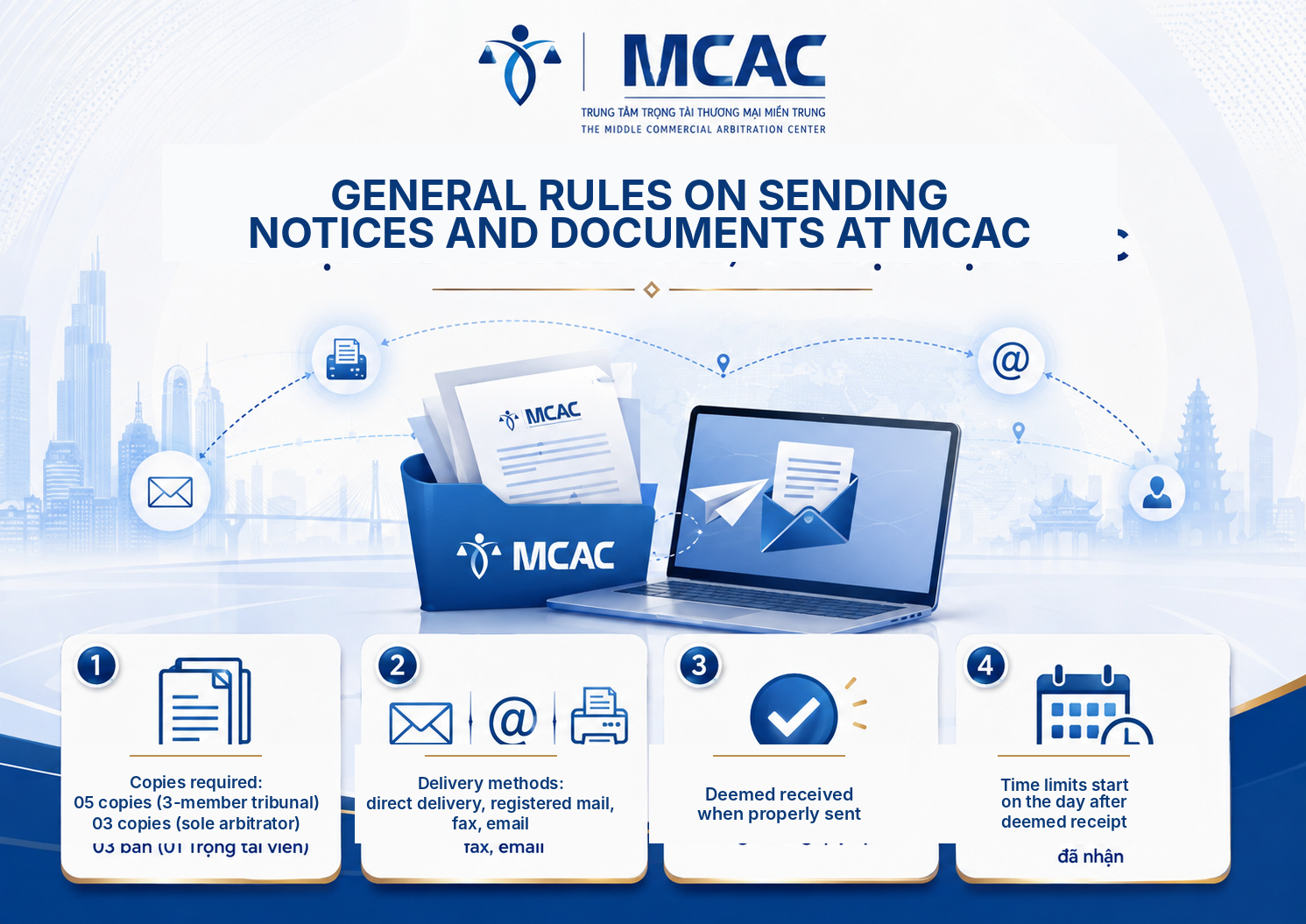
Pursuant to Article 3.1 of the MCAC Rules of Arbitration, any notice or document submitted by a party to the Center must be provided in a sufficient number of copies for the Center to distribute one copy to each member of the Arbitral Tribunal, one copy to the opposing party, and retain one copy for its records.
In practice, where the Arbitral Tribunal consists of three arbitrators, each party should submit five (05) copies of the relevant documents. Where the dispute is heard by a sole arbitrator, each party should submit three (03) copies.
2. By what methods does MCAC serve notices and documents on the parties?
Under Article 3.2 of the MCAC Rules of Arbitration, the Center may serve notices and documents on the parties by any of the following methods:
- Personal delivery;
- Registered mail;
- Facsimile (fax);
- Email; or
- Any other method that provides a record of the transmission.
The availability of multiple methods of service helps ensure that notices and documents are delivered to the parties in a convenient, efficient, and verifiable manner.
3. When are notices and documents served by MCAC deemed to have been received?
According to Article 3.3 of the MCAC Rules of Arbitration, notices and documents served by the Center are deemed to have been received if they have been sent in accordance with Article 3.2 of the Rules, namely:
"Notices and documents shall be sent by the Center to the addresses provided by the parties and may be served by personal delivery, registered mail, facsimile, email, or any other method that provides a record of such transmission."
Accordingly, parties should ensure that they provide MCAC with complete and accurate contact information, including their mailing address, email address, and any other relevant contact details, and promptly notify the Center of any changes to such information.
4. How are procedural time limits calculated under the MCAC Rules of Arbitration?
The time limits prescribed under the MCAC Rules of Arbitration commence on the day following the date on which a notice or document is deemed to have been received in accordance with Article 3.3 of the Rules:
"Notices and documents sent by the Center shall be deemed received on the date they are actually received by the parties or are deemed to have been received if they have been served in accordance with Article 3.2 of these Rules."
The calculation of procedural time limits is as follows:
- If the first day of the time period falls on a non-business day at the place of receipt, the time period shall commence on the first following business day.
- If the final day of the time period falls on a non-business day at the place of receipt, the time period shall expire at the end of the first following business day.
- Non-business days occurring during the running of the time period shall nevertheless be counted in calculating the time limit.
Parties should pay close attention to the date on which notices and documents are deemed to have been received in order to ensure the timely exercise of their procedural rights and the fulfillment of their procedural obligations.
The article above has analyzed in detail is "GENERAL PROVISIONS ON THE SERVICE OF NOTICES AND DOCUMENTS AT MCAC". For more detailed information or legal assistance, please contact the MCAC Secretariat:
- Hotline: 0935 925 068 - 0236 3656799
- Email: contact@mcac.vn
- Read more: SPECIAL TOPIC: AN ARBITRATION AGREEMENT CONCLUDED BY A PERSON WITHOUT AUTHORITY TO ACT AS THE LEGAL REPRESENTATIVE
Related news
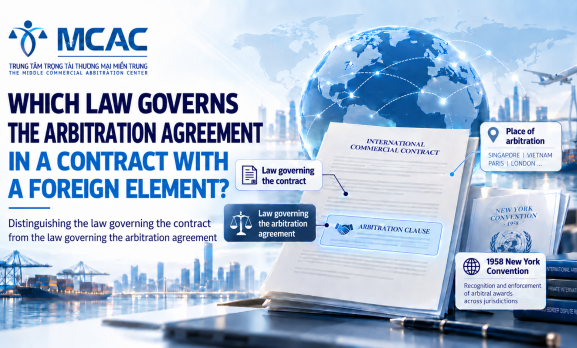
WHICH LAW GOVERNS AN ARBITRATION AGREEMENT IN A CONTRACT WITH FOREIGN ELEMENTS?
In international commercial transactions, parties often agree on the law governing their contract and on arbitration as the method of dispute resolution. However, does the law governing the contract automatically govern the arbitration agreement? If the parties have not agreed on the applicable law, which country's law is used to determine the validity of the arbitration agreement?
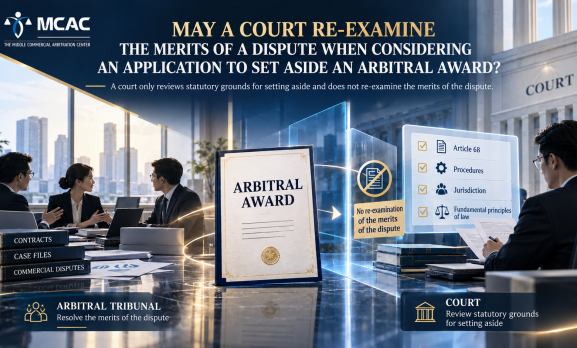
MAY A COURT RE-EXAMINE THE MERITS OF A DISPUTE WHEN CONSIDERING AN APPLICATION TO SET ASIDE AN ARBITRAL AWARD?
When considering an application to set aside an arbitral award, is the Court entitled to reassess evidence, reconsider the parties' rights and obligations, or alter the findings and decisions made by the Arbitral Tribunal?