Working hour: Monday – Friday/8AM – 5PM
|Email: contact@mcac.vn
|Hotline: (+84) 935 925 068 - 0236 3656799
| Language:



Điện thoại: (+84) 935 925 068
Language:

SPECIAL TOPIC: AN ARBITRATION AGREEMENT CONCLUDED BY A PERSON WITHOUT AUTHORITY TO ACT AS THE LEGAL REPRESENTATIVE
03/08/2026


1. Case Background
An Arbitral Tribunal under Arbitration Center X resolved a dispute arising from Interior Design and Construction Contract No. 25/2012/HĐKT/TGĐ.OZ between Anh & Quan Company (the Respondent) and OZ Company (the Claimant). The Construction Contract was signed by Mr. Toshio, who was not the legal representative of Anh & Quan Company.
Based on the relevant case files and documents, the Arbitral Tribunal determined that although the arbitration agreement contained in the Contract had not been signed by the legal representative of Anh & Quan Company, it was not deemed invalid.
At the hearing, the representatives of Anh & Quan Company confirmed that the outstanding amount had not been paid because the works performed by OZ Company allegedly failed to meet the required quality standards and had not yet been accepted, handed over, or subject to final account settlement.
Anh & Quan Company argued that because Mr. Toshio lacked the legal capacity and authority to act as its legal representative when entering into the Contract, the Contract was invalid, thereby rendering the arbitration agreement invalid.
The competent People’s Court of Ho Chi Minh City held that the arbitration agreement was not invalid.
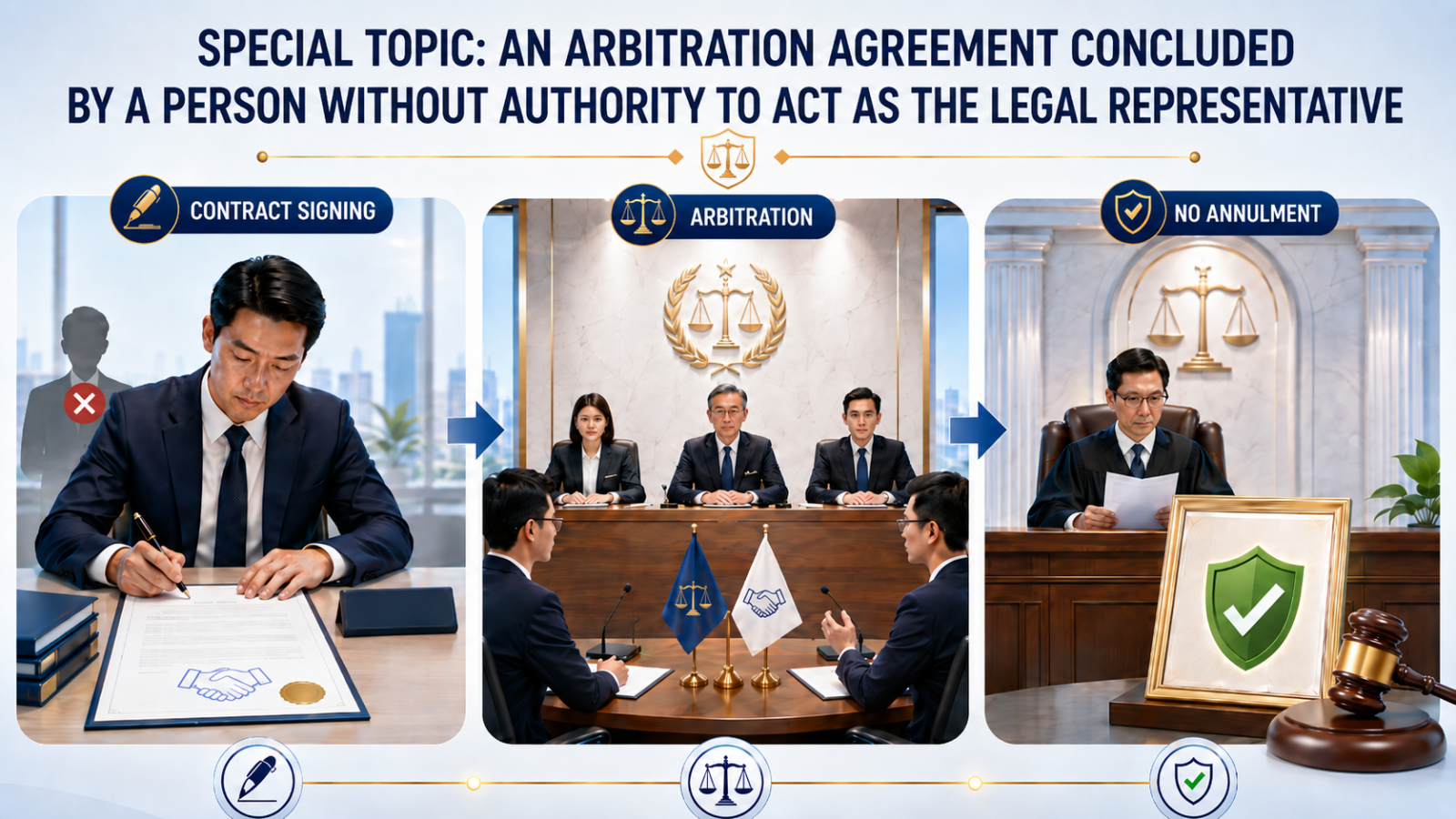
2. Judgment and Decision
Decision No. 810/2017/QĐ-PQTT dated 29 June 2017 of the People’s Court of Ho Chi Minh City
Regarding the legal validity of Interior Design and Construction Contract No. 25/2012/HĐKT/TGĐ.OZ dated 9 April 2012, although the Construction Contract was signed by Mr. Toshio, who was not the legal representative of Anh & Quan Company, the two companies had, in practice, exchanged numerous documents and reconciled their outstanding accounts during the performance of the works.
In its Statement of Defense dated 30 January 2015 and at the arbitral hearing, the representatives of Anh & Quan Company confirmed that the outstanding amount had not been paid because the works performed by OZ Company allegedly failed to meet the required quality standards and had not yet been accepted, handed over, or subject to final account settlement.
Prior to the commencement of the arbitration proceedings, Anh & Quan Company had not issued any written document denying the validity of Contract No. 25/2012/HĐKT/TGĐ.OZ dated 9 April 2012 signed by Mr. Toshio. This provided sufficient grounds to determine that Anh & Quan Company was aware of and consented to the performance of the Contract signed by Mr. Toshio.
Anh & Quan Company’s argument that Mr. Toshio lacked the legal capacity and authority to act as its legal representative when entering into the Contract, thereby rendering the Contract and consequently the arbitration agreement invalid, had no legal basis.
Upon reviewing the Arbitral Award dated 8 July 2015, the Court Panel considering the application found that:
-
The arbitration agreement between the parties was lawful and valid.
-
The composition of the Arbitral Tribunal and the arbitral proceedings complied with the law and the parties’ agreement.
-
All parties acknowledged that the dispute fell within the jurisdiction of the Arbitral Tribunal.
-
There was no evidence that any document or evidence submitted by the parties and relied upon by the Arbitral Tribunal in rendering the Award had been forged.
-
The Arbitral Award was not contrary to the fundamental principles of Vietnamese law.
Accordingly, the grounds advanced by Anh & Quan Company in support of its application to set aside the Arbitral Award did not fall within the statutory grounds for setting aside an arbitral award under Article 68 of the Law on Commercial Arbitration. Therefore, there were no grounds for the Court Panel to accept the application submitted by Anh & Quan Joint Stock Company.
The People’s Procuracy of Ho Chi Minh City, which participated in the hearing, expressed the following opinion:
The Court Panel should reject Anh & Quan Company’s application to set aside the Arbitral Award rendered by the Arbitral Tribunal under Arbitration Center X on 8 July 2015 in Ho Chi Minh City.
For the foregoing reasons,
DECIDES:
1. Not to set aside Arbitral Award No. 68/14HCM rendered by the Arbitral Tribunal under Arbitration Center X on 8 July 2015 in Ho Chi Minh City, resolving the dispute arising from Interior Design and Construction Contract No. 25/2012/HĐKT/TGĐ.OZ dated 9 April 2012 (...).
2. This Decision is final and enforceable from the date of its issuance. The parties and the Arbitral Tribunal shall have no right to lodge a complaint or appeal, and the People’s Procuracy shall have no right to protest against this Decision.
3. Commentary
In legal practice, transactions and contracts are frequently entered into by persons who are not the legal representatives of enterprises but may nevertheless remain binding upon the parties.
In the above dispute, the Respondent argued that:
-
Mr. Toshio was not the legal representative of Anh & Quan Company.
-
Interior Design and Construction Contract No. 25/2012/HĐKT/TGĐ.OZ signed by Mr. Toshio should be deemed invalid.
-
Because the arbitration agreement formed part of Contract No. 25/2012/HĐKT/TGĐ.OZ, the arbitration agreement should also be deemed invalid.
Under Clause 2, Article 18 of the 2010 Law on Commercial Arbitration, an arbitration agreement is invalid where “the person who entered into the arbitration agreement lacked authority under the law.”
In such circumstances, was the Respondent’s argument valid?
The Court Panel of the People’s Court of Ho Chi Minh City found that Anh & Quan Company’s argument—that Mr. Toshio was not its legal representative and that his execution of Contract No. 25/2012/HĐKT/TGĐ.OZ dated 9 April 2012 was therefore invalid, consequently rendering the arbitration agreement invalid—had no legal basis.
The Court Panel based its findings on the following grounds:
First, during the performance of the works, the parties exchanged numerous documents and reconciled their outstanding accounts. The parties thereby acknowledged the rights and obligations arising from the Contract.
Second, Anh & Quan Company had not issued any written document denying the validity of Contract No. 25/2012/HĐKT/TGĐ.OZ dated 9 April 2012 signed by Mr. Toshio.
There were therefore sufficient grounds to establish that the Respondent was aware of and acknowledged the Contract, including the arbitration agreement contained therein, entered into with the Claimant. The Respondent was also aware of and did not object to the validity of either the Contract or the arbitration agreement contained in the Contract.
Third, in its Statement of Defense dated 30 January 2015 and at the arbitral hearing, the representatives of Anh & Quan Company confirmed that the outstanding amount had not been paid because the works performed by OZ Company allegedly failed to meet the required quality standards and had not yet been accepted, handed over, or subject to final account settlement.
Based on the above findings, the Court Panel considered that the person who entered into the transaction was aware that he lacked representative authority but nevertheless proceeded with the transaction, while OZ Company did not object to the transaction.
On the basis of the foregoing legal grounds, the Court Panel concluded that the arbitration agreement between Anh & Quan Company and OZ Company contained in the Contract was legally valid and enforceable.
The Court Panel’s approach was consistent with Article 142 of the 2015 Civil Code, which provides:
“A civil transaction entered into or performed by a person without representative authority shall not give rise to rights and obligations for the purportedly represented person. The person without representative authority must nevertheless perform the obligations toward the person with whom he or she transacted, except where the latter knew or should have known of the lack of representative authority but still entered into the transaction.”
Accordingly, the approach adopted by both the Arbitral Tribunal and the Court Panel was consistent with the circumstances of the dispute and the applicable provisions of law. Although the Contract was not signed by the legal representative, given the circumstances of the dispute, the Company remained legally liable in accordance with the law.
The article above has analyzed in detail is "SPECIAL TOPIC: AN ARBITRATION AGREEMENT CONCLUDED BY A PERSON WITHOUT AUTHORITY TO ACT AS THE LEGAL REPRESENTATIVE". For more detailed information or legal assistance, please contact the MCAC Secretariat:
- Hotline: 0935 925 068 - 0236 3656799
- Email: contact@mcac.vn
- Read more: WHAT CONDITIONS MUST BE SATISFIED TO CONSOLIDATE MULTIPLE DISPUTES INTO A SINGLE ARBITRATION PROCEEDING?
Related news
WHICH LAW GOVERNS AN ARBITRATION AGREEMENT IN A CONTRACT WITH FOREIGN ELEMENTS?
In international commercial transactions, parties often agree on the law governing their contract and on arbitration as the method of dispute resolution. However, does the law governing the contract automatically govern the arbitration agreement? If the parties have not agreed on the applicable law, which country's law is used to determine the validity of the arbitration agreement?
MAY A COURT RE-EXAMINE THE MERITS OF A DISPUTE WHEN CONSIDERING AN APPLICATION TO SET ASIDE AN ARBITRAL AWARD?
When considering an application to set aside an arbitral award, is the Court entitled to reassess evidence, reconsider the parties' rights and obligations, or alter the findings and decisions made by the Arbitral Tribunal?