Working hour: Monday – Friday/8AM – 5PM
|Email: contact@mcac.vn
|Hotline: (+84) 935 925 068 - 0236 3656799
| Language:



Điện thoại: (+84) 935 925 068
Language:

CAN LAND-RELATED DISPUTES BE RESOLVED THROUGH ARBITRATION?
16/03/2026


In current investment and business activities, many commercial transactions are directly related to land use rights, such as project transfers, investment cooperation, land leases, or real estate development. When disputes arise, in addition to court proceedings, a commonly raised question is whether disputes related to land can be resolved through commercial arbitration.
The Land Law 2024 has introduced new provisions recognising the possibility of resolving certain land-related disputes through commercial arbitration. However, not all land disputes fall within the jurisdiction of arbitration. Correctly identifying the nature of the dispute is therefore essential in determining the appropriate dispute resolution mechanism.

1. What Constitutes a Land Dispute?
Pursuant to Article 3(47) of the Land Law 2024, a land dispute is defined as a dispute concerning the rights and obligations of land users between two or more parties in land-related legal relationships.
According to Resolution No. 04/2017/NQ-HĐTP dated 5 May 2017 of the Council of Judges of the Supreme People’s Court, disputes related to land are generally classified into two main categories:
- Disputes over land use rights, namely disputes concerning the determination of which party holds the lawful right to use a particular land plot;
- Other disputes related to land use rights, such as disputes arising from transactions involving land use rights, disputes over the inheritance of land use rights, or disputes over the division of marital property where the common property includes land use rights.
2. Jurisdiction of Commercial Arbitration
Pursuant to Article 2 of the Law on Commercial Arbitration 2010, arbitration has jurisdiction to resolve the following types of disputes:
- Disputes arising between parties from commercial activities;
- Disputes arising between parties where at least one party engages in commercial activities;
- Other disputes between parties that are permitted by law to be resolved through arbitration.
Accordingly, the jurisdiction of arbitration is primarily associated with disputes arising from commercial activities or with cases where the law expressly permits dispute resolution through arbitration.
3. Which Land-Related Disputes May Be Resolved Through Arbitration?
The Land Law 2024 introduces new provisions recognising the jurisdiction of commercial arbitration in resolving certain disputes related to land. In particular, Article 236(5) of the Land Law 2024 provides that:
“Disputes between parties arising from commercial activities related to land shall be resolved by the courts in accordance with civil procedure law or by Vietnamese commercial arbitration in accordance with the law on commercial arbitration.”
In addition, Article 236(6) of the Land Law 2024 stipulates that People’s Committees at all levels are responsible for providing dossiers and documents relating to land management and land use at the request of the court or commercial arbitration for the purpose of resolving the dispute.
Accordingly, the current land legislation recognises the jurisdiction of commercial arbitration to resolve disputes arising from commercial activities related to land. In practice, disputes falling within this category often arise from commercial transactions involving land use rights, such as:
- Disputes arising from contracts for the transfer, lease, sublease, or mortgage of land use rights and land-attached assets in the course of business activities;
- Disputes arising from investment cooperation agreements or real estate development projects;
- Disputes in real estate business projects, including disputes between developers and customers (purchasers or tenants) concerning handover schedules, property area, construction quality, or payment terms;
- Disputes relating to capital contributions in the form of land use rights, where parties contribute land use rights to establish a new legal entity or to implement a project.
Conversely, land disputes that do not arise from commercial activities do not fall within the jurisdiction of arbitration. Examples include:
- Inheritance disputes involving land use rights;
- Disputes concerning land boundaries or shared access paths between households or individuals;
- Disputes concerning the determination of which party holds the lawful land use right.
4. Conclusion
It can be observed that the current land legislation clearly recognises that disputes arising from commercial activities related to land may be resolved through commercial arbitration. These new provisions allow the parties concerned greater flexibility in selecting an appropriate dispute resolution mechanism.
Arbitration, with its advantages such as procedural flexibility, confidentiality, relatively efficient resolution timelines, and the final and binding nature of arbitral awards (which are not subject to appeal or protest), may therefore constitute a suitable option for parties involved in commercial disputes relating to land.
The article above has analyzed in detail is "Can land-related disputes be resolved through arbitration?". For more detailed information or legal assistance, please contact the MCAC Secretariat:
- Hotline: 0935 925 068 - 0236 365 6799
- Email: contact@mcac.vn
- Read more: Notes on drafting an arbitration agreement clause to avoid invalidity
Related news
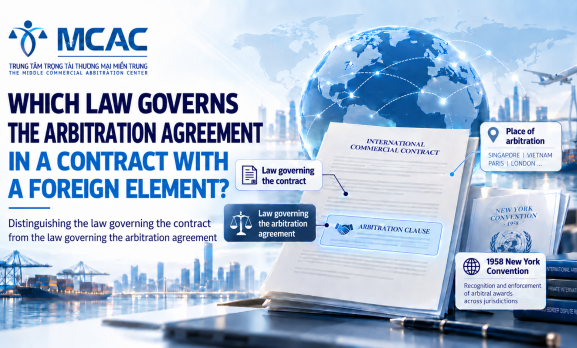
WHICH LAW GOVERNS AN ARBITRATION AGREEMENT IN A CONTRACT WITH FOREIGN ELEMENTS?
In international commercial transactions, parties often agree on the law governing their contract and on arbitration as the method of dispute resolution. However, does the law governing the contract automatically govern the arbitration agreement? If the parties have not agreed on the applicable law, which country's law is used to determine the validity of the arbitration agreement?
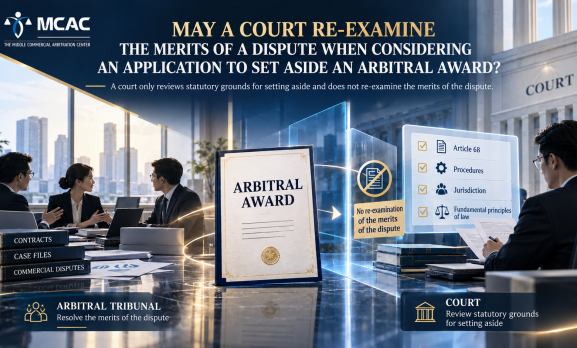
MAY A COURT RE-EXAMINE THE MERITS OF A DISPUTE WHEN CONSIDERING AN APPLICATION TO SET ASIDE AN ARBITRAL AWARD?
When considering an application to set aside an arbitral award, is the Court entitled to reassess evidence, reconsider the parties' rights and obligations, or alter the findings and decisions made by the Arbitral Tribunal?