Working hour: Monday – Friday/8AM – 5PM
|Email: contact@mcac.vn
|Hotline: (+84) 935 925 068 - 0236 3656799
| Language:



Điện thoại: (+84) 935 925 068
Language:

NOTES ON DRAFTING AN ARBITRATION AGREEMENT CLAUSE TO AVOID INVALIDITY
11/03/2026


In practice, when concluding commercial contracts, the arbitration agreement clause plays an important role in establishing the mechanism for dispute resolution between the parties. However, not every arbitration clause recorded in a contract automatically has legal validity. In reality, many disputes arise from arbitration agreements that are drafted unclearly, do not comply with legal regulations, or fail to satisfy the conditions for validity of an arbitration agreement, leading to such agreements being declared invalid.
Pursuant to Clause 2, Article 3 of the Law on Commercial Arbitration 2010, an arbitration agreement is understood as an agreement between the parties to resolve by arbitration disputes that have arisen or may arise. On the basis of this agreement, the parties mutually agree to choose commercial arbitration as the method for resolving disputes instead of the courts.
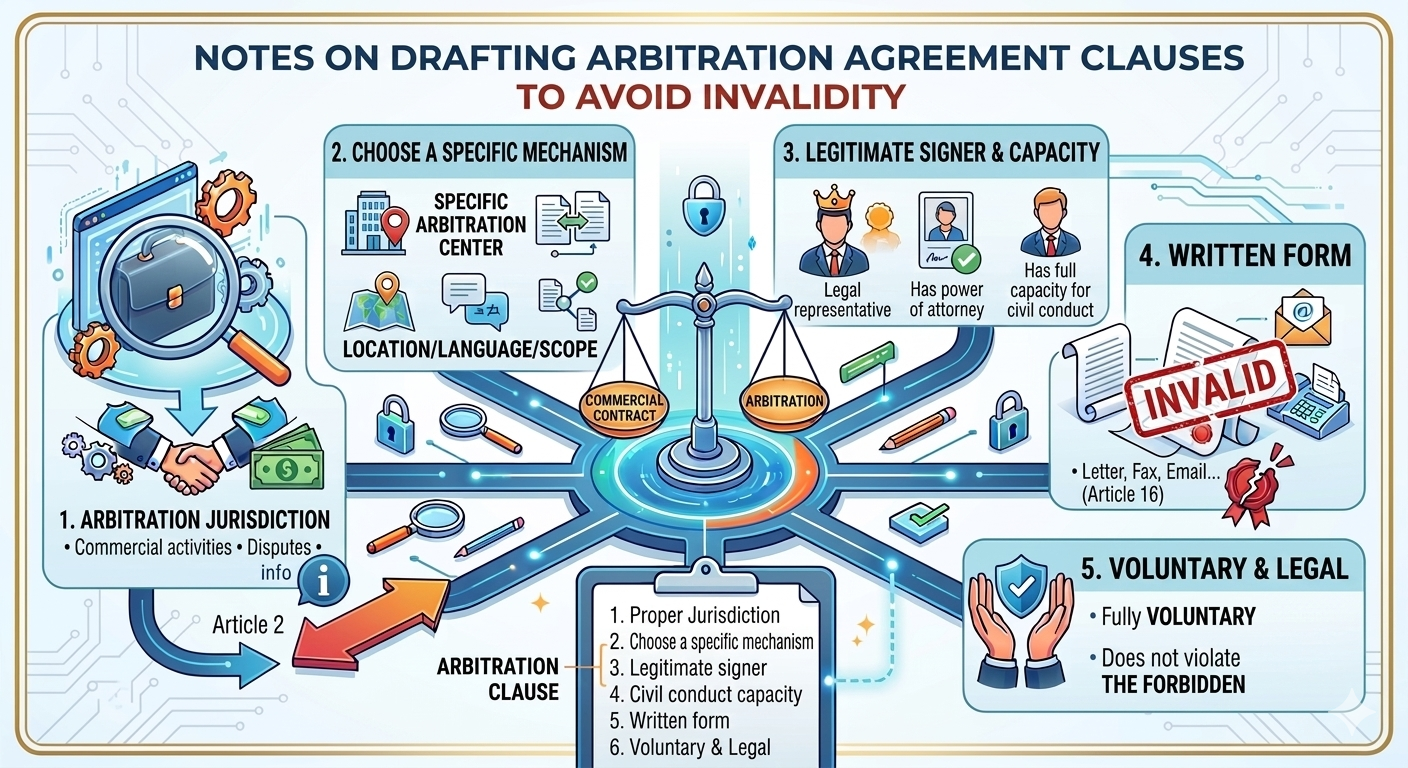
According to Article 18 of the Law on Commercial Arbitration 2010 and Resolution No. 01/2014/NQ-HĐTP dated March 20, 2014 of the Council of Judges of the Supreme People’s Court, an arbitration agreement may be declared invalid in certain circumstances. Therefore, when drafting an arbitration clause in a contract, the parties should note the following issues:
1. Ensuring the dispute falls within the jurisdiction of arbitration
According to Article 2 of the Law on Commercial Arbitration 2010 (“LCA”), arbitration has jurisdiction to resolve the following disputes:
- Disputes arising from commercial activities;
- Disputes arising between parties in which at least one party engages in commercial activities;
- Other disputes between parties that are permitted by law to be resolved by arbitration.
Therefore, when drafting an arbitration clause, the parties must ensure that the dispute to be resolved by arbitration falls within the scope of jurisdiction mentioned above. If the arbitration agreement is established to resolve disputes that are not within the jurisdiction of arbitration, such agreement may be declared invalid pursuant to Clause 1, Article 18 of the Law on Commercial Arbitration 2010.
2. Clearly identifying the arbitration dispute resolution mechanism
The arbitration clause must clearly and definitively express the parties’ intention to choose arbitration as the dispute resolution method instead of the courts. In practice, many clauses are drafted in the form that “disputes may be resolved at the court or by arbitration,” which makes the arbitration agreement unclear.
In addition, an important element of the arbitration clause is to clearly identify the dispute resolution mechanism. The parties should specify the name of the arbitration center where the dispute will be resolved or clearly agree that the dispute will be settled by ad hoc arbitration. Recording the incorrect name of an arbitration institution or providing vague provisions may lead to difficulties in identifying the competent authority to resolve the dispute.
Furthermore, to ensure clarity and feasibility of the arbitration clause, the parties should also consider stipulating several procedural issues, such as the seat of arbitration and the language of arbitration proceedings. Determining these elements in advance will help minimize procedural disputes during the resolution process.
At the same time, the arbitration clause should clearly define the scope of disputes to be submitted to arbitration, for example disputes arising from or relating to the conclusion, performance, amendment, or termination of the contract. Clearly defining the scope helps avoid situations where one party argues that a specific dispute does not fall within the scope of the arbitration agreement.
3. Ensuring that the person signing the arbitration agreement has proper authority
According to Clause 2, Article 18 of the Law on Commercial Arbitration, an arbitration agreement is invalid if the person establishing the arbitration agreement does not have the authority prescribed by law.
According to the guidance under Resolution No. 01/2014/NQ-HĐTP, this situation may occur when the person signing the arbitration agreement is not the legal representative of the enterprise, is not duly authorized, or signs beyond the scope of the granted authorization.
Therefore, during the process of concluding contracts, the parties should carefully verify the legal status and authority of the signatory to ensure that the arbitration clause is validly established.
4. Ensuring that the parties establishing the arbitration agreement have civil legal capacity
Under civil law, an arbitration agreement may be declared invalid if the person establishing the agreement does not have civil act capacity in accordance with the law.
According to the Civil Code 2015 and the guidance under Resolution No. 01/2014/NQ-HĐTP, subjects such as minors, persons who have lost civil act capacity, or persons with limited civil act capacity do not have full capacity to establish and perform civil transactions.
Therefore, ensuring that the parties signing the arbitration agreement possess full civil act capacity is an important factor to ensure the validity of the arbitration clause.
5. Ensuring the form of the arbitration agreement complies with legal requirements
According to Article 16 of the Law on Commercial Arbitration, an arbitration agreement must be made in writing.
Clause 2, Article 16 provides that an arbitration agreement is deemed to be in writing in cases such as: an arbitration clause in a contract, a separate agreement, exchanges through letters, fax, email, or other forms of information exchange in accordance with the law.
If the arbitration agreement is not expressed in written form or there is no evidence proving the existence of a written agreement, the arbitration agreement may be declared invalid pursuant to Clause 4, Article 18 of the Law on Commercial Arbitration.
6. Ensuring the arbitration agreement is established voluntarily
According to Clause 5, Article 18 of the Law on Commercial Arbitration, an arbitration agreement is invalid if one party is deceived, threatened, or coerced during the establishment of the agreement and requests the agreement to be declared invalid.
In addition, the principle of freedom and voluntariness in commitments and agreements is also recognized under Article 3 of the Civil Code 2015. Accordingly, parties participating in a transaction must do so completely voluntarily and without being influenced by fraudulent or coercive acts.
Therefore, the arbitration clause must be established based on the voluntary and equal will of the parties during the contract formation process.
7. Ensuring that the content of the arbitration agreement does not violate prohibitions of the law
According to Clause 6, Article 18 of the Law on Commercial Arbitration, an arbitration agreement is invalid if its content violates prohibitions of the law. Article 123 of the Civil Code 2015 also stipulates that civil transactions whose purpose or content violates legal prohibitions or is contrary to social ethics shall be invalid.
Therefore, the content of the arbitration agreement must comply with legal regulations and must not violate prohibitions of the law.
Conclusion
In practice, when concluding commercial contracts, the arbitration agreement clause plays a crucial role in establishing the dispute resolution mechanism between the parties. If the arbitration clause is not drafted in accordance with legal regulations, the arbitration agreement may be declared invalid, resulting in the dispute not being resolved through arbitration as originally intended by the parties.
For example, for disputes resolved at the Central Vietnam Commercial Arbitration Center (MCAC), the parties may refer to the following clause:
A. MODEL ARBITRATION CLAUSE APPLICABLE TO NORMAL PROCEDURES
“Article…: Dispute Settlement”
1. Any dispute arising from or related to this Contract shall be resolved by arbitration at the Middle Commercial Arbitration Center (MCAC) under its Arbitration Rules.
2. The number of arbitrators shall be… (one or three).
3. The place of arbitration shall be…
4. The language to be used in the arbitral proceedings shall be… (Only applicable to disputes involving foreign elements or disputes with at least one foreign-invested economic organization; state a single language).
5. The governing law of the contract is the substantive law of… (Only applicable to disputes involving foreign elements and in cases, the parties do not agree on applicable law in another clause).”
Therefore, when drafting an arbitration clause, the parties should pay particular attention to the scope of arbitral jurisdiction, the legal status and authority of the signatories, the form of the agreement, and the legality and voluntariness of its establishment. A well-drafted arbitration clause that complies with legal regulations will help ensure an effective, swift, and appropriate dispute resolution mechanism for the parties in commercial relations.
The article above has analyzed in detail is "Notes on drafting an arbitration agreement clause to avoid invalidity". For more detailed information or legal assistance, please contact the MCAC Secretariat:
- Hotline: 0935 925 068 - 0236 365 6799
- Email: contact@mcac.vn
- Read more: Is the arbitral tribunal empowered to collect evidence, or is it limited to the evidence submitted by the parties?
Related news
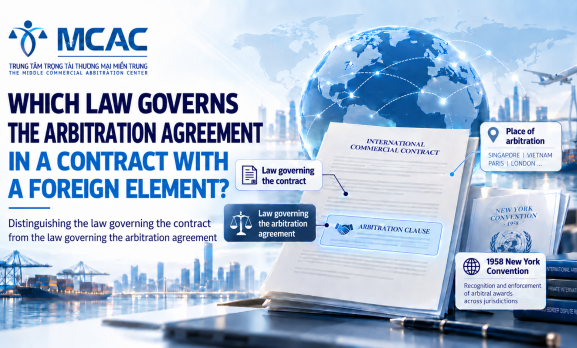
WHICH LAW GOVERNS AN ARBITRATION AGREEMENT IN A CONTRACT WITH FOREIGN ELEMENTS?
In international commercial transactions, parties often agree on the law governing their contract and on arbitration as the method of dispute resolution. However, does the law governing the contract automatically govern the arbitration agreement? If the parties have not agreed on the applicable law, which country's law is used to determine the validity of the arbitration agreement?
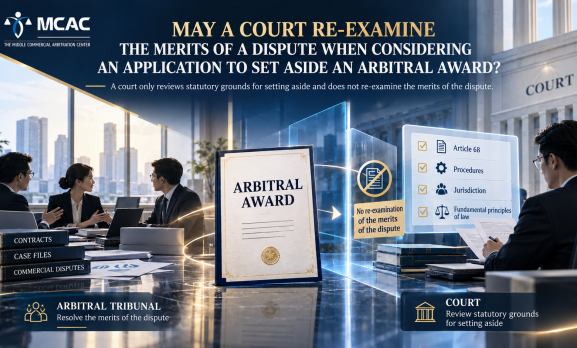
MAY A COURT RE-EXAMINE THE MERITS OF A DISPUTE WHEN CONSIDERING AN APPLICATION TO SET ASIDE AN ARBITRAL AWARD?
When considering an application to set aside an arbitral award, is the Court entitled to reassess evidence, reconsider the parties' rights and obligations, or alter the findings and decisions made by the Arbitral Tribunal?