Working hour: Monday – Friday/8AM – 5PM
|Email: contact@mcac.vn
|Hotline: (+84) 935 925 068 - 0236 3656799
| Language:



Điện thoại: (+84) 935 925 068
Language:

CHOICE OF LANGUAGE IN ARBITRAL PROCEEDINGS: COMMENTARY ON DECISION NO. 1191/2021/QD-PQTT OF THE PEOPLE’S COURT OF HO CHI MINH CITY SETTING ASIDE AN ARBITRAL AWARD
19/08/2026


In arbitral proceedings involving a foreign element, or where at least one party is a foreign-invested enterprise, the parties are entitled to agree on the language to be used for resolving their dispute. The Arbitral Tribunal may determine the language of the proceedings only in the absence of such an agreement.
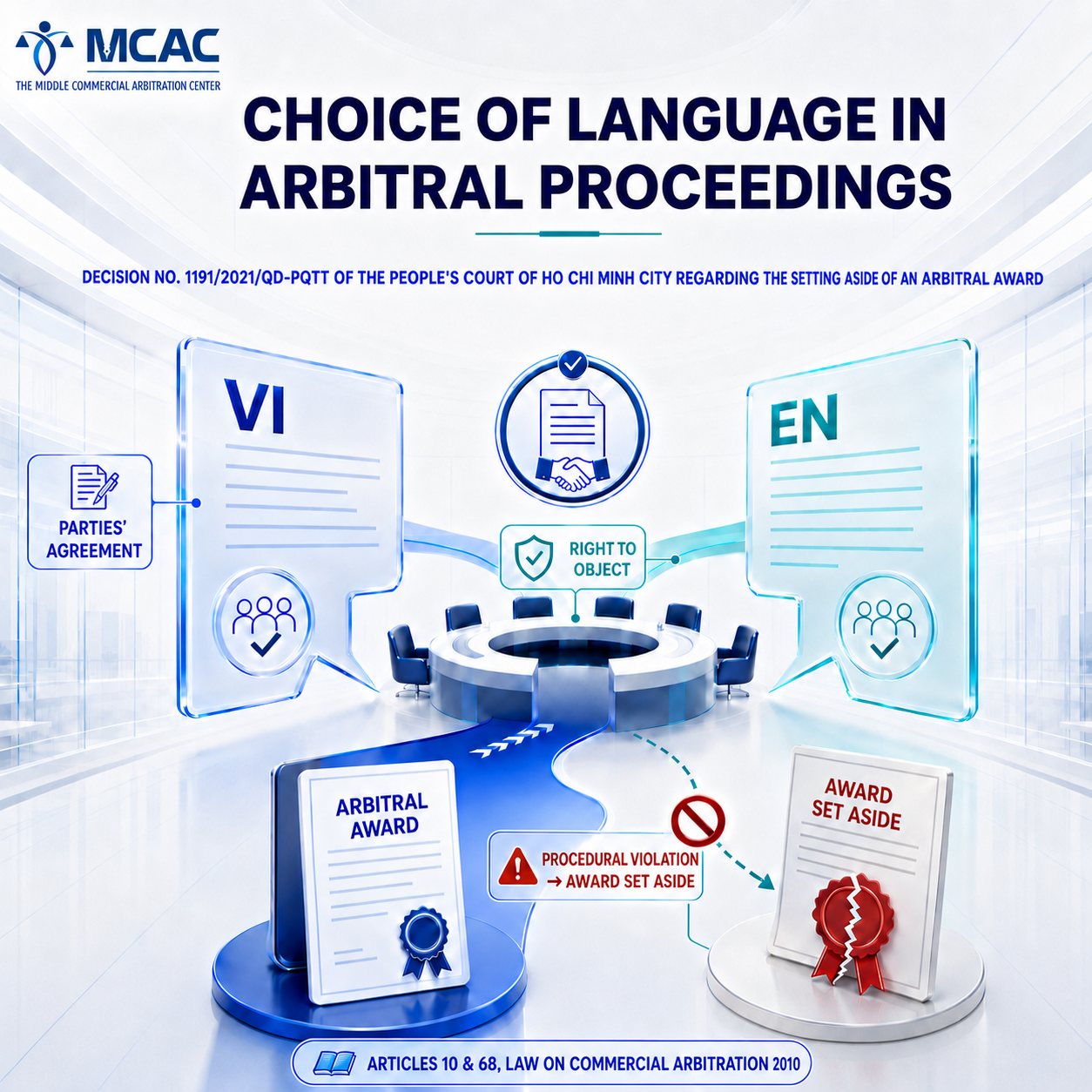
Decision No. 1191/2021/QD-PQTT dated 1 December 2021 of the People’s Court of Ho Chi Minh City is a noteworthy case concerning the consequences of determining the language of arbitral proceedings in a manner inconsistent with the parties’ agreement.
1. Summary of the case
Company A Limited (the “Claimant”) and Company V (the “Respondent”) entered into Design Consultancy Services Contract No. C-SGN-EXT-19-005-B00. Under Article 9.3 of the Contract, the parties agreed that, in the event of a dispute, the language to be used in the arbitral proceedings would be English “or/and” Vietnamese.
After a dispute arose, the Claimant initiated arbitration against the Respondent at Arbitration Centre X. The dispute was resolved by a Sole Arbitrator, and English was designated as the language of the arbitral proceedings.
On 7 April 2021, the Sole Arbitrator rendered Arbitral Award No. 49/20 HCM, ordering the Respondent to pay the Claimant a total amount of VND 8,875,130,030, comprising payments under the relevant invoices, costs arising from the reduction in the scope of work, and arbitration fees.
2. Application to set aside the arbitral award
Disagreeing with the Arbitral Award, the Respondent submitted an application to the People’s Court of Ho Chi Minh City requesting that the Award be set aside. One of the grounds raised by the Respondent was that the Sole Arbitrator’s decision to use English as the language of the proceedings was inconsistent with the parties’ agreement.
The Respondent argued that the Contract was executed in Vietnamese and that Vietnamese had also been used in the parties’ communications and throughout the performance of the Contract. Immediately after receiving notice that the dispute had been accepted for resolution, the Respondent requested that Vietnamese be selected as the language of the proceedings. The Respondent continued to object to the exclusive use of English in its Statement of Defence, in its written submissions to the Arbitration Centre, and at the hearing. Nevertheless, the Sole Arbitrator maintained the decision to use English, and no Vietnamese interpreter was provided at the hearing.
The People’s Court of Ho Chi Minh City held that the phrase “English or/and Vietnamese” in Article 9.3 of the Contract should be interpreted as requiring the use of both languages. However, the Sole Arbitrator used English only, despite the Respondent’s repeated objections throughout the proceedings.
Considering that the Contract and the communications between the parties were in Vietnamese and that no Vietnamese interpreter was provided at the hearing, the Court found that the proceedings had not adequately ensured fairness or protected the Respondent’s right to participate in the proceedings.
On that basis, the Court granted the Respondent’s application and set aside Arbitral Award No. 49/20 HCM dated 7 April 2021.
3. Commentary
Article 10.2 of the 2010 Law on Commercial Arbitration provides that, for disputes involving a foreign element or disputes in which at least one party is a foreign-invested enterprise, the language of the arbitral proceedings shall be agreed upon by the parties. Only in the absence of such an agreement may the Arbitral Tribunal determine the language of the proceedings.[2]
Similarly, Article 23.2 of the MCAC Rules of Arbitration provides that the language of arbitration in disputes involving a foreign element or in which at least one party is a foreign-invested enterprise shall be agreed upon by the parties. In the absence of such an agreement, the Arbitral Tribunal shall determine the language or languages to be used in the proceedings, taking into account relevant circumstances, including the language of the contract.[3]
In the present dispute, the parties had agreed on the language of the proceedings in Article 9.3 of the Contract. Accordingly, the determination of the language should first have been made on the basis of and in accordance with that agreement.
However, the phrase “English or/and Vietnamese” is open to several interpretations: English may be used, Vietnamese may be used, or both languages may be used concurrently. In this case, the Court interpreted the agreement as requiring the use of both English and Vietnamese. This interpretation was reached in light of the specific circumstances: the Contract was executed in Vietnamese; the parties communicated and performed the Contract in Vietnamese; the Respondent was a Vietnamese enterprise; and the Respondent had repeatedly objected to the exclusive use of English.
Therefore, the Court’s finding that “English or/and Vietnamese” meant that both languages must be used should be understood as an interpretation based on the specific circumstances of this case. It should not be generalised into a rule applicable to every agreement containing the phrase “or/and.”
In addition to recognising the parties’ right to choose the language of the proceedings, Article 4.1 of the 2010 Law on Commercial Arbitration requires arbitrators to respect the parties’ lawful agreements. Article 4.3 further establishes the principle that the parties to a dispute are equal in terms of their rights and obligations and requires the Arbitral Tribunal to facilitate the exercise of those rights and obligations.
In this case, the Respondent objected immediately after English was designated as the language of the proceedings and maintained its objection throughout the resolution of the dispute. Accordingly, the Respondent had not waived its right to object under Article 13 of the 2010 Law on Commercial Arbitration. Conversely, where a party becomes aware of a breach of the arbitration agreement but continues to participate in the proceedings without raising an objection within the applicable time limit, that party may lose its right to object before either the Arbitral Tribunal or the Court.
Under Article 68.2(b) of the 2010 Law on Commercial Arbitration, an arbitral award may be set aside where the composition of the Arbitral Tribunal or the arbitral proceedings were inconsistent with the parties’ agreement or contrary to the provisions of the Law. In this case, the Sole Arbitrator’s exclusive use of English, failure to provide a Vietnamese interpreter, and continuation of the proceedings despite the Respondent’s repeated objections were found by the Court to constitute procedural violations. These violations formed the basis for the Court’s decision to grant the application to set aside the Arbitral Award.
This case demonstrates that, where a language clause is ambiguous, the Arbitral Tribunal should consult the parties and specifically determine the language to be used in written submissions, at hearings, and in the arbitral award. The Arbitral Tribunal should also clarify the requirements for translating documents and evidence, the arrangements for interpretation, and responsibility for interpretation costs.
The article above has analyzed in detail is "CHOICE OF LANGUAGE IN ARBITRAL PROCEEDINGS: COMMENTARY ON DECISION NO. 1191/2021/QD-PQTT OF THE PEOPLE’S COURT OF HO CHI MINH CITY SETTING ASIDE AN ARBITRAL AWARD". For more detailed information or legal assistance, please contact the MCAC Secretariat:
- Hotline: 0935 925 068 - 0236 3656799
- Email: contact@mcac.vn
- Read more: SELECTING THE NUMBER OF ARBITRATORS: BALANCING COST OPTIMISATION AND THE COMPREHENSIVENESS OF THE AWARD
Related news
WHICH LAW GOVERNS AN ARBITRATION AGREEMENT IN A CONTRACT WITH FOREIGN ELEMENTS?
In international commercial transactions, parties often agree on the law governing their contract and on arbitration as the method of dispute resolution. However, does the law governing the contract automatically govern the arbitration agreement? If the parties have not agreed on the applicable law, which country's law is used to determine the validity of the arbitration agreement?
MAY A COURT RE-EXAMINE THE MERITS OF A DISPUTE WHEN CONSIDERING AN APPLICATION TO SET ASIDE AN ARBITRAL AWARD?
When considering an application to set aside an arbitral award, is the Court entitled to reassess evidence, reconsider the parties' rights and obligations, or alter the findings and decisions made by the Arbitral Tribunal?