Working hour: Monday – Friday/8AM – 5PM
|Email: contact@mcac.vn
|Hotline: (+84) 935 925 068 - 0236 3656799
| Language:



Điện thoại: (+84) 935 925 068
Language:

COMMERCIAL AND BUSINESS DISPUTES WITHIN THE JURISDICTION OF ARBITRATION
23/06/2026


In a modern market economy, commercial and business disputes are an inevitable consequence of the establishment and performance of transactions among business entities. Alongside the traditional avenue of court litigation, commercial arbitration has increasingly become the preferred dispute resolution mechanism for businesses. This shift is attributable to the distinctive advantages of arbitration, including procedural flexibility, confidentiality of commercial information, adjudication by industry experts, and, most importantly, the broad international recognition and enforcement of arbitral awards.
However, not all commercial disputes may be resolved through arbitration. The laws of each jurisdiction establish certain limitations in order to safeguard public policy and the broader interests of society.
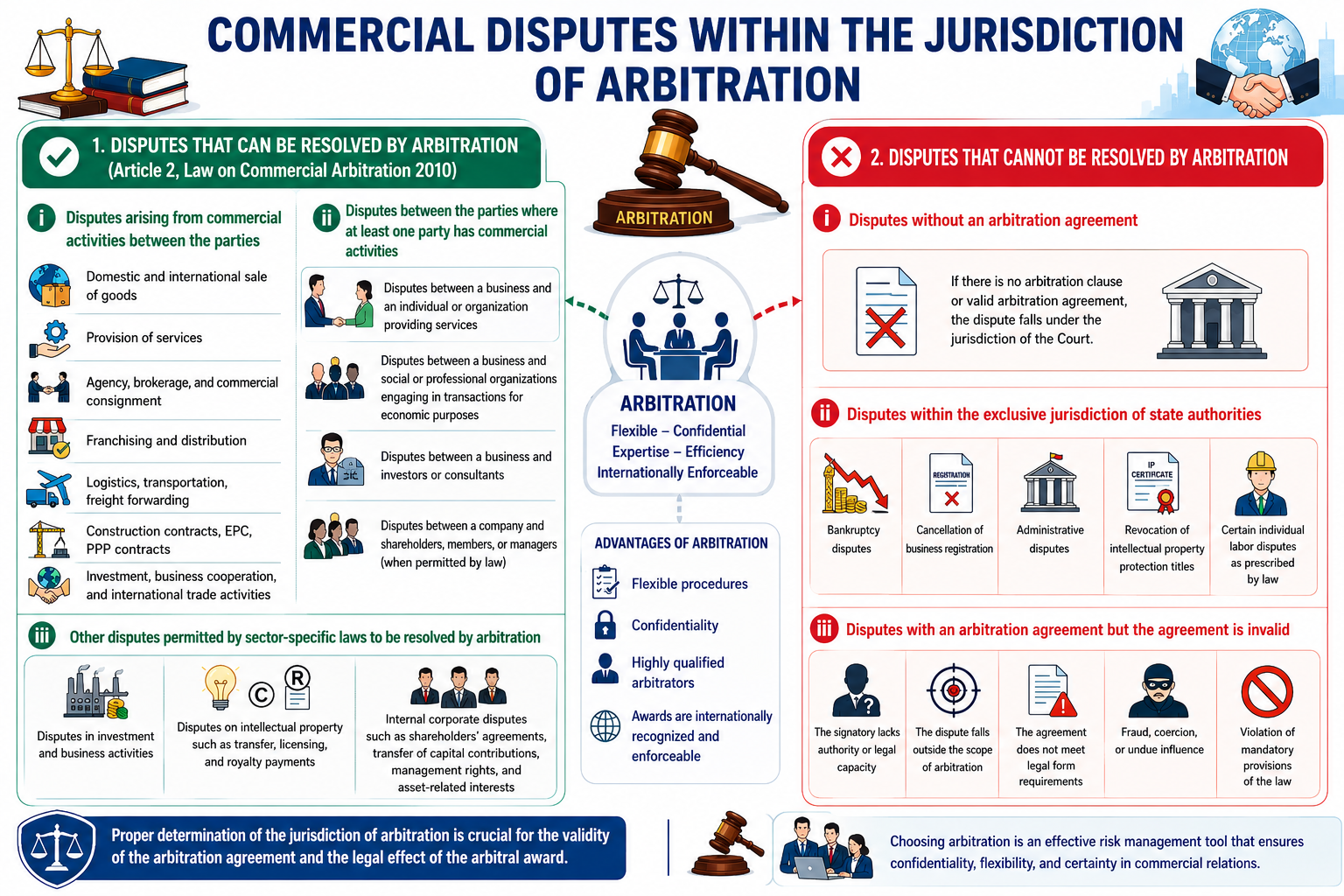
1. Types of Commercial and Business Disputes That May Be Referred to Arbitration
1.1. Disputes Arising Between Parties from Commercial Activities
(Article 2(1) of the Law on Commercial Arbitration 2010)
This category constitutes the largest proportion of disputes and most clearly reflects the core function of commercial arbitration in resolving business disputes. To determine whether a dispute falls within this category, it is necessary to examine the nature of the disputed relationship based on the concept of “commercial activities” under Article 3 of the Commercial Law 2005.
Accordingly, commercial activities are activities conducted for profit-making purposes, including the sale and purchase of goods, provision of services, investment, trade promotion, and other profit-oriented activities.
In practice, disputes arising from commercial activities commonly include:
- Disputes arising from domestic and international sale and purchase contracts;
- Disputes relating to commercial service contracts;
- Disputes arising from agency, brokerage, and commercial entrustment relationships;
- Disputes concerning distribution systems and franchise arrangements;
- Disputes in the fields of logistics, transportation, and freight forwarding;
- Disputes regarding payment obligations, delivery obligations, or contractual performance;
- Disputes arising from construction contracts, EPC contracts, and PPP contracts;
- Disputes arising from investment activities, business cooperation, and international trade.
1.2. Disputes Arising Between Parties Where at Least One Party Engages in Commercial Activities
(Article 2(2) of the Law on Commercial Arbitration 2010)
In the course of business operations, enterprises frequently establish relationships with independent professionals, social organizations, investors, consultants, and other entities that may not be registered businesses but nevertheless participate in transactions of a commercial nature.
Accordingly, the following disputes may fall within the jurisdiction of arbitration, provided that the parties have entered into a valid arbitration agreement:
- Disputes between enterprises and individuals providing services or performing contractual obligations;
- Disputes between enterprises and social organizations, professional associations, or non-profit organizations participating in transactions with economic objectives;
- Disputes between investors and service providers arising during the implementation of investment projects;
- Disputes between companies and shareholders, capital-contributing members, or company managers in circumstances permitted by law and where an arbitration agreement exists.
This provision reflects a modern trend in international arbitration law, whereby jurisdiction is determined not primarily by the legal status of the parties but rather by the commercial nature of the transaction and the parties’ freedom to choose their dispute resolution mechanism. Such an approach broadens access to arbitration, enhances flexibility in the business environment, and aligns with Vietnam’s international economic integration objectives.
1.3. Other Disputes Permitted by Specialized Laws to Be Resolved Through Arbitration
(Article 2(3) of the Law on Commercial Arbitration 2010)
This provision demonstrates the legislative intention to expand the scope of arbitration in line with international practices while allowing specialized legislation to determine which disputes are suitable for resolution outside the court system.
(i) Investment Disputes
The Investment Law 2025 devotes Article 13 specifically to dispute resolution mechanisms in investment and business activities. Arbitration is expressly recognized as one of the methods for resolving disputes relating to investment and business activities in Vietnam, including:
- Disputes among domestic investors;
- Disputes involving foreign-invested economic organizations;
- Disputes between domestic investors or foreign-invested economic organizations and competent state authorities concerning investment and business activities conducted within the territory of Vietnam;
- Disputes among investors where at least one party is a foreign investor or an economic organization specified in Article 20(1)(a), (b), and (c) of the Investment Law.
For disputes between foreign investors and competent state authorities relating to investment and business activities in Vietnam, arbitration in Vietnam is available as a dispute resolution mechanism in addition to court proceedings, unless otherwise agreed by the parties or provided by an international treaty to which the Socialist Republic of Vietnam is a party.
(ii) Intellectual Property Disputes
Article 198 of the Law on Intellectual Property 2005, as amended and supplemented, recognizes arbitration as one of the means available to intellectual property rights holders for protecting their rights.
Examples of arbitrable intellectual property disputes include:
- Disputes arising from trademark assignment or transfer agreements;
- Disputes relating to licensing agreements for copyrights, related rights, or industrial property rights;
- Disputes concerning royalty payments and licensing fees;
- Disputes regarding the scope of use and exploitation obligations of intellectual property rights.
It should be noted, however, that disputes concerning administrative decisions on the grant, invalidation, or termination of protection titles are not subject to arbitration and must be resolved through administrative procedures or court proceedings in accordance with specialized legislation.
(iii) Internal Corporate Disputes
Disputes arising within a company may also be resolved through arbitration, including:
- Disputes concerning the performance of shareholders’ agreements;
- Disputes regarding pre-emptive rights to purchase shares;
- Disputes involving the transfer of capital contributions;
- Disputes concerning capital contribution obligations and the allocation of management rights;
- Disputes among company members relating to property rights and interests.
2. Commercial and Business Disputes That Cannot Be Referred to Arbitration
Commercial arbitration is fundamentally a dispute resolution mechanism based on party autonomy and mutual agreement. Consequently, arbitral jurisdiction is always subject to statutory limitations.
From a legal perspective, the following categories of disputes are generally excluded from arbitration:
First, Disputes Without an Arbitration Agreement
This is a fundamental prerequisite. Where a contract does not contain an arbitration clause and the parties have not entered into a separate arbitration agreement, jurisdiction belongs to the courts in accordance with civil procedure law.
Second, Disputes Falling Within the Exclusive Jurisdiction of State Authorities
Examples include:
- Bankruptcy proceedings;
- Revocation or cancellation of enterprise registration;
- Administrative lawsuits;
- Cancellation of decisions granting intellectual property protection titles;
- Certain individual labor disputes.
Third, Disputes Subject to an Invalid Arbitration Agreement
In practice, common grounds rendering an arbitration agreement invalid include:
- The person entering into the arbitration agreement lacked authority;
- The dispute falls outside the jurisdiction of arbitration;
- The form of the arbitration agreement fails to satisfy statutory requirements;
- One party was deceived, threatened, or coerced into entering into the arbitration agreement and subsequently requests that it be declared invalid;
- The arbitration agreement violates mandatory provisions of law;
- The person entering into the arbitration agreement lacked legal capacity under the Civil Code.
3. Conclusion
Under current Vietnamese law, the jurisdiction of commercial arbitration has been expanded in a manner increasingly aligned with international standards. It encompasses not only disputes arising directly from commercial activities but also disputes connected with profit-making purposes or otherwise permitted by law to be resolved through arbitration.
As business activities become increasingly diverse and complex, choosing arbitration is not merely a matter of selecting a dispute resolution mechanism; it is also an effective legal risk management tool that promotes confidentiality, flexibility, and stability in commercial relationships. Accordingly, accurately determining the scope of arbitral jurisdiction is of decisive importance to both the validity of arbitration agreements and the enforceability of arbitral awards in practice.
The article above has analyzed in detail is "COMMERCIAL AND BUSINESS DISPUTES WITHIN THE JURISDICTION OF ARBITRATION". For more detailed information or legal assistance, please contact the MCAC Secretariat:
- Hotline: 0935 925 068 - 0236 3656799
- Email: contact@mcac.vn
- Read more:CHECKLIST FOR DRAFTING ARBITRATION CLAUSES: COMMON ISSUES TO NOTE
Related news
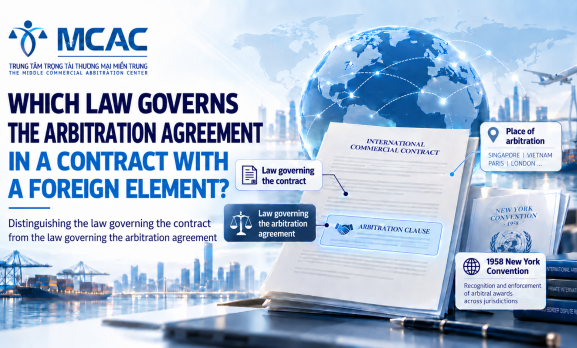
WHICH LAW GOVERNS AN ARBITRATION AGREEMENT IN A CONTRACT WITH FOREIGN ELEMENTS?
In international commercial transactions, parties often agree on the law governing their contract and on arbitration as the method of dispute resolution. However, does the law governing the contract automatically govern the arbitration agreement? If the parties have not agreed on the applicable law, which country's law is used to determine the validity of the arbitration agreement?
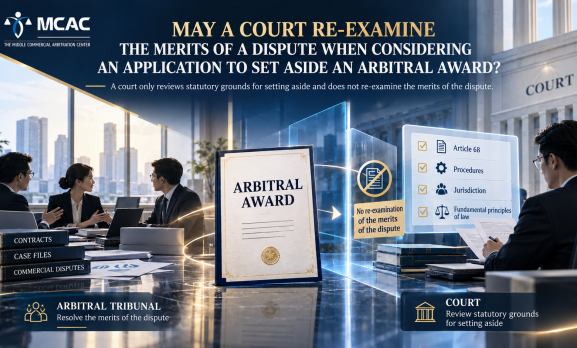
MAY A COURT RE-EXAMINE THE MERITS OF A DISPUTE WHEN CONSIDERING AN APPLICATION TO SET ASIDE AN ARBITRAL AWARD?
When considering an application to set aside an arbitral award, is the Court entitled to reassess evidence, reconsider the parties' rights and obligations, or alter the findings and decisions made by the Arbitral Tribunal?