Working hour: Monday – Friday/8AM – 5PM
|Email: contact@mcac.vn
|Hotline: (+84) 935 925 068 - 0236 3656799
| Language:



Điện thoại: (+84) 935 925 068
Language:

DISTINGUISHING INSTITUTIONAL ARBITRATION AND AD HOC ARBITRATION IN COMMERCIAL DISPUTE RESOLUTION
06/04/2026


In the context of increasingly dynamic and diverse commercial activities, disputes among commercial actors have become more prevalent. In addition to dispute resolution through the courts, commercial arbitration has increasingly been chosen by businesses due to its flexibility, confidentiality, and the final and binding nature of arbitral awards.
Pursuant to the Law on Commercial Arbitration 2010 (“LCA”), commercial arbitration exists in two principal forms: institutional arbitration and ad hoc arbitration. Each form has distinct characteristics in terms of organisation, procedure, and scope of application. A clear understanding of the differences between these two forms enables parties to select the dispute resolution mechanism most appropriate to their needs and the nature of the dispute.
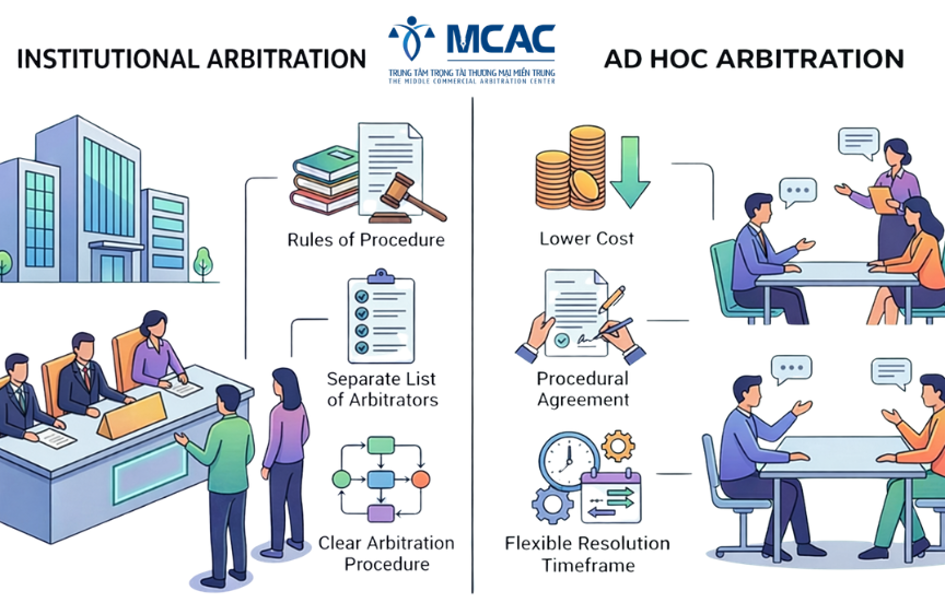
1. Concepts of Institutional Arbitration and Ad Hoc Arbitration
1.1. Institutional Arbitration
Pursuant to Article 3(6) of the LCA, institutional arbitration is defined as a form of dispute resolution conducted at an arbitral institution in accordance with the provisions of the law and the arbitration rules of that institution.
Arbitral institutions are non-governmental organisations established at the initiative of arbitrators and authorised to operate by competent state authorities. Such institutions possess legal personality, their own seal and bank accounts, and a stable place of business. In addition, each arbitral institution maintains its own arbitration rules and a panel of arbitrators, thereby providing the legal and procedural framework for the constitution of the arbitral tribunal and the resolution of disputes.
1.2. Ad Hoc Arbitration
Pursuant to Article 3(7) of the LCA, ad hoc arbitration is defined as a form of dispute resolution conducted in accordance with the law and the procedures agreed upon by the parties.
Unlike institutional arbitration, ad hoc arbitration does not operate as a permanent organisation. The arbitral tribunal is constituted only when a dispute arises and ceases to exist upon the resolution of the dispute. This form of arbitration does not have a permanent seat, administrative structure, or a fixed panel of arbitrators.
2. Comparison between Institutional Arbitration and Ad Hoc Arbitration
Although both constitute forms of arbitration, institutional arbitration and ad hoc arbitration differ in several fundamental respects, including organisational structure, procedural framework, and operational mechanisms.
|
Criteria |
Institutional Arbitration |
Ad Hoc Arbitration |
|
Nature |
Conducted under the auspices of arbitral institutions, which are non-governmental organisations established in accordance with law and operating independently from state authorities. |
Established only upon the occurrence of a dispute on the basis of the parties’ agreement and ceases to exist once the dispute has been resolved. |
|
Organisational Structure |
Possesses legal personality, a seal, bank accounts, and a stable place of business. Arbitral institutions typically have an administrative structure, including a president, vice-presidents, and possibly a secretary-general, as well as a panel of arbitrators. |
Does not have a permanent seat, administrative structure, or a fixed panel of arbitrators. |
|
Conduct of Proceedings |
Disputes are resolved by arbitrators selected from the institution’s panel in accordance with its arbitration rules. |
Arbitrators are appointed by the parties or designated as agreed, and may be selected from within or outside any institutional panel. |
|
Procedural Rules |
Governed by the arbitration rules of the relevant institution, which the arbitral tribunal must follow. |
No inherent procedural rules; the parties must agree on procedural rules or adopt rules of an arbitral institution or other established rules. |
|
Costs |
Generally higher, including both arbitral fees and administrative fees. |
Potentially lower due to the absence of administrative fees, although costs may increase if administrative support or secretarial services are engaged. |
|
Duration |
May be longer due to compliance with institutional procedural rules. |
More flexible; the parties may agree on streamlined procedures to expedite the resolution of the dispute. |
|
Recognition and Enforcement |
Arbitral awards are generally more readily recognised and enforced. |
In certain cases, recognition and enforcement may be more challenging if the proceedings are not conducted in a structured manner. |
In practice, institutional arbitration is more commonly used, particularly in commercial disputes involving business entities. This is largely due to the availability of well-defined procedural frameworks, professional administrative support, and panels of arbitrators with expertise across various fields.
In Viet Nam, several arbitral institutions have been operating effectively in the resolution of commercial disputes, including the Vietnam International Arbitration Centre (VIAC), the Middle Commercial Arbitration Center (MCAC), and the Southern Trade Arbitration Centre (STAC). These institutions promulgate their own arbitration rules and maintain panels of qualified and experienced arbitrators, thereby contributing to the effectiveness of arbitration as a dispute resolution mechanism in practice.
3. Conclusion
It may be observed that institutional arbitration and ad hoc arbitration are both recognised forms of arbitration under the law, each with distinct organisational features and procedural frameworks. Institutional arbitration offers greater stability and procedural support, whereas ad hoc arbitration affords the parties a higher degree of autonomy and flexibility in designing the arbitral process.
Accordingly, when agreeing on arbitration as a dispute resolution mechanism, the parties should carefully consider the nature of the dispute, its level of complexity, and their preference for flexibility or procedural support in order to select the most appropriate form of arbitration. An informed choice at the outset may contribute significantly to the efficient conduct of the proceedings and mitigate potential legal risks.
The article above has analyzed in detail is "Distinguishing institutional arbitration and ad hoc arbitration in commercial dispute resolution". For more detailed information or legal assistance, please contact the MCAC Secretariat:
- Hotline: 0935 925 068 - 0236 3656799
- Email: contact@mcac.vn
- Read more: Matters relating to the arbitration agreement considered by the arbitral tribunal
Related news

WHICH LAW GOVERNS AN ARBITRATION AGREEMENT IN A CONTRACT WITH FOREIGN ELEMENTS?
In international commercial transactions, parties often agree on the law governing their contract and on arbitration as the method of dispute resolution. However, does the law governing the contract automatically govern the arbitration agreement? If the parties have not agreed on the applicable law, which country's law is used to determine the validity of the arbitration agreement?
MAY A COURT RE-EXAMINE THE MERITS OF A DISPUTE WHEN CONSIDERING AN APPLICATION TO SET ASIDE AN ARBITRAL AWARD?
When considering an application to set aside an arbitral award, is the Court entitled to reassess evidence, reconsider the parties' rights and obligations, or alter the findings and decisions made by the Arbitral Tribunal?