Working hour: Monday – Friday/8AM – 5PM
|Email: contact@mcac.vn
|Hotline: (+84) 935 925 068 - 0236 3656799
| Language:



Điện thoại: (+84) 935 925 068
Language:

HOW DOES COMMERCIAL ARBITRATION HELP BUSINESSES SAVE TIME AND COSTS?
05/03/2026


In the context of increasingly dynamic business activities that require flexibility, speed, and efficiency, choosing an appropriate dispute resolution mechanism is particularly important for businesses. A prolonged dispute resolution process not only increases administrative expenses, opportunity costs, and various legal risks, but also adversely affects the legitimate rights and interests of the parties involved in the dispute.
In response to this need, commercial arbitration is recognized under Vietnamese law as an alternative dispute resolution method outside the court system, with notable characteristics such as efficiency, flexibility, confidentiality, and the finality of arbitral awards. In practice, many businesses choose arbitration not only for its professional expertise but also for its ability to significantly save time and costs compared to traditional court litigation.
The legal question that arises is: “Through which legal and practical mechanisms does commercial arbitration help businesses save time and costs?”

1. Legal basis for the efficiency and promptness of arbitration proceedings
The Law on Commercial Arbitration 2010 (LCA) establishes a number of principles and procedural mechanisms aimed at ensuring that disputes resolved through arbitration are handled promptly, effectively, and conclusively.
First, the LCA recognizes the finality of arbitral awards under Clause 5 Article 4 and Article 61. Accordingly, an arbitral award takes effect from the date of issuance and is not subject to appeal or protest under appellate procedures as in court proceedings. This provision clearly reflects the legislator’s intention to avoid prolonged disputes through multiple levels of adjudication, thereby significantly shortening the overall dispute resolution time.
In addition, the LCA allows the disputing parties to proactively agree on procedural rules and timelines, except for certain mandatory time limits. The Arbitral Tribunal is granted the authority to conduct proceedings in a flexible manner, depending on the specific characteristics of each dispute.
These legal mechanisms form an important foundation for commercial arbitration to demonstrate its advantages in terms of time and cost efficiency in practice.
2. Commercial arbitration helps reduce dispute resolution time
Compared to court litigation, arbitration proceedings generally require significantly less time due to several factors.
First, arbitration results in a final and binding award, ensuring the definitive resolution of disputes and preventing disputes from being prolonged for many years.
Second, during the dispute resolution process, the Arbitral Tribunal has the authority to determine the procedural schedule, including the time for hearings and deadlines for submissions and evidence, based on the nature and complexity of the dispute. At the Central Vietnam International Arbitration Center (MCAC), the MCAC Arbitration Rules allow extensions for certain procedural deadlines upon legitimate requests while still maintaining mandatory time limits to ensure that the dispute resolution process is not unnecessarily delayed or stalled.
Based on practical arbitration proceedings and the provisions from Article 32 to Article 61 of the Law on Commercial Arbitration, the average duration for resolving a dispute through arbitration is typically around three to four months, from the commencement of arbitration proceedings to the issuance of the arbitral award.
Third, arbitration proceedings allow simplified procedures, focusing primarily on the core issues of the dispute. Limiting formalistic procedures helps shorten the resolution time while still ensuring the parties’ right to present arguments and evidence.
According to Clause 6 Article 3 of the LCA 2010, arbitration centers may allow parties to agree on applying expedited procedures in order to shorten the dispute resolution process. Currently, many simple disputes resolved at arbitration centers under expedited procedures can be completed within approximately 40 days.
3. Commercial arbitration helps businesses reduce dispute resolution costs
In addition to time efficiency, commercial arbitration also helps businesses save costs in several aspects.
First, resolving disputes within a shorter timeframe significantly reduces indirect costs, including case management costs, personnel expenses for participating in proceedings, costs caused by disruptions to business operations, and opportunity costs resulting from the diversion of resources.
Second, arbitration proceedings allow parties to flexibly choose the form of proceedings, the seat of arbitration, and the method of organizing hearings, pursuant to Clause 1 Article 11 of the LCA. Article 22 of the MCAC Arbitration Rules provides that:
“The time and place for hearings shall be determined by the Arbitral Tribunal unless otherwise agreed by the parties. The Arbitral Tribunal may conduct hearings through teleconference, video conference, or other appropriate methods if agreed by the parties.”
In practice, the Arbitral Tribunal may organize hearings based on the parties’ agreement or the most convenient conditions available, thereby ensuring efficiency in terms of both time and reasonable costs for the parties.
4. Conclusion
In arbitration proceedings, time and cost are closely interconnected. The shorter the dispute resolution process, the lower the indirect costs borne by the parties.
Through mechanisms such as flexible procedural timelines, final and binding arbitral awards, and transparent cost determination, commercial arbitration enables parties to better control risks related to time and financial resources when disputes arise.
Choosing commercial arbitration at the contract drafting stage is therefore not only a method for resolving disputes when they occur but also a strategic decision that helps protect the legitimate rights and interests of businesses in an effective and sustainable manner.
The article above has analyzed in detail is "How does commercial arbitration help businesses save time and costs?". For more detailed information or legal assistance, please contact the MCAC Secretariat:
- Hotline: 0935 925 068
- Email: contact@mcac.vn
- Read more: Is the arbitral tribunal empowered to collect evidence, or is it limited to the evidence submitted by the parties?
Related news
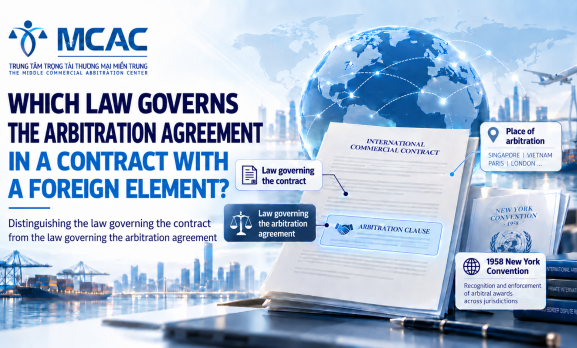
WHICH LAW GOVERNS AN ARBITRATION AGREEMENT IN A CONTRACT WITH FOREIGN ELEMENTS?
In international commercial transactions, parties often agree on the law governing their contract and on arbitration as the method of dispute resolution. However, does the law governing the contract automatically govern the arbitration agreement? If the parties have not agreed on the applicable law, which country's law is used to determine the validity of the arbitration agreement?
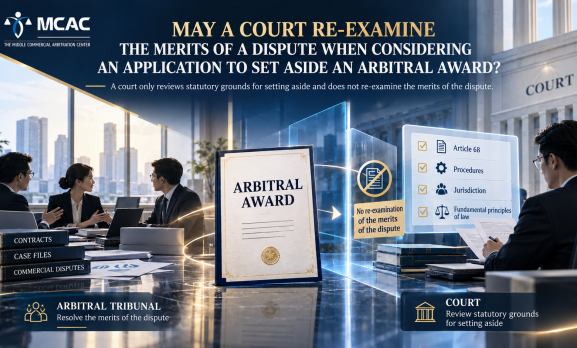
MAY A COURT RE-EXAMINE THE MERITS OF A DISPUTE WHEN CONSIDERING AN APPLICATION TO SET ASIDE AN ARBITRAL AWARD?
When considering an application to set aside an arbitral award, is the Court entitled to reassess evidence, reconsider the parties' rights and obligations, or alter the findings and decisions made by the Arbitral Tribunal?