Working hour: Monday – Friday/8AM – 5PM
|Email: contact@mcac.vn
|Hotline: (+84) 935 925 068 - 0236 3656799
| Language:



Điện thoại: (+84) 935 925 068
Language:

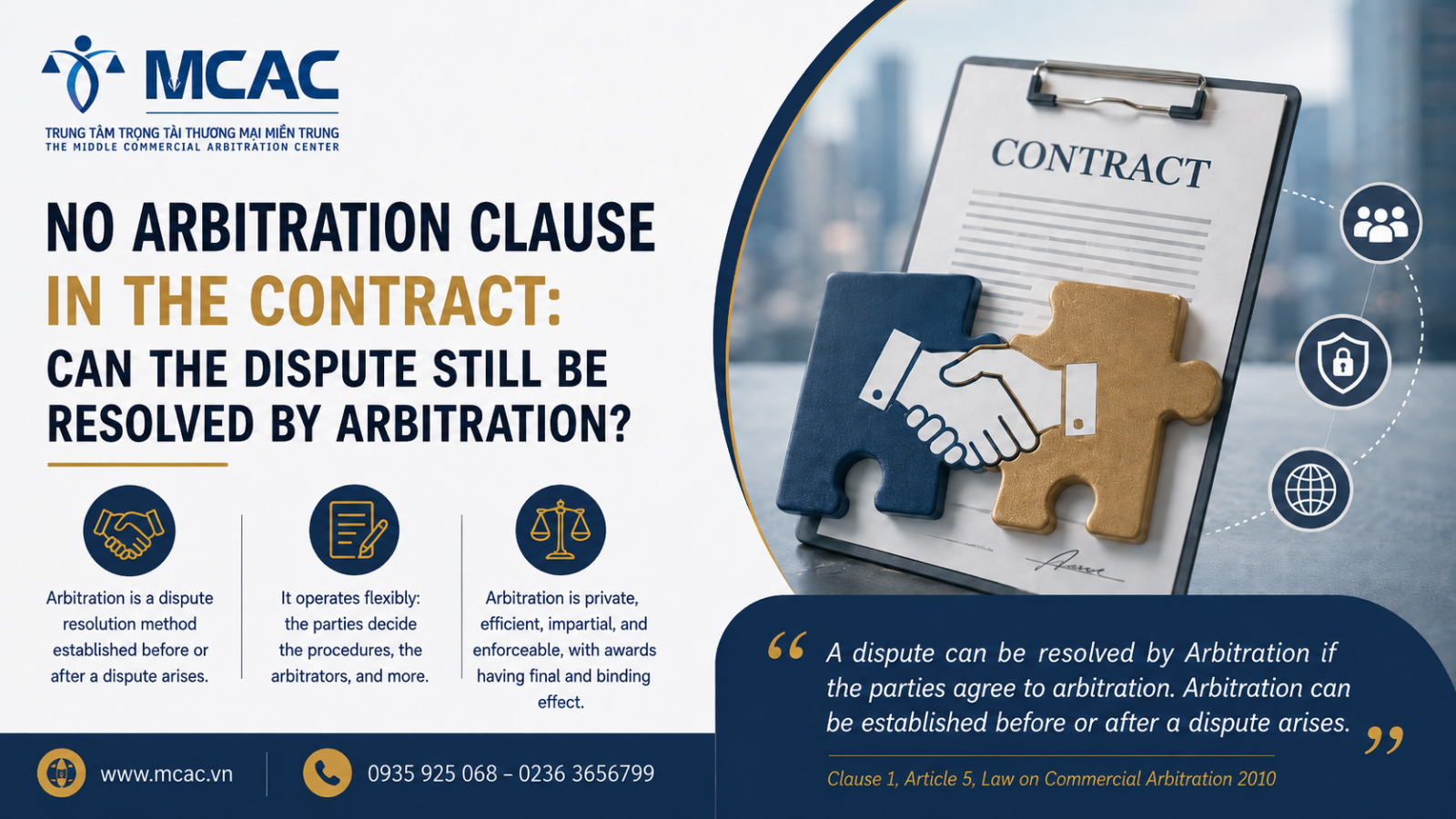
NO ARBITRATION CLAUSE IN THE CONTRACT: CAN THE DISPUTE STILL BE RESOLVED BY ARBITRATION?
10/08/2026


Under Vietnamese law, the inclusion of an arbitration clause in a contract is not a prerequisite for establishing arbitral jurisdiction. Rather, arbitral jurisdiction is determined based on the existence of a valid arbitration agreement between the parties. Such an agreement may be concluded either before or after a dispute arises.
Accordingly, the absence of an arbitration clause in a contract does not necessarily mean that the dispute must be resolved by a court. If the parties subsequently enter into a valid arbitration agreement in accordance with the law, the dispute may still fall within the jurisdiction of commercial arbitration.
1. Legal Basis
Pursuant to Clause 1, Article 5 of the 2010 Law on Commercial Arbitration (“LCA 2010”):
“A dispute shall be resolved by arbitration if the parties have an arbitration agreement. An arbitration agreement may be made either before or after a dispute arises.”
From a legal perspective, arbitration agreements may generally be classified into two principal forms based on the time and manner in which they are concluded:
1. Arbitration clause: An arbitration agreement incorporated directly into the underlying contract at the time of its execution, before any dispute arises.
2. Separate arbitration agreement: An arbitration agreement concluded separately from the main contract, usually after a dispute has arisen.
Therefore, the absence of an arbitration clause in the contract does not deprive the parties of their right to choose arbitration, provided that the applicable legal requirements are satisfied.
Circumstances in Which a Dispute May Still Be Resolved by Commercial Arbitration Despite the Absence of an Arbitration Clause in the Contract
(i) Conclusion of an Arbitration Agreement After a Dispute Arises
After a dispute arises, if the parties consider arbitration advantageous due to such features as confidentiality, procedural flexibility, expeditious resolution, and the final and binding nature of arbitral awards, they may agree to submit the dispute to arbitration by entering into a separate arbitration agreement.
However, in order to be legally valid, such agreement must be made in a form compliant with Article 16 of the LCA 2010, which recognizes, among other forms, agreements made through emails, fax, telegrams, electronic communications, and other legally recognized means.
(ii) Arbitration Agreement Incorporated by Reference
Point d, Clause 2, Article 16 of the LCA 2010 broadens the recognition of arbitration agreements by acknowledging the validity of arbitration clauses incorporated by reference.
This approach reflects the flexibility of the law in respecting the parties’ intentions while also accommodating commercial contracting practices, in which standard terms and conditions are often contained in separate documents rather than in the principal contract itself.
Documents referred to by the parties and containing an arbitration agreement may include, among others, standard-form contracts, documents, company charters, or other relevant instruments.
(iii) Arbitration Agreement Established Through Procedural Conduct
Point dd, Clause 2, Article 16 of the LCA 2010 recognizes that an arbitration agreement may also be established through the parties’ conduct during arbitral proceedings.
Accordingly, where the Claimant files a Statement of Claim with an arbitration center and invokes the existence of an arbitration agreement or proposes that the dispute be resolved by arbitration, and the Respondent subsequently participates in the arbitral proceedings and submits a Statement of Defense addressing the substance of the dispute without objecting to or denying the jurisdiction of the arbitral tribunal, such conduct may constitute an arbitration agreement recognized by law.
This provision reflects the principle of respect for party autonomy and helps prevent parties from abusing jurisdictional objections for the purpose of delaying dispute resolution.
However, there are also circumstances in which a dispute may not be resolved by commercial arbitration despite the existence of an arbitration agreement. Pursuant to Clause 3, Article 2 of Resolution No. 01/2014/NQ-HDTP guiding the implementation of certain provisions of the 2010 Law on Commercial Arbitration, such circumstances include:
a) There is a court decision setting aside the arbitral award or setting aside the decision of the Arbitral Tribunal recognizing the parties’ settlement agreement;
b) There is a decision of the Arbitral Tribunal or arbitration center terminating the dispute resolution proceedings in the circumstances prescribed in Clause 1, Article 43 and Points a, b, d and dd, Clause 1, Article 59 of the LCA;
c) The dispute falls within the circumstances prescribed in Clauses 1, 2, 3 and 5, Article 4 of Resolution No. 01/2014/NQ-HDTP, specifically:
- The parties have agreed to resolve their dispute at a specific arbitration center, but that arbitration center has ceased operations without any successor arbitration institution, and the parties are unable to agree on another arbitration center to resolve the dispute.
- The parties have specifically agreed on the appointment of an arbitrator for ad hoc arbitration, but when the dispute arises, due to a force majeure event or objective impediment, the arbitrator is unable to participate in resolving the dispute, or the arbitration center or court is unable to identify or appoint the arbitrator agreed upon by the parties, and the parties are unable to agree on a substitute arbitrator.
- The parties have specifically agreed on the appointment of an arbitrator for ad hoc arbitration, but when the dispute arises, the arbitrator refuses the appointment or the arbitration center refuses to appoint such arbitrator, and the parties are unable to agree on a substitute arbitrator.
- An arbitration agreement between a supplier of goods or services and a consumer is incorporated into the supplier’s standard terms and conditions for the provision of goods or services as prescribed in Article 17 of the LCA 2010, but after the dispute arises, the consumer does not agree to resolve the dispute by arbitration.
2. Conclusion
An arbitration clause incorporated into a contract is not the sole basis for a dispute to be resolved by commercial arbitration. What is essential is the existence of a valid arbitration agreement between the parties, whether concluded before or after the dispute arises.
Such an agreement may take various forms, including a contractual appendix, a separate written agreement, email correspondence, letters, or documents incorporated by reference in accordance with the 2010 Law on Commercial Arbitration.
These provisions reflect the law’s respect for the parties’ freedom of agreement and party autonomy in commercial activities, while enabling them to choose a more flexible and efficient mechanism for resolving disputes.
The article above has analyzed in detail is "NO ARBITRATION CLAUSE IN THE CONTRACT: CAN THE DISPUTE STILL BE RESOLVED BY ARBITRATION?". For more detailed information or legal assistance, please contact the MCAC Secretariat:
- Hotline: 0935 925 068 - 0236 3656799
- Email: contact@mcac.vn
- Read more: ATTENDING AN ARBITRATION HEARING AT MCAC: LEGAL FRAMEWORK AND PRACTICAL CONSIDERATIONS
Related news
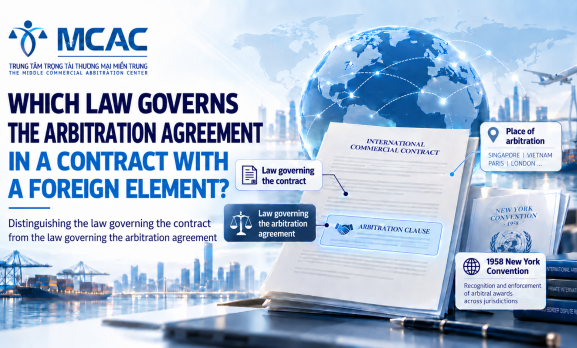
WHICH LAW GOVERNS AN ARBITRATION AGREEMENT IN A CONTRACT WITH FOREIGN ELEMENTS?
In international commercial transactions, parties often agree on the law governing their contract and on arbitration as the method of dispute resolution. However, does the law governing the contract automatically govern the arbitration agreement? If the parties have not agreed on the applicable law, which country's law is used to determine the validity of the arbitration agreement?
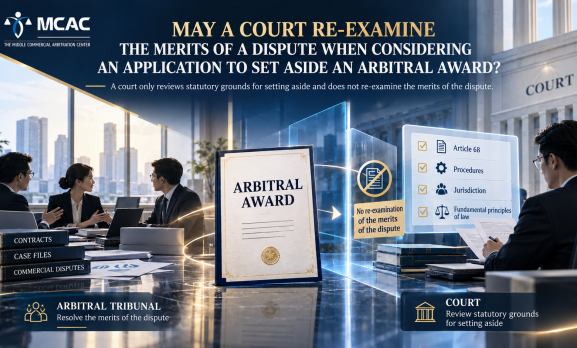
MAY A COURT RE-EXAMINE THE MERITS OF A DISPUTE WHEN CONSIDERING AN APPLICATION TO SET ASIDE AN ARBITRAL AWARD?
When considering an application to set aside an arbitral award, is the Court entitled to reassess evidence, reconsider the parties' rights and obligations, or alter the findings and decisions made by the Arbitral Tribunal?