Working hour: Monday – Friday/8AM – 5PM
|Email: contact@mcac.vn
|Hotline: (+84) 935 925 068 - 0236 3656799
| Language:



Điện thoại: (+84) 935 925 068
Language:

SEAT OF ARBITRATION AND PLACE OF HEARINGS IN ARBITRAL PROCEEDINGS
08/04/2026


In commercial arbitration proceedings, in addition to issues such as the jurisdiction of the Arbitral Tribunal and the procedures for dispute resolution, the determination of the “seat of arbitration” and the “place of hearings” is of particular legal significance.
In practice, however, these two concepts are often confused. This confusion is not merely terminological but may also lead to significant legal consequences. It is therefore essential to clearly recognize that these are two entirely distinct concepts in terms of their nature and legal implications.
1. Seat of Arbitration
The Law on Commercial Arbitration 2010 (“LCA”) establishes the legal framework for determining the “seat of arbitration.” Accordingly, Clause 8, Article 3 of the LCA provides that the place where the Arbitral Tribunal conducts dispute resolution shall be determined based on the agreement of the parties or, in the absence of such agreement, by the Arbitral Tribunal.
Pursuant to Clause 1, Article 11 of the LCA:
“The parties have the right to agree on the place of arbitration; in the absence of such agreement, the Arbitral Tribunal shall decide. The place of arbitration may be within or outside the territory of Vietnam.”
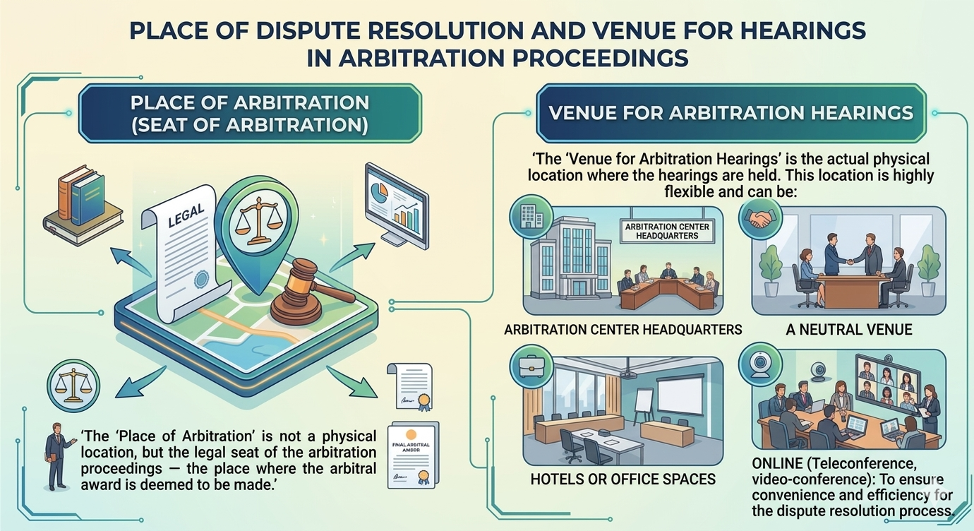
From a legal perspective, the “seat of arbitration” is not merely a physical location but the legal seat of the arbitral proceedings—the place where the arbitral award is deemed to be made.
Accordingly, the seat of arbitration has the following core legal implications:
(i) Determination of the place where the arbitral award is made: Under Clause 8, Article 3 of the LCA, if the seat of arbitration is in Vietnam, the arbitral award shall be deemed to be rendered in Vietnam, regardless of the place where the hearing is conducted.
(ii) Determination of the competent enforcement authority: Pursuant to Clause 1, Article 8 of the LCA, the competent authority for enforcement of an arbitral award is the civil judgment enforcement agency at the provincial or municipal level where the Arbitral Tribunal renders the award.
(iii) Determination of the court having jurisdiction to support arbitral proceedings: The seat of arbitration determines which court has jurisdiction to provide judicial support.
2. Place of Hearings and Its Distinction from the Seat of Arbitration
Unlike the seat of arbitration, the “place of hearings” refers to the actual physical location where hearings are conducted. Under Article 11 of the LCA, the place of hearings may be agreed upon by the parties; in the absence of such agreement, the Arbitral Tribunal has the authority to determine a location that is appropriate for the resolution of the dispute:
“Unless otherwise agreed by the parties, the Arbitral Tribunal may conduct hearings at any place it considers appropriate for consultation among its members, taking witness testimony, consulting experts, or conducting inspection of goods, assets, or other documents.”
The place of hearings is highly flexible and may include:
- The headquarters of an arbitration center
- A neutral venue
- Hotels or office premises
- Or virtual platforms (teleconference, video conference), to ensure convenience and efficiency in dispute resolution
In addition, pursuant to Clause 1, Article 25 of the Arbitration Rules of the Middle Commercial Arbitration Center (MCAC):
“The time and place for conducting hearings shall be decided by the Arbitral Tribunal unless otherwise agreed by the parties. The Arbitral Tribunal may conduct hearings by teleconference, video conference, or other appropriate means if agreed by the parties.”
Accordingly, the Arbitral Tribunal may determine the time and place of hearings, including online formats, unless otherwise agreed by the parties.
3. Conclusion
When drafting arbitration clauses, businesses should clearly distinguish between the “seat of arbitration” and the “place of hearings.” The proper determination of the seat of arbitration is of critical importance in ensuring the legality and enforceability of arbitral proceedings.
Therefore, when drafting arbitration clauses, parties should use precise and clear terminology to avoid confusion between these two concepts, thereby minimizing unnecessary disputes in the course of dispute resolution.
The article above has analyzed in detail is "Seat of arbitration and place of hearings in arbitral proceedings". For more detailed information or legal assistance, please contact the MCAC Secretariat:
- Hotline: 0935 925 068 - 0236 3656799
- Email: contact@mcac.vn
- Read more: Matters relating to the arbitration agreement considered by the arbitral tribunal
Related news

WHICH LAW GOVERNS AN ARBITRATION AGREEMENT IN A CONTRACT WITH FOREIGN ELEMENTS?
In international commercial transactions, parties often agree on the law governing their contract and on arbitration as the method of dispute resolution. However, does the law governing the contract automatically govern the arbitration agreement? If the parties have not agreed on the applicable law, which country's law is used to determine the validity of the arbitration agreement?

MAY A COURT RE-EXAMINE THE MERITS OF A DISPUTE WHEN CONSIDERING AN APPLICATION TO SET ASIDE AN ARBITRAL AWARD?
When considering an application to set aside an arbitral award, is the Court entitled to reassess evidence, reconsider the parties' rights and obligations, or alter the findings and decisions made by the Arbitral Tribunal?