Working hour: Monday – Friday/8AM – 5PM
|Email: contact@mcac.vn
|Hotline: (+84) 935 925 068 - 0236 3656799
| Language:



Điện thoại: (+84) 935 925 068
Language:

THE RIGHT TO REQUEST WITNESSES TO PROVIDE INFORMATION AND DOCUMENTS IN ARBITRATION PROCEEDINGS
25/03/2026


In the process of resolving disputes through arbitration, evidence plays a fundamental role in determining the objective truth of the dispute. In addition to documents and materials provided by claimants and respondents, witness testimony and materials provided by witnesses constitute an important source of evidence, contributing to clarifying facts related to the dispute.
Current law, particularly the Law on Commercial Arbitration 2010, together with the procedural rules of arbitration centers, including The Middle Commercial Arbitration Center (MCAC), has established a relatively comprehensive legal framework governing the right to request witnesses to provide information and documents, thereby ensuring the effectiveness of arbitration proceedings.
1. Identification of witnesses in arbitration proceedings
In arbitration proceedings, the identification of witnesses is primarily initiated by the disputing parties, in line with the principles of party autonomy and the burden of proof. On that basis, the Arbitral Tribunal requests the parties to provide necessary information, including:
- Full name and address of the witness;
- Matters to be testified;
- Relationship with the parties;
- Language to be used (if necessary).
This mechanism not only ensures the parties’ autonomy in collecting and presenting evidence but also enables the Arbitral Tribunal to assess the facts of the dispute objectively and comprehensively.
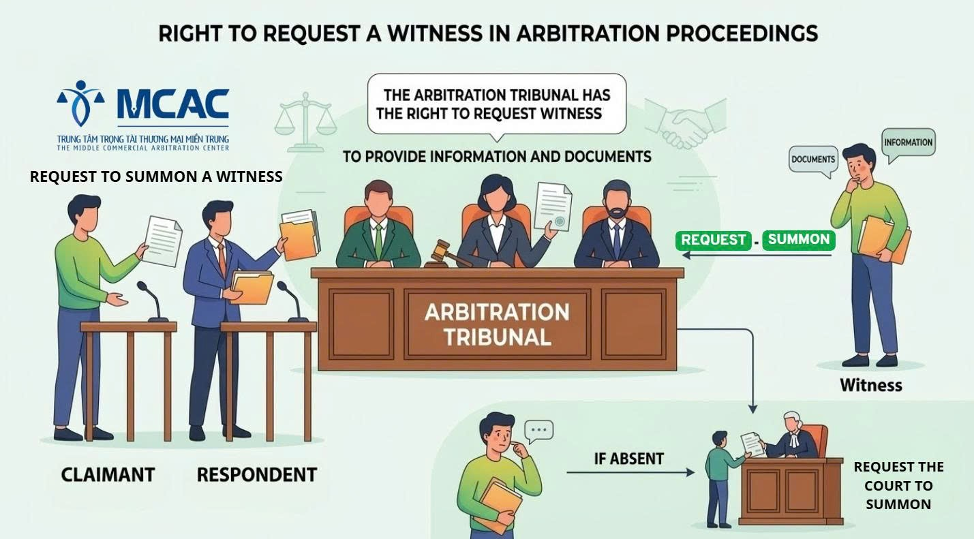
2. The right to request witnesses to provide information and documents
Pursuant to Articles 46 and 47 of the Law on Commercial Arbitration 2010, upon request of one or more parties and where deemed necessary, the Arbitral Tribunal has the authority to:
- Request witnesses to attend hearings;
- Request witnesses to provide relevant information and documents;
- Request witnesses to submit written statements.
These provisions are further specified in Article 20 of the MCAC Arbitration Rules, clarifying the Tribunal’s authority to summon witnesses and allocate related costs.
In practice, witness participation may take various flexible forms, including in-person attendance, online participation, or submission of written statements. This flexibility enables the Arbitral Tribunal to effectively access sources of evidence while ensuring the efficiency of the proceedings.
In cases where a witness is unable to attend the hearing, the Arbitral Tribunal may:
- Postpone the hearing to ensure evidence collection; or
- Continue resolving the dispute based on available records if the absence does not materially affect the proceedings.
Costs related to witnesses are allocated based on clear principles:
- If one party requests the summoning of a witness: that party bears the costs;
- If both parties request or the Arbitral Tribunal deems it necessary to summon the witness: costs are allocated among the parties by the Tribunal.
3. Court assistance mechanism in summoning witnesses
As arbitration lacks direct coercive power, it is supported by judicial mechanisms from the courts. Pursuant to Article 47 of the Law on Commercial Arbitration 2010 and Article 20 of the MCAC Rules, where a duly summoned witness fails to attend without a legitimate reason and such absence obstructs dispute resolution, the Arbitral Tribunal has the right to submit a written request to a competent court to issue a decision to summon the witness.
The request must clearly state:
- The content of the dispute;
- Information about the witness;
- Reasons for the request;
- Time and location at which the witness is required to appear.
Within 07 working days from the receipt of the request, the Chief Justice of the competent court shall assign a judge to consider and resolve the request. Within 05 working days from the assignment, the judge must issue a decision on summoning the witness.
Conclusion
The right to request witnesses to provide information and documents is an essential aspect of arbitration proceedings, ensuring the parties’ right to present evidence and assisting the Arbitral Tribunal in accurately determining the substance of the dispute. The combination of arbitration’s procedural flexibility and court assistance in summoning witnesses creates a compatible, efficient, and practical system for resolving commercial disputes through arbitration.
The article above has analyzed in detail is "The right to request witnesses to provide information and documents in arbitration proceedings". For more detailed information or legal assistance, please contact the MCAC Secretariat:
- Hotline: 0935 925 068 - 0236 3656799
- Email: contact@mcac.vn
- Read more: Who can become an arbitrator arccording vietnamese law?
Related news
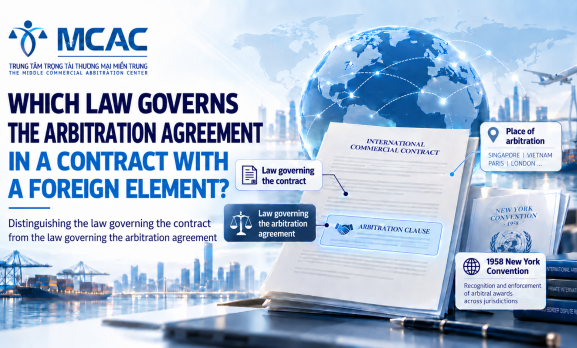
WHICH LAW GOVERNS AN ARBITRATION AGREEMENT IN A CONTRACT WITH FOREIGN ELEMENTS?
In international commercial transactions, parties often agree on the law governing their contract and on arbitration as the method of dispute resolution. However, does the law governing the contract automatically govern the arbitration agreement? If the parties have not agreed on the applicable law, which country's law is used to determine the validity of the arbitration agreement?
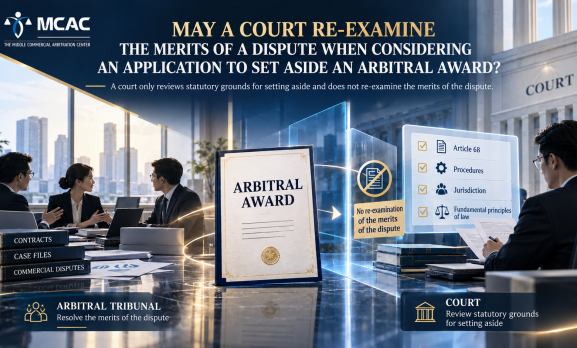
MAY A COURT RE-EXAMINE THE MERITS OF A DISPUTE WHEN CONSIDERING AN APPLICATION TO SET ASIDE AN ARBITRAL AWARD?
When considering an application to set aside an arbitral award, is the Court entitled to reassess evidence, reconsider the parties' rights and obligations, or alter the findings and decisions made by the Arbitral Tribunal?