Working hour: Monday – Friday/8AM – 5PM
|Email: contact@mcac.vn
|Hotline: (+84) 935 925 068 - 0236 3656799
| Language:



Điện thoại: (+84) 935 925 068
Language:

News



CAN A BUSINESS AUDIO- OR VIDEO-RECORD AN ARBITRAL HEARING?
Can a business record or film an arbitration hearing? This article examines Vietnamese arbitration law and MCAC Rules on confidentiality, recording rights, evidence, and key risks.

MAY DOCUMENTS AND EVIDENCE BE SUBMITTED AFTER THE DEADLINE IN ARBITRAL PROCEEDINGS?
During arbitral proceedings, the parties may not always be able to collect all relevant documents and evidence from the outset. Certain evidence may only be discovered after the Statement of Claim or Statement of Defence has been submitted, or after the deadline prescribed by the Arbitral Tribunal. In such circumstances, will late-submitted documents and evidence still be considered?

ARBITRATION AND COURTS: KEY DIFFERENCES AND ADVANTAGES OF ARBITRATION THAT BUSINESSES SHOULD KNOW
Courts and arbitration are both methods of dispute resolution and act as adjudicative forums for the parties to a dispute. The outcomes of dispute resolution by a court or by arbitration have equivalent legal effect. Some basic similarities are as follows:

DETERMINING LATE-PAYMENT INTEREST IN ARBITRAL PROCEEDINGS: COMMENTARY ON DECISION NO. 131/2024/QĐ-PQTT ON THE SETTING ASIDE OF AN ARBITRAL AWARD
Decision No. 131/2024/QĐ-PQTT dated June 27, 2024 of the People’s Court of Ho Chi Minh City is a notable practical case concerning a request to set aside an arbitral award in relation to the determination of late-payment interest.[1]
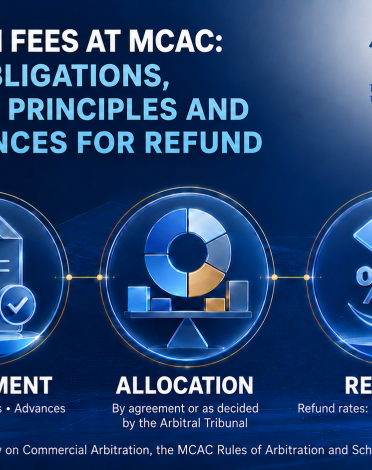
ARBITRATION FEES AT MCAC: PAYMENT OBLIGATIONS, ALLOCATION PRINCIPLES, AND REFUND CASES
When choosing arbitration to resolve disputes, parties are typically concerned about the fees and expenses payable, the timing of their financial obligations, the principles governing cost allocation, and the circumstances under which arbitration fees may be refunded.
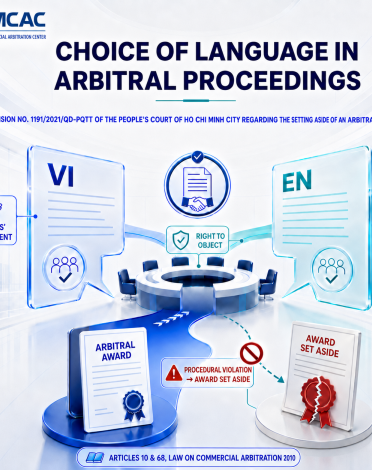
CHOICE OF LANGUAGE IN ARBITRAL PROCEEDINGS: COMMENTARY ON DECISION NO. 1191/2021/QD-PQTT OF THE PEOPLE’S COURT OF HO CHI MINH CITY SETTING ASIDE AN ARBITRAL AWARD
In arbitral proceedings involving a foreign element, or where at least one party is a foreign-invested enterprise, the parties are entitled to agree on the language to be used for resolving their dispute. The Arbitral Tribunal may determine the language of the proceedings only in the absence of such an agreement.